Today I went to the funeral Mass for Fr Tom Kraft, OP (see his Caring Bridge page here and a lovely tribute to him on the Catherine of Siena Institute blog here) at St Dominic's in Benicia. The funeral was absolutely beautiful, and the great love which so many people from so many places have for this gentle and loving man was palpable. He will be missed terribly, but we can all hope that just a fraction of his generosity and loving kindness has rubbed off on those he touched. There was a lunch after in the parish hall, and the only people I knew weren't in there, so I was sitting by myself. An older, retired Dominican, Fr Vic, sat down by me, and we had the most beautiful conversation, and I hope I get to see him again around here! He was at Blessed Sacrament in Seattle back in the 50s or so, and he has retired three times so far, but it looks like this last one 'took.' He was a lovely man, and he also gave me a bit of Dominican history here, which was nice because it so easily gets eclipsed by the Franciscans'.
Before I left for the service, a guy, Eulices, delivered a washer for 50-. A couple weeks ago, our washer and water heaters stopped working in the same week. The dryer was already extinct by that time and, actually, one water heater was still functional, but our new volunteer, Terry, a retired union guy and still a card- (and hat- and shirt-) carrying Wobbly, told us it was a lost case, as well, and that we might only have a few more days of any hot water. We bit the bullet on the water heaters, as he said there was no point in buying used ones. He got a company to donate one completely and give us a reduced price on the second, and then he donated all the labor to move and install them.
That, however, allowed showers and dishwashing to continue, but none of our guests is employed, so using the laundromat is not feasible for them, and I've tried washing jeans and towels in a bathtub before, and let me assure you: it doesn't work. Enter me and Craigslist, and Eulices' ad wherein he mentions that he could deliver in the area! Thank God! So he came this morning, and he also said he would bring by a bike sometime for our earn-a-bike program for day laborers! It turns out he is unemployed himself, laid off three weeks ago from being a hotel manager. He has gone to many interviews with no luck, and now changed his resume (dumbed down, he called it) to sound less qualified - and therefore cheaper.
We also received an enormous TV yesterday out in Castro Valley, with two futons, a little table, lots of linens and various other stuff. The lady even rented a UHaul to move it in! Thursday happens to be our day to pick up at the food bank, and then after that our food-distribution day (we topped the last two weeks of 145 people with a total of about 160; last year at this time it was about 50 people a week), so we had extra volunteers around to help us move the stuff into the truck and then into the house. Michael set the old TV on the sidewalk, and it took about 30 seconds for someone to ask if they could take it.
All in all, yesterday was a long, busy day, but a great one. Today was sad buy joyful, and it was so good to see Fr Daniel and Jesson from Blessed Sacrament. Jesson is the amazing liturgist for the parish, but he also spent years working with the dying with the Missionaries of Charity in India, and he used that gift and experience to take care of Fr Tom in his last difficult weeks. Fr Tom's suffering is over, and he is gone, but there are many deeply, deeply beautiful people at Blessed Sacrament, and Fr Tom's charity, goodness, and profound gentleness of heart lives on in them. I hope they know how special they are, and how special a community they have made.
Showing posts with label Dominicans. Show all posts
Showing posts with label Dominicans. Show all posts
Saturday, January 31, 2009


Saturday, August 23, 2008
Hopeless Causes, Claretians, and Charisms
'La caridad me urge, me impele, me obliga a gritar.' -St. Antonio Maria Claret
'You will find something more in woods than in books. Trees and stones will teach you that which you can never learn from masters.' - St. Bernard of Clairvaux
'To reach something good it is very useful to have gone astray, and thus acquire experience.' - St. Teresa of Avila
'Arm yourself with prayer rather than a sword; wear humility rather than fine clothes.' - St. Dominic
With all that being said, in regards to my statement in the last post about there being no one-fits-all spirituality, I do not mean to say that some truths cannot be universal, nor either that admiring and utilizing elements of other traditions is inherently wrong or fatuous. But trading one inadequately-investigated tradition for superficial adherence to another, one set of misapprehended truths for another yet more confusing system, is every bit as goofy as Chesterton makes it sound. Familiarity is a no more sufficient basis for renouncing a spiritual tradition than it is for divorcing a spouse or vowing never again to read Dostoevsky or eat ice cream.
Augustine defended his use of Plotinus by likening it to the Jews taking the gold out of Egypt, and varied things from different sources may have especial resonance to individual seekers. What is necessary when confronted with all these sparkling jewels is a determined refusal either to make lead out of them or to appropriate what seems convenient or commonsensical while gravely mistaking its essence.
In that vein, there are as many different spiritualities available within Catholicism as there are Catholics. John Dunne, John Dear, John Main, and the fourteenth-century Dominican John Tauler have not only the same name but a shared focus on contemplation and meditation that would not be entirely unfamiliar to a real Buddhist. Martin de Porres, Vincent de Paul, Francis of Assisi, Oscar Romero, Dorothy Day, Antonio Claret, Cesar Chavez, Jean Vanier, and Simone Weil can give anyone a good start who wishes he could combine his love of the poor and the suffering with his love of God.
And this is where the saints come in. There are two primary ways to look at the saints. One is as Friends of God. They did so well in this lifetime that they have God's ear in the next, so while you are praying to God directly that the Red Sox please, please, please take the pennant this time, you can also suggest to St. Jude that this may be the sort of hopeless case worthy of his attention as an advocate. If you are struggling in school, you can ask a brilliant scholar like Aquinas to help you along, or you can petition someone who battled the same challenges to at least give you the courage to keep plugging away diligently.
The other way to see them is as Heroes for Grownups. Saints can indeed be intimidating: they were saints, after all, and we are probably not. But each is as memorable for what he or she overcame as for what s/he accomplished, and meditating on those struggles is often where we can gain the most. They were also individuals, with distinct tendencies and temperaments, walking very different paths toward union, and just as we feel greater sympathy toward particular people we meet in daily life, so, too, will different saints' stories seem more or less apropos of our own journeys, strivings, and weaknesses.
I don't know why people are scared of saints. I think particularly if we refuse to idolize them, to make them into something they were not (i.e., perfect), we can see in their examples how far a small, flawed, and eminently human being - possibly a human being who shared some of our own fears and failures - can get in this life by not letting those fears and weaknesses surmount him.
'You will find something more in woods than in books. Trees and stones will teach you that which you can never learn from masters.' - St. Bernard of Clairvaux
'To reach something good it is very useful to have gone astray, and thus acquire experience.' - St. Teresa of Avila
'Arm yourself with prayer rather than a sword; wear humility rather than fine clothes.' - St. Dominic
With all that being said, in regards to my statement in the last post about there being no one-fits-all spirituality, I do not mean to say that some truths cannot be universal, nor either that admiring and utilizing elements of other traditions is inherently wrong or fatuous. But trading one inadequately-investigated tradition for superficial adherence to another, one set of misapprehended truths for another yet more confusing system, is every bit as goofy as Chesterton makes it sound. Familiarity is a no more sufficient basis for renouncing a spiritual tradition than it is for divorcing a spouse or vowing never again to read Dostoevsky or eat ice cream.
Augustine defended his use of Plotinus by likening it to the Jews taking the gold out of Egypt, and varied things from different sources may have especial resonance to individual seekers. What is necessary when confronted with all these sparkling jewels is a determined refusal either to make lead out of them or to appropriate what seems convenient or commonsensical while gravely mistaking its essence.
In that vein, there are as many different spiritualities available within Catholicism as there are Catholics. John Dunne, John Dear, John Main, and the fourteenth-century Dominican John Tauler have not only the same name but a shared focus on contemplation and meditation that would not be entirely unfamiliar to a real Buddhist. Martin de Porres, Vincent de Paul, Francis of Assisi, Oscar Romero, Dorothy Day, Antonio Claret, Cesar Chavez, Jean Vanier, and Simone Weil can give anyone a good start who wishes he could combine his love of the poor and the suffering with his love of God.
And this is where the saints come in. There are two primary ways to look at the saints. One is as Friends of God. They did so well in this lifetime that they have God's ear in the next, so while you are praying to God directly that the Red Sox please, please, please take the pennant this time, you can also suggest to St. Jude that this may be the sort of hopeless case worthy of his attention as an advocate. If you are struggling in school, you can ask a brilliant scholar like Aquinas to help you along, or you can petition someone who battled the same challenges to at least give you the courage to keep plugging away diligently.
The other way to see them is as Heroes for Grownups. Saints can indeed be intimidating: they were saints, after all, and we are probably not. But each is as memorable for what he or she overcame as for what s/he accomplished, and meditating on those struggles is often where we can gain the most. They were also individuals, with distinct tendencies and temperaments, walking very different paths toward union, and just as we feel greater sympathy toward particular people we meet in daily life, so, too, will different saints' stories seem more or less apropos of our own journeys, strivings, and weaknesses.
I don't know why people are scared of saints. I think particularly if we refuse to idolize them, to make them into something they were not (i.e., perfect), we can see in their examples how far a small, flawed, and eminently human being - possibly a human being who shared some of our own fears and failures - can get in this life by not letting those fears and weaknesses surmount him.
Monday, August 18, 2008
"'Et tu, Brute,' rief Er auf Lateinisch
--wie est dort die Landesprache war."
I've apologized once, and I've apologized twice, and I've apologized more than that, too, for when my rhetoric verges over into the preachy ~
~ See, the thing is, much as I might love Dominicans, I grew up when and where I grew up, none of which admittedly were the best of all possible places or times and any of which maybe should have been the thirteenth or fourteenth or seventeenth century but were not and, accordingly, while I have absolutely no bad feelings whatsoever about 'prædicare' since I can't speak any Latin other than 'Non calor sed umor est qui nobis incommodat,'* I cannot help but wince, shake a little, and discreetly and in an eminently ladylike fashion vomit inside my mouth from smelling the imagined leeching vapors of petroleum by-products from obstreperous and designed-to-impress synthetic altar-flower arrangements basted with 'Inspired-by-Nature' 'fresheners' at 7 AM sharp every Sunday anytime I find myself within 26 miles of 'preachy'~
So it is that every time I go off on caritas, agape, empathy, compassion, love, the Beatitudes, the Song of Songs, Bernard of Clairvaux, Nagarjuna, Dostoevsky, Avalokitesvara, or even Common Decent Neighborliness, I always feel as though I have too much product and too many extensions in my hair, too overwhelming a desire to restate endlessly the obvious with an ever-increasing lack of delicacy, decency, and eloquence, too great a tendency to tripthongize my dipthongs, and a garish and enormous Daughters of the Confederacy pin tacked to my (it would be, under the circumstances) abundant bosom.
So, as a sop to myself and those of you who find my exhortations as tiring as I do, here is a panel from my favorite comic strip writer, Peter Blegvad, whose Leviathan ran in the Independent and to which I was as addicted when I lived in Greece and Suffolk as I was to Gauloises Bleues and those pull-out, frame-able sections about minerals, indigenous beetles, and traffic patterns in the Sunday El País.
*'It's not the heat; it's the humidity.'
I've apologized once, and I've apologized twice, and I've apologized more than that, too, for when my rhetoric verges over into the preachy ~
~ See, the thing is, much as I might love Dominicans, I grew up when and where I grew up, none of which admittedly were the best of all possible places or times and any of which maybe should have been the thirteenth or fourteenth or seventeenth century but were not and, accordingly, while I have absolutely no bad feelings whatsoever about 'prædicare' since I can't speak any Latin other than 'Non calor sed umor est qui nobis incommodat,'* I cannot help but wince, shake a little, and discreetly and in an eminently ladylike fashion vomit inside my mouth from smelling the imagined leeching vapors of petroleum by-products from obstreperous and designed-to-impress synthetic altar-flower arrangements basted with 'Inspired-by-Nature' 'fresheners' at 7 AM sharp every Sunday anytime I find myself within 26 miles of 'preachy'~
So it is that every time I go off on caritas, agape, empathy, compassion, love, the Beatitudes, the Song of Songs, Bernard of Clairvaux, Nagarjuna, Dostoevsky, Avalokitesvara, or even Common Decent Neighborliness, I always feel as though I have too much product and too many extensions in my hair, too overwhelming a desire to restate endlessly the obvious with an ever-increasing lack of delicacy, decency, and eloquence, too great a tendency to tripthongize my dipthongs, and a garish and enormous Daughters of the Confederacy pin tacked to my (it would be, under the circumstances) abundant bosom.
So, as a sop to myself and those of you who find my exhortations as tiring as I do, here is a panel from my favorite comic strip writer, Peter Blegvad, whose Leviathan ran in the Independent and to which I was as addicted when I lived in Greece and Suffolk as I was to Gauloises Bleues and those pull-out, frame-able sections about minerals, indigenous beetles, and traffic patterns in the Sunday El País.
*'It's not the heat; it's the humidity.'
More from our Correspondent in Geneva
Well, very excitingly (to me, anyway) today is St. Jane Frances de Chantal's day. It is exciting to me not just because I love her and her story, but because also this not only brings us back to Savoy (yikes! who would have thought!) and Geneva and all its Calvinists, and gets back to that issue of historicity that I snarkily mentioned a few posts back. Which I'll get to a few lines down, or a few posts down the road, but first: St. Jane Frances, or Ste. Jeanne Françoise, if you like your French names to stay in French.

She is sort of another St. Francis' St. Clare: his student, his peer, his friend, his spiritual companion, and his travel partner on a long and profound journey. This time, it is a François-Francis instead of a Francesco one, the sixteenth century instead of the thirteenth, the Renaissance rather than the Middle Ages, and a Francis born of Savoyard nobility rather than of wealthy Umbrian merchants. This Francis, Francis de Sales, was a carefree and competent student, then lawyer, and then a bishop, rather than an apathetic student turned playboy-dandy turned mendicant, and before joining and guiding Jane Frances on her spiritual journey, he set out like Francis of Assisi on a way of life quite unlike that his family had intended for him, turning his back on his wealth like Francis, but going over to Geneva to convert Calvinists à la St. Dominic instead of founding an order à la the Franciscan Francis.

Both St. Francis de Sales' and St. Jane Frances' stories are stories of waiting. Francis felt a strong vocation before he went to law school, but he waited and waited, wanting to make sure it was truly a vocation rather than his ego leading him. St. Jane was a young devout widow with children when she felt overcome with a desire to serve God more fully. When Jane asked the now Bishop Francis to undertake her spiritual direction, he counseled her to patience: 'I had to know fully what God himself wanted. I had to be sure that everything in this should be done as though his hand had done it.' Just as he had waited for his calling and for his Calvinists, and as he would later for his new sister's convent, Francis counseled Jane again to wait when she told him of her overwhelming desire to take vows: 'Be patient until you get the wings of a dove, and then you can fly. I am very much afraid that you are a little too ardent and headlong, that you pursue too many desires rather too eagerly. Courage, my dear sister; if our will belongs to God, we ourselves are surely His.'
And this moderation was an essential element of the institute, and then order, the two founded in 1610, the Order of the Visitation of the Blessed Virgin. So that religious aspirants of older age or less robust health, 'strong souls with weak bodies,' might be able to fulfill their calling, Francis and Jane dispensed with the sort of physical austerities Poor Clares and other orders endured. St. Francis advised the community's new members and superior, 'Let your humility be boundless; let it be the source of your virtues; let it be manifested in all your actions, till gentleness towards your neighbor become natural to you by force of your frequent use of it.' Later, St. Jane described the charism of the order as essentially 'a spirit of deep humility before God and of great gentleness toward our neighbor.'
This gentleness was modeled already by Jane the wife and widow as she fed the town's poor and sick, and in the very gentleness of the rule itself: St. Jane accepted into the order a woman in her eighties and those young and old women whose infirmities would have barred them from religious life were it not for the inclusiveness of Salesian spirituality and its insistence that all people, regardless of health, wealth, status, occupation, age, or education, are called to love and holiness, and that we can manifest our love in small but profound acts of mercy and compassion. As Thomas Dailey said in Praying with Francis de Sales, 'Enabled and ennobled by this love, human beings are capable of much more than might well be imagined. They are capable of living a true life of devotion in the midst of worldly pursuits. They are capable of giving birth, through faith, to a new culture of life and of love.'
Also, unlike Savonarola, Francis de Sales in The Devout Life reveals that he thought games and jokes and dancing were okay, if in moderation: 'I am inclined to say about balls what doctors say of certain articles of food, such as mushrooms and the like--the best are not good for much; but if eat them you must, at least mind that they are properly cooked,' and 'if you would dance or play rightly, it must be done as a recreation, not as a pursuit, for a brief space of time, not so as make you unfit for other things.' I like anyone who has bad things to say about mushrooms.

She is sort of another St. Francis' St. Clare: his student, his peer, his friend, his spiritual companion, and his travel partner on a long and profound journey. This time, it is a François-Francis instead of a Francesco one, the sixteenth century instead of the thirteenth, the Renaissance rather than the Middle Ages, and a Francis born of Savoyard nobility rather than of wealthy Umbrian merchants. This Francis, Francis de Sales, was a carefree and competent student, then lawyer, and then a bishop, rather than an apathetic student turned playboy-dandy turned mendicant, and before joining and guiding Jane Frances on her spiritual journey, he set out like Francis of Assisi on a way of life quite unlike that his family had intended for him, turning his back on his wealth like Francis, but going over to Geneva to convert Calvinists à la St. Dominic instead of founding an order à la the Franciscan Francis.

Both St. Francis de Sales' and St. Jane Frances' stories are stories of waiting. Francis felt a strong vocation before he went to law school, but he waited and waited, wanting to make sure it was truly a vocation rather than his ego leading him. St. Jane was a young devout widow with children when she felt overcome with a desire to serve God more fully. When Jane asked the now Bishop Francis to undertake her spiritual direction, he counseled her to patience: 'I had to know fully what God himself wanted. I had to be sure that everything in this should be done as though his hand had done it.' Just as he had waited for his calling and for his Calvinists, and as he would later for his new sister's convent, Francis counseled Jane again to wait when she told him of her overwhelming desire to take vows: 'Be patient until you get the wings of a dove, and then you can fly. I am very much afraid that you are a little too ardent and headlong, that you pursue too many desires rather too eagerly. Courage, my dear sister; if our will belongs to God, we ourselves are surely His.'
And this moderation was an essential element of the institute, and then order, the two founded in 1610, the Order of the Visitation of the Blessed Virgin. So that religious aspirants of older age or less robust health, 'strong souls with weak bodies,' might be able to fulfill their calling, Francis and Jane dispensed with the sort of physical austerities Poor Clares and other orders endured. St. Francis advised the community's new members and superior, 'Let your humility be boundless; let it be the source of your virtues; let it be manifested in all your actions, till gentleness towards your neighbor become natural to you by force of your frequent use of it.' Later, St. Jane described the charism of the order as essentially 'a spirit of deep humility before God and of great gentleness toward our neighbor.'
This gentleness was modeled already by Jane the wife and widow as she fed the town's poor and sick, and in the very gentleness of the rule itself: St. Jane accepted into the order a woman in her eighties and those young and old women whose infirmities would have barred them from religious life were it not for the inclusiveness of Salesian spirituality and its insistence that all people, regardless of health, wealth, status, occupation, age, or education, are called to love and holiness, and that we can manifest our love in small but profound acts of mercy and compassion. As Thomas Dailey said in Praying with Francis de Sales, 'Enabled and ennobled by this love, human beings are capable of much more than might well be imagined. They are capable of living a true life of devotion in the midst of worldly pursuits. They are capable of giving birth, through faith, to a new culture of life and of love.'
Also, unlike Savonarola, Francis de Sales in The Devout Life reveals that he thought games and jokes and dancing were okay, if in moderation: 'I am inclined to say about balls what doctors say of certain articles of food, such as mushrooms and the like--the best are not good for much; but if eat them you must, at least mind that they are properly cooked,' and 'if you would dance or play rightly, it must be done as a recreation, not as a pursuit, for a brief space of time, not so as make you unfit for other things.' I like anyone who has bad things to say about mushrooms.
Saturday, August 9, 2008
Infelix Ego -
if they only hadn't stolen all those left shoes, I could have pawned them and the visor-light and made a bid!
Wow, in just the same manner of everything I think or do or feel being reduplicated in some way about 12 hours later, this time it was over on the Intentional Disciples blog, which is the blog for the Catherine of Siena Institute, which was started at Blessed Sacrament parish here in Seattle, which had a Dominican mass today, which was the Feast Day of St. Dominic - they had a quiz on whose signature is this?
It was Savonarola's, and you could buy it at auction at the moment if you were thusly disposed (and thusly endowed), and I know it was Savonarola's not just because I'm not one to forget a pretty face,

but because I have been reading about him and trying to figure out his place in early Protestantism, if there is such a place. I would say Protestantism, but excepting Lutherans I do often get the sense that many Protestant denominations take a - what? - segmented? discontinuous? disarticulated? view of Christian history, inasmuch as those inclined that way tend to see two punctuating epochs - the First/Second Covenants, and then the Reformation/now - with a large fuzzy bit in between populated by hazy robed figures undeserving of much scrutiny.
Yet even among this group there are some revered figures in medieval theology (and, admittedly, among other groups there are loads), and many of the ideas of this singular figure (who himself ended up in a bonfire, but not before being treated to the rack first by his Medici hosts) prefigured many of the Reformers' concerns. He criticized the excesses of Rome and of Orders in much the same language and to much the same level of vituperation as Reformers did - yet he also echoed the return-to-the-heart-of-Jesus'-Christianity sentiment that had resounded over and over throughout the Middle Ages. The Church eventually had all his works formally banned - but by that time they were best-sellers all over the place and being printed in areas and languages too far from Rome to control.
Anyway, if you like the asceticism of a Calvin but prefer a Florentine accent in denunciations of dancing and drink, you would love Savonarola. If you like the gist of Dante but would prefer to do away with all the needless poesy, he's your man. And if you are inclined to think that Boccaccio and Erasmus would be just fine were it not for the wit, you will find all the spleen you need but none of the humor you don't in the fiery Dominican from Florence.
Here is some of Isaias' bonfire of the vanities in Savonarola's honor. I think this is most poetic in the King James. And the Dominican New Testament translation by Francis Spencer, OP, doesn't have Isaias, for what may or may not be obvious reasons.
Moreover the LORD saith, Because the daughters of Zion are haughty, and walk with stretched forth necks and wanton eyes, walking and mincing as they go, and making a tinkling with their feet:
Wow, in just the same manner of everything I think or do or feel being reduplicated in some way about 12 hours later, this time it was over on the Intentional Disciples blog, which is the blog for the Catherine of Siena Institute, which was started at Blessed Sacrament parish here in Seattle, which had a Dominican mass today, which was the Feast Day of St. Dominic - they had a quiz on whose signature is this?
It was Savonarola's, and you could buy it at auction at the moment if you were thusly disposed (and thusly endowed), and I know it was Savonarola's not just because I'm not one to forget a pretty face,

but because I have been reading about him and trying to figure out his place in early Protestantism, if there is such a place. I would say Protestantism, but excepting Lutherans I do often get the sense that many Protestant denominations take a - what? - segmented? discontinuous? disarticulated? view of Christian history, inasmuch as those inclined that way tend to see two punctuating epochs - the First/Second Covenants, and then the Reformation/now - with a large fuzzy bit in between populated by hazy robed figures undeserving of much scrutiny.
Yet even among this group there are some revered figures in medieval theology (and, admittedly, among other groups there are loads), and many of the ideas of this singular figure (who himself ended up in a bonfire, but not before being treated to the rack first by his Medici hosts) prefigured many of the Reformers' concerns. He criticized the excesses of Rome and of Orders in much the same language and to much the same level of vituperation as Reformers did - yet he also echoed the return-to-the-heart-of-Jesus'-Christianity sentiment that had resounded over and over throughout the Middle Ages. The Church eventually had all his works formally banned - but by that time they were best-sellers all over the place and being printed in areas and languages too far from Rome to control.
Anyway, if you like the asceticism of a Calvin but prefer a Florentine accent in denunciations of dancing and drink, you would love Savonarola. If you like the gist of Dante but would prefer to do away with all the needless poesy, he's your man. And if you are inclined to think that Boccaccio and Erasmus would be just fine were it not for the wit, you will find all the spleen you need but none of the humor you don't in the fiery Dominican from Florence.
Here is some of Isaias' bonfire of the vanities in Savonarola's honor. I think this is most poetic in the King James. And the Dominican New Testament translation by Francis Spencer, OP, doesn't have Isaias, for what may or may not be obvious reasons.
Moreover the LORD saith, Because the daughters of Zion are haughty, and walk with stretched forth necks and wanton eyes, walking and mincing as they go, and making a tinkling with their feet:
Therefore the LORD will smite with a scab the crown of the head of the daughters of Zion, and the LORD will discover their secret parts.
In that day the Lord will take away the bravery of their tinkling ornaments about their feet, and their cauls, and their round tires like the moon, The chains, and the bracelets, and the mufflers, The bonnets, and the ornaments of the legs, and the headbands, and the tablets, and the earrings, The rings, and nose jewels, The changeable suits of apparel, and the mantles, and the wimples, and the crisping pins, The glasses, and the fine linen, and the hoods, and the veils.
And it shall come to pass, that instead of sweet smell there shall be stink; and instead of a girdle a rent; and instead of well set hair baldness; and instead of a stomacher a girding of sackcloth; and burning instead of beauty.
Thursday, July 24, 2008
Coherent Narratives (in Life, friends, not here.)
Caution: This entry says nothing of consequence about anything of consequence. Things of substance, written somewhat coherently, are elsewhere; skip ahead or back if you want one of those. If you like your logic loose, loopy, and slapdash, read on.
...At any rate, Dominicans being everywhere does not mitigate the fact that the last place I would expect to find one in my blog is IN-in my blog, but it seems you can't escape them with anything near the sort of regularity and indeed predictability with which we routinely fail to bump into Cistercians at the Circle K (do Circle K's still exist? I used to buy my Now 'n' Laters there, and once got a Bit o' Honey with a mosquito half-embedded in the top), but Fr. Fones, of prudential-judgment-and-politics, whom/which you'll remember from a few posts back, left a lovely comment about one of my posts about poverty.
But that's not what I'm getting to. Although, if only more people would comment, that would be great. Although, 'more people commenting' does presuppose someone is reading, and I think that is where the whole idea sort of loses a bit of steam.
At any rate.
Unlike a journal entry or emails, I try to afford those nonexistent readers of my blog the courtesy not only of a concluding sentence, but often a good title, too, when something strikes me. This allows me to believe, by framing the post so nicely, that there is indeed a middle thus framed, leaving me free of guilt and able to carry on with outfit-coordination for another day.
However.
Dominicans were called sometimes, by some, in certain parts, the Black Friars, or the Blackfriars, due, unsurprisingly, to their wearing of a black outergarment. And Shakespeare's (well, partly Shakespeare's) Blackfriars Theatre in London is on the site of a 13th-century Dominican monastery which, after Henry VIII's dissolution of the monasteries in England, France, and Wales in the 16th century, had very few friars of any color left in it.
That fact notwithstanding.
I was trying to trying to come up with something vaguely amusing for the title here. Now, stepping up another century, the Black Robes were the Jesuits, the Sulpicians, and the Récollets in New France. But mostly the Jesuits. I could use 'black robe' if I gave it a twist. But I lacked a twist.
So at this point (in the naming of one stupid blog entry!) we have: Dominicans, Shakespeare, England, egomaniacal homicidal kings, Québec, Jesuits, and the color black. Which is a lot of things, but not much to work with. So I looked up stuff on the author of Black Robe, the Belfast native Brian Moore, who also wrote Judith Hearne, which became The Lonely Passion of Judith Hearne with Maggie Smith and Bob Hoskins, which I did not see and have nothing funny to say about.
But Black Robe also became a movie about two centuries after bad King Henry, when in 1991 it was directed by Bruce Beresford, who had previously directed Driving Miss Daisy, which is about slow driving and a slow-building relationship. Black Robe happily retained in film form many of the difficult moral issues of the book. And it had Lothaire Bluteau, of Jesus of Montréal fame, in the lead as Fr. Laforgue, whose deep faith leads him to great courage. It's one of my favorite films, and is at times unbearably beautiful and at others unbearably disturbing.
Which of course has nothing to do with Dominicans. Inconveniently.
However, it turns out that that when he died in 1999 (in Malibu, which is far, far away from Shakespeare and the Algonquins of either 1600s-Québec or 1920s-New-York-City type), Moore was working on a novel based on the life of Arthur Rimbaud, while in 1984 his screenplay for Simone de Beauvoir's (a thinky, ethical risking-her-life-for-the-good-of-others atheist if ever there were one) Le Sang des Autres, her novel about the French Resistance, was made into an American film by French director Claude Chabrol. And is said to be ungreat.
But to go back a century now, Arthur Rimbaud, while probably more anti-religion than either Mr. Moore or Mme. de Beauvoir, and not one to trouble himself overmuch with ethical problems - from gun-running (and some biographers say slave-running, as well) to stealing people's husbands - was, despite all that and his early death and even earlier renunciation of poetry-writing (at 20), one of the most influential poets in modern times.
Which brings us to me, as the stupid URL of this blog, oisive-vitesse (which only exists because I couldn't get vifargent) (who only has one post, by the way, from 2004), which is a very stupid pun on a very famous Rimbaud poem and also has to do with my driving style, which could very well be characterized (by a gentle person, charitable of heart and tolerant by nature) as 'relaxed,' or 'easy-going.'
The line I bastardized is from the poem 'La chanson de la plus haute tour,' and goes something like this:
'Oisive jeunesse
A tout asservie,
Par délicatesse
J'ai perdue ma vie.
Ah! Que le temps viennent
Où les coeurs s'éprennent.'
And likewise something like this:
'Idle youth
Enslaved to everything,
Through sensitivity
I have wasted my life.
Oh! Let the time come
When hearts open up.'
Which is ungraceful, but there you go. You get what you pay for. Anyway, 'oisive' means lazy, even though birds are anything but. Sort of like Canadian Smarties, which are no longer made by Rowntree and are basically sweeter M & M's, with nothing acidic or 'smarty' about them. And I'm not a lazy driver, but I'm sure it looks like either the car or I must be at times. Still, I have remembered this stanza always (I have no idea what the rest of the poem says) not just because I like the redemptive hope of the last line, not if such a time comes, but when (literally 'where,' but we'll not trouble ourselves excessively with that for now; the certainty holds either way), but also because it can seem sometimes that all our youthful passion for fifty thousand different things simultaneously could have been wasted.
I don't think it is. I think we take it with us. I think perhaps one has to reach a certain age to be able to look back and see just how shockingly coherent the narrative of our lives is. Maybe the aggregate of facts simply has to be large enough to let the pattern emerge. All my childhood obsessions I still have, if sometimes in mitigated form. All my tastes and predilections (except those for footed pjyamas and tea with sugar) remain about the same, with some accommodation for education and fine-tuning (I no longer want literally to live in a genie bottle; I'm content to hang a Moroccan lantern inside, and string some curtains around, my bateau ivre of a bed and call it done), and I'm most satisfied or content when I have some version of the things that made me happiest as a child and adolescent - down to the bottle full of buttons I spent countless hours sorting and resorting on my grandmother's floor. I don't think it's wasted; I think we just sometimes take too long to realize what it taught us about ourselves.
...At any rate, Dominicans being everywhere does not mitigate the fact that the last place I would expect to find one in my blog is IN-in my blog, but it seems you can't escape them with anything near the sort of regularity and indeed predictability with which we routinely fail to bump into Cistercians at the Circle K (do Circle K's still exist? I used to buy my Now 'n' Laters there, and once got a Bit o' Honey with a mosquito half-embedded in the top), but Fr. Fones, of prudential-judgment-and-politics, whom/which you'll remember from a few posts back, left a lovely comment about one of my posts about poverty.
But that's not what I'm getting to. Although, if only more people would comment, that would be great. Although, 'more people commenting' does presuppose someone is reading, and I think that is where the whole idea sort of loses a bit of steam.
At any rate.
Unlike a journal entry or emails, I try to afford those nonexistent readers of my blog the courtesy not only of a concluding sentence, but often a good title, too, when something strikes me. This allows me to believe, by framing the post so nicely, that there is indeed a middle thus framed, leaving me free of guilt and able to carry on with outfit-coordination for another day.
However.
Dominicans were called sometimes, by some, in certain parts, the Black Friars, or the Blackfriars, due, unsurprisingly, to their wearing of a black outergarment. And Shakespeare's (well, partly Shakespeare's) Blackfriars Theatre in London is on the site of a 13th-century Dominican monastery which, after Henry VIII's dissolution of the monasteries in England, France, and Wales in the 16th century, had very few friars of any color left in it.
That fact notwithstanding.
I was trying to trying to come up with something vaguely amusing for the title here. Now, stepping up another century, the Black Robes were the Jesuits, the Sulpicians, and the Récollets in New France. But mostly the Jesuits. I could use 'black robe' if I gave it a twist. But I lacked a twist.
So at this point (in the naming of one stupid blog entry!) we have: Dominicans, Shakespeare, England, egomaniacal homicidal kings, Québec, Jesuits, and the color black. Which is a lot of things, but not much to work with. So I looked up stuff on the author of Black Robe, the Belfast native Brian Moore, who also wrote Judith Hearne, which became The Lonely Passion of Judith Hearne with Maggie Smith and Bob Hoskins, which I did not see and have nothing funny to say about.
But Black Robe also became a movie about two centuries after bad King Henry, when in 1991 it was directed by Bruce Beresford, who had previously directed Driving Miss Daisy, which is about slow driving and a slow-building relationship. Black Robe happily retained in film form many of the difficult moral issues of the book. And it had Lothaire Bluteau, of Jesus of Montréal fame, in the lead as Fr. Laforgue, whose deep faith leads him to great courage. It's one of my favorite films, and is at times unbearably beautiful and at others unbearably disturbing.
Which of course has nothing to do with Dominicans. Inconveniently.
However, it turns out that that when he died in 1999 (in Malibu, which is far, far away from Shakespeare and the Algonquins of either 1600s-Québec or 1920s-New-York-City type), Moore was working on a novel based on the life of Arthur Rimbaud, while in 1984 his screenplay for Simone de Beauvoir's (a thinky, ethical risking-her-life-for-the-good-of-others atheist if ever there were one) Le Sang des Autres, her novel about the French Resistance, was made into an American film by French director Claude Chabrol. And is said to be ungreat.
But to go back a century now, Arthur Rimbaud, while probably more anti-religion than either Mr. Moore or Mme. de Beauvoir, and not one to trouble himself overmuch with ethical problems - from gun-running (and some biographers say slave-running, as well) to stealing people's husbands - was, despite all that and his early death and even earlier renunciation of poetry-writing (at 20), one of the most influential poets in modern times.
Which brings us to me, as the stupid URL of this blog, oisive-vitesse (which only exists because I couldn't get vifargent) (who only has one post, by the way, from 2004), which is a very stupid pun on a very famous Rimbaud poem and also has to do with my driving style, which could very well be characterized (by a gentle person, charitable of heart and tolerant by nature) as 'relaxed,' or 'easy-going.'
The line I bastardized is from the poem 'La chanson de la plus haute tour,' and goes something like this:
'Oisive jeunesse
A tout asservie,
Par délicatesse
J'ai perdue ma vie.
Ah! Que le temps viennent
Où les coeurs s'éprennent.'
And likewise something like this:
'Idle youth
Enslaved to everything,
Through sensitivity
I have wasted my life.
Oh! Let the time come
When hearts open up.'
Which is ungraceful, but there you go. You get what you pay for. Anyway, 'oisive' means lazy, even though birds are anything but. Sort of like Canadian Smarties, which are no longer made by Rowntree and are basically sweeter M & M's, with nothing acidic or 'smarty' about them. And I'm not a lazy driver, but I'm sure it looks like either the car or I must be at times. Still, I have remembered this stanza always (I have no idea what the rest of the poem says) not just because I like the redemptive hope of the last line, not if such a time comes, but when (literally 'where,' but we'll not trouble ourselves excessively with that for now; the certainty holds either way), but also because it can seem sometimes that all our youthful passion for fifty thousand different things simultaneously could have been wasted.
I don't think it is. I think we take it with us. I think perhaps one has to reach a certain age to be able to look back and see just how shockingly coherent the narrative of our lives is. Maybe the aggregate of facts simply has to be large enough to let the pattern emerge. All my childhood obsessions I still have, if sometimes in mitigated form. All my tastes and predilections (except those for footed pjyamas and tea with sugar) remain about the same, with some accommodation for education and fine-tuning (I no longer want literally to live in a genie bottle; I'm content to hang a Moroccan lantern inside, and string some curtains around, my bateau ivre of a bed and call it done), and I'm most satisfied or content when I have some version of the things that made me happiest as a child and adolescent - down to the bottle full of buttons I spent countless hours sorting and resorting on my grandmother's floor. I don't think it's wasted; I think we just sometimes take too long to realize what it taught us about ourselves.
Tuesday, July 22, 2008
Personally, I Love that Santa Claus Joke
But I'm an idiot, so it stands to reason. Also I still love the one from a Christmas cracker about a million Christmases ago, wherein the psychologist asks the patient how long he has thought he was a dog. The patient replies, 'Depuis que je suis chiot,' which was even funnier to me when I thought that 'chiot' meant sheep, which gives you a significant and no doubt chilling insight into my desperate sense of humor.
And since you didn't ask, and since the only joke I've put on here was the ghastly one about Santa Claus and pizza, here's an equally well-traveled one about Jesuits and Dominicans (there are millions, I assure you, and at times the Dominicans get the upper hand instead):
A Jesuit (sometimes it's a Franciscan or something else) and a Dominican were debating about whose order was the greater. After months of arguing, they decided to ask for an answer from God when they died. Years later, they met in heaven and decided to go to the throne of God to resolve their old disagreement. God seemed a bit puzzled about the question and told them he would reply in writing a few days later. After much deliberation, God sent the following letter:
And since you didn't ask, and since the only joke I've put on here was the ghastly one about Santa Claus and pizza, here's an equally well-traveled one about Jesuits and Dominicans (there are millions, I assure you, and at times the Dominicans get the upper hand instead):
A Jesuit (sometimes it's a Franciscan or something else) and a Dominican were debating about whose order was the greater. After months of arguing, they decided to ask for an answer from God when they died. Years later, they met in heaven and decided to go to the throne of God to resolve their old disagreement. God seemed a bit puzzled about the question and told them he would reply in writing a few days later. After much deliberation, God sent the following letter:
My beloved children,
Please stop bickering about such trivial matters. Both of your orders are equally great and good in my eyes.
Sincerely yours,
God, S.J.
Sunday, July 20, 2008
'I went out to a hazel wood
Because a fire was in my head.'
Too much writing elsewhere (including inside my head, where those page-long sentences sometimes remain until I can manage to parse them out at least somewhat before wrestling them into print) to get stuff down here in the past few days.
But the problem is, when I do this I get lost on here, and by the time I come back I've had nine gorgeous conversations, sixteen confusing ones, finished reading two books, and written a few novel-length journal entries. Then I come back here and wonder, What was I saying? Not to mention, Did I figure out what my blog 'persona' (which seems at times a necessary contrivance in order just to get the thing done!) is going to be yet? And, do I have to?
Anyway, I went to a lecture by Fr. Michael Fones, of the Catherine of Siena Insitute, the Dominicans, and Catholicism in general, about prudential judgment, which is, I think, an overall good thing to practice, whatever your religious or irreligious stripe. It was an engaging and useful talk, and it was directed primarily toward how the use of prudential judgment might inform our political decisions. I am as frustrated as anyone else about the state of governance and politics, and I have no intention of going into depth about my abundant grievances here (which would also result in destroying the coyly vague, nonsectarian portion of my blog persona - the only part of that persona that remains consistent!) - without which it would be difficult to justify lambasting the reprehensible actions of politicos of every stripe when I see fit. Nor am I going to give the outline of what he said; maybe he will put the slides or a print version online - because it was a very useful presentation - and then I will put in a link.
That being said, one great point he made is that if we are to be wise citizens we cannot afford to be one-issue voters. I think that seems obvious at first hearing, yet on reflection I would argue many, many people are at least nearly that: one concern is so close to their hearts that it overrides their reason on other issues. In the United States this becomes a thorny problem due to the persistence and rigidity of the two-party system wherein a huge portion of voters will never find a candidate with whom they can fully agree. For a candidate to shirk part of a party's platform means no party money, which means in practice unelectability for the daring renegade. So candidates must swallow those aspects they don't entirely agree with -- and then voters must, as well, when they get to the booth to choose the lesser of two evils.
Too much writing elsewhere (including inside my head, where those page-long sentences sometimes remain until I can manage to parse them out at least somewhat before wrestling them into print) to get stuff down here in the past few days.
But the problem is, when I do this I get lost on here, and by the time I come back I've had nine gorgeous conversations, sixteen confusing ones, finished reading two books, and written a few novel-length journal entries. Then I come back here and wonder, What was I saying? Not to mention, Did I figure out what my blog 'persona' (which seems at times a necessary contrivance in order just to get the thing done!) is going to be yet? And, do I have to?
Anyway, I went to a lecture by Fr. Michael Fones, of the Catherine of Siena Insitute, the Dominicans, and Catholicism in general, about prudential judgment, which is, I think, an overall good thing to practice, whatever your religious or irreligious stripe. It was an engaging and useful talk, and it was directed primarily toward how the use of prudential judgment might inform our political decisions. I am as frustrated as anyone else about the state of governance and politics, and I have no intention of going into depth about my abundant grievances here (which would also result in destroying the coyly vague, nonsectarian portion of my blog persona - the only part of that persona that remains consistent!) - without which it would be difficult to justify lambasting the reprehensible actions of politicos of every stripe when I see fit. Nor am I going to give the outline of what he said; maybe he will put the slides or a print version online - because it was a very useful presentation - and then I will put in a link.
That being said, one great point he made is that if we are to be wise citizens we cannot afford to be one-issue voters. I think that seems obvious at first hearing, yet on reflection I would argue many, many people are at least nearly that: one concern is so close to their hearts that it overrides their reason on other issues. In the United States this becomes a thorny problem due to the persistence and rigidity of the two-party system wherein a huge portion of voters will never find a candidate with whom they can fully agree. For a candidate to shirk part of a party's platform means no party money, which means in practice unelectability for the daring renegade. So candidates must swallow those aspects they don't entirely agree with -- and then voters must, as well, when they get to the booth to choose the lesser of two evils.
Thursday, July 10, 2008
'Laissez-vous faire, Milord,
Venez dans mon royaume!'
And I'm sorry to be redundant about my royaume, such as it is, but when I turned on the BBC World Service very late last night (this is what happens when there are too few dishwasher-volunteers and one's 'nap' ends at 11:30 PM), the first upcoming story they promoted was about an 800-year-old Dominican church in Maastricht, once serving a long-since-destroyed friary, eventually turned into bike storage, and now become a bookstore. (Both those links go to stories on the converted building.)
Seriously. I don't ask for this stuff. And it's getting odd. I'm scared that if someone should send me a gift of an old book found in their grandfather's attic they thought would amuse me, it's going to be Tintin and the Black Friars, or that if I haphazardly throw on an Edith Piaf CD in the car, 'Milord' and 'L'Accordéoniste' will have been replaced somehow by a recording of a Dominican Mass.
(By the way, try one on for size at the historic Blessed Sacrament church in Seattle's University District, on 8/8/08, as part of their centenary celebration. I make no guarantees about la Piaf or Tintin being there, however.)
And I'm sorry to be redundant about my royaume, such as it is, but when I turned on the BBC World Service very late last night (this is what happens when there are too few dishwasher-volunteers and one's 'nap' ends at 11:30 PM), the first upcoming story they promoted was about an 800-year-old Dominican church in Maastricht, once serving a long-since-destroyed friary, eventually turned into bike storage, and now become a bookstore. (Both those links go to stories on the converted building.)
Seriously. I don't ask for this stuff. And it's getting odd. I'm scared that if someone should send me a gift of an old book found in their grandfather's attic they thought would amuse me, it's going to be Tintin and the Black Friars, or that if I haphazardly throw on an Edith Piaf CD in the car, 'Milord' and 'L'Accordéoniste' will have been replaced somehow by a recording of a Dominican Mass.
(By the way, try one on for size at the historic Blessed Sacrament church in Seattle's University District, on 8/8/08, as part of their centenary celebration. I make no guarantees about la Piaf or Tintin being there, however.)
Wednesday, July 9, 2008
'Between soup and love,
the first is better.' -Spanish proverb
I couldn't disagree more, but then, other than a couple bisques and chilled consommé with fresh mint and lemon, I tend to find soup a rather terrifying proposition. However, whether we agree or disagree with old Spanish chestnut-writers, or old Spanish-chestnut writers (and I do make exception to my soup exception for a good chestnut bisque, I assure you), the degrees of separation between soup and love are not as numerous as may appear. They involve:
- Belle-Epoque Grandes Horizontales
- guilds
- lesbian thespians
- cured meats
- Jacobins
- gastronomic proto-Taylorism
----and Dominicans.
You think I can't pull these together; you suspect it could be done by no one. And it is a disparate list. But I can and I will, and it will further buttress my argument that just when you let down your guard and imagine it can't possibly happen here, you meet Dominicans in the strangest of places...
The august Auguste Escoffier is the name that unites this strange list. I was reading Kenneth James' absorbing biography of the chef (from which any names or numbers herein are taken), which briefly gives a summation of the state of restaurants and cuisine in France and England before Ritz and Escoffier launched the Savoy in London. There was very much in France (though by no means paralleled in England) by this time a tradition of haute cuisine; Escoffier's revolution on the Continent was the efficiency and systematization brought by his brigade system, and a substantial reduction thereby, in the name of modernization and productivity, of the number and severity of beatings of cooks delivered by chefs. Corporal punishment in a kitchen slows everything down, and Escoffier believed quality and speed could coexist.
Despite there being by Escoffier's time a short history of fine restaurants in France, this development could not have happened without the short history of the guillotine, a more severe form of corporal punishment than that used by successful chefs in their private reigns of terror in tiny, sweaty fiefdoms. The Jacobins had, amongst other things, succeeded in producing a class of ronin chefs, as prior to the Revolution the best cooks had always worked for the best families. Gourmandise took place on estates and in castles; eating out was, as it had been since the time of the ancient Romans, the province of travelers, who had no choice of entrée at the hostelry they stopped at, but rather partook of the same potluck pot au feu as the rest of the overnight guests.
An enterprising Parisian by the name of Boulanger twenty-some years before the Revolution conceived of offering a sit-down meal with a choice of options from a menu to city-dwellers wanting a meal but no room to go with it. The climax of his meal was always a soup, which he called a 'restorative,' or 'restaurant,' getting him in trouble with the guilds, who had continued to operate since the Middle Ages in various formulations and groupings as the sole source of takeaway items such as cured meats, cooked meats, bread, pastry, sausages and sauces. Specifically, the traiteurs (
Enter Escoffier, England, and César Ritz. The world of dining in Britain changed for the better with the opening of the Savoy: there was fine food, organization, modern menus, ambiance, and personalized service for the guests. All that remained was to coax well-to-do Victorians, with their armies of servants and cooks, out of the house on occasion for epicurean entertainment. While Victorian gentlemen were accustomed to dining out, they did so in the company of other men or with women other than their wives; it was considered unseemly for ladies to be seen eating in public. Thus one prong in Ritz' and Escoffier's campaign was to create an atmosphere that would welcome and enchant, rather than discomfit, wives and other ladies of virtue. To succeed in this would require banishing the other sorts of ladies, such as actresses, singers, and those more skilled in the companionship arts than the domestic. An evening dress-code stipulation eliminated some; barring single female diners left well-heeled-but-dateless demimondaines dining elsewhere.
One celebrity courtesan who lacked neither escorts nor evening dress and thus continued to patronize the Savoy was one-time Folies Bergère dancer Mlle. Liane de Pougy, born Anne Marie Chassaigne and later crowned Princess Anne-Marie Ghika of Romania, who despite two marriages and a Sapphic amour she described as the love of her life, renounced her past life of scandal and splendor and finished her days serving disabled orphans at the Asylum of St. Anne as a Dominican tertiary.
In (there's no way it wouldn't be, is there?) Savoy...
And you thought I couldn't do it.
I couldn't disagree more, but then, other than a couple bisques and chilled consommé with fresh mint and lemon, I tend to find soup a rather terrifying proposition. However, whether we agree or disagree with old Spanish chestnut-writers, or old Spanish-chestnut writers (and I do make exception to my soup exception for a good chestnut bisque, I assure you), the degrees of separation between soup and love are not as numerous as may appear. They involve:
- Belle-Epoque Grandes Horizontales
- guilds
- lesbian thespians
- cured meats
- Jacobins
- gastronomic proto-Taylorism
----and Dominicans.
You think I can't pull these together; you suspect it could be done by no one. And it is a disparate list. But I can and I will, and it will further buttress my argument that just when you let down your guard and imagine it can't possibly happen here, you meet Dominicans in the strangest of places...
The august Auguste Escoffier is the name that unites this strange list. I was reading Kenneth James' absorbing biography of the chef (from which any names or numbers herein are taken), which briefly gives a summation of the state of restaurants and cuisine in France and England before Ritz and Escoffier launched the Savoy in London. There was very much in France (though by no means paralleled in England) by this time a tradition of haute cuisine; Escoffier's revolution on the Continent was the efficiency and systematization brought by his brigade system, and a substantial reduction thereby, in the name of modernization and productivity, of the number and severity of beatings of cooks delivered by chefs. Corporal punishment in a kitchen slows everything down, and Escoffier believed quality and speed could coexist.
Despite there being by Escoffier's time a short history of fine restaurants in France, this development could not have happened without the short history of the guillotine, a more severe form of corporal punishment than that used by successful chefs in their private reigns of terror in tiny, sweaty fiefdoms. The Jacobins had, amongst other things, succeeded in producing a class of ronin chefs, as prior to the Revolution the best cooks had always worked for the best families. Gourmandise took place on estates and in castles; eating out was, as it had been since the time of the ancient Romans, the province of travelers, who had no choice of entrée at the hostelry they stopped at, but rather partook of the same
An enterprising Parisian by the name of Boulanger twenty-some years before the Revolution conceived of offering a sit-down meal with a choice of options from a menu to city-dwellers wanting a meal but no room to go with it. The climax of his meal was always a soup, which he called a 'restorative,' or 'restaurant,' getting him in trouble with the guilds, who had continued to operate since the Middle Ages in various formulations and groupings as the sole source of takeaway items such as cured meats, cooked meats, bread, pastry, sausages and sauces. Specifically, the traiteurs (
Enter Escoffier, England, and César Ritz. The world of dining in Britain changed for the better with the opening of the Savoy: there was fine food, organization, modern menus, ambiance, and personalized service for the guests. All that remained was to coax well-to-do Victorians, with their armies of servants and cooks, out of the house on occasion for epicurean entertainment. While Victorian gentlemen were accustomed to dining out, they did so in the company of other men or with women other than their wives; it was considered unseemly for ladies to be seen eating in public. Thus one prong in Ritz' and Escoffier's campaign was to create an atmosphere that would welcome and enchant, rather than discomfit, wives and other ladies of virtue. To succeed in this would require banishing the other sorts of ladies, such as actresses, singers, and those more skilled in the companionship arts than the domestic. An evening dress-code stipulation eliminated some; barring single female diners left well-heeled-but-dateless demimondaines dining elsewhere.
One celebrity courtesan who lacked neither escorts nor evening dress and thus continued to patronize the Savoy was one-time Folies Bergère dancer Mlle. Liane de Pougy, born Anne Marie Chassaigne and later crowned Princess Anne-Marie Ghika of Romania, who despite two marriages and a Sapphic amour she described as the love of her life, renounced her past life of scandal and splendor and finished her days serving disabled orphans at the Asylum of St. Anne as a Dominican tertiary.
In (there's no way it wouldn't be, is there?) Savoy...
And you thought I couldn't do it.
Sunday, June 29, 2008
Habitual Concerns
Alright, more on Merton, it seems, and nothing on Dominicans. Okay, not really so much on Merton, either, truth be told, but it starts with him.
In the same part of the same book, the Sign of Jonas, where Merton deals a bit with his struggle between intellect and something like what he construed as 'real work' or the 'right path' to communion with the Divine at the time, he mentions his correspondence with some Carthusians. For Merton the Trappist Cistercian, the spirituality and life of the Carthusians seems to have seemed higher, purer, better. At the time he wrote that particular entry, there was no Carthusian monastery in the US (by the early 1950s, however, there was a small Carthusian Foundation, followed by construction of the Charterhouse of the Transfiguration in Vermont, completed by 1960), and Dom Porion suggested to Merton from France that the idea of an American Carthusian charterhouse was an unlikely one at any point. The Carthusian rule is the most austere of all the orders, and Americans, well...
Echoing Merton's respect for the Carthusian charisms, Robert Speaight, visiting the monastery at the time for a performance, remarked to Merton that 'half the people he knew at at some time or other tried to become Carthusians.' Merton reflects upon Dom Porion's letter that 'I saw at once very clearly how literally the contemplative vocation is taken by the Carthusians...It reminded me of my own longing for solitude, interior purity, perfect silence, a life for God alone. I haven't prayed in months as I have been praying since I read that letter...but burning up with the desire of God and with shame at my unmitigated interior activity and the futility of so much that I do.'
Now, part of Merton's frustration would arise in anyone committed to any sort of a mission, whether religious or secular. He had to do all sorts of administrative things for his publishing and for the monastery, he had to proofread, revise, order books for his monastery, 'barter' books with other communities, and he had to read and answer fan mail, as the world's most famous Catholic, the world's favorite monk, and some kind of unintentional poster boy for religion and the contemplative way in the new age. And as he said, 'the theology of contemplation does not mix well with fan mail. Also it is difficult.' These are all rather worldly things, 'noisy' things - even the theology of contemplation - compared to the encompassing silence he wished to cultivate and live inside - a silence to which it seemed the Carthusians had more ready access.
And this is what I am getting to: this apparent human need to have a hierarchy, rather than an egalitarian taxonomy, of gifts. The Tibetan Buddhists are better than straight-up Mahayana, because theirs is a solidly monastic tradition. The priest is better than the devoted father of three, because he is celibate. A Poor Clare is better than a Franciscan sister, because she has renounced all possessions, not 'merely' embraced poverty. The choir nun is better than the lay sister, and Carthusians are better than Cistercians, who are better than Benedictines, who are better than Dominicans. And any religious who wears a habit is better than a religious who doesn't.
I see a lot of this, and a whole lot of the latter. Vocations are booming, too (okay, relatively speaking) in more 'traditional' orders part of whose tradition includes centuries-old garb. There are good and bad reasons to be drawn to orders part of whose rule includes habits, but as someone with a lot of experience with clothing, history of clothing, anthropology of clothing, psychology of clothing, and philosophy/semiotics (yes, there is such a thing) of clothing, I can understand and relate to feelings on both sides. In part this whole issue relates to the 'traditionalist' stream in Catholicism in general, and I'm not not going to get into that specifically. Everyone's spirituality is their own, and it's up to the individual and his conscience to figure out what his path is.
But there is a sound bit of logic on the part of apostolic or active (i.e., out in the world doing stuff; not solely contemplative) orders for not wearing 13th-century clothing. When the Franciscan and Dominican orders were started, the clothing reflected the clothing of the common people of the time. It was meant in part as a bridge between the brother or sister and the population they were called to serve among. Yes, a vow of poverty is indeed one of the vows of every religious, so even the many who came at that time from aristocratic backgrounds would have renounced their rich robes in favor of simple garments, but the aim is greater, and more communal, than that.
Clothing is on the surface (forgive the pun) completely trivial. It's just fabric and some fasteners, shoes, maybe some jewelry. But what we wear conditions how people perceive us. And it does so in an instant, rather than gradually, as through diction, accent, mannerisms, vocabulary. Clothing can also condition our own behavior: imagine just your own gait in an evening gown and heels versus in shorts, a baggy tee-shirt and 'flip-flops.' And the average person, consciously or no, does treat people differently based on their clothing. Whatever we might wish the ideal be, in reality clothing is always an easily readable declaration of something.
So, an ungreat reason for wanting the habit (and, certainly, for focusing overmuch on that aspect in assaying an order's 'worth' or level of spirituality) involves this declarative aspect. It can signify, and be read as, an unbridgeable distance between the person in it and everyone else, between the sister and the world. A habit neither confers nor proves holiness or inaccessibility, but it can easily be perceived that way, most particularly in environments hostile to or ignorant of, religion, religious life, or spirituality. For those populations, whether they are university students, counseling patients, or clients of a soup line, a habit can be a barrier to natural and vital human interaction, to a feeling of community - which is for anyone suffering any kind of trial what is most precisely and urgently needed.
Merton indirectly brings up another motive for desiring the habit. He talks in his later work about his juvenile and facile contempt for all things worldly, which he believed in his immaturity had led him to a larger contempt for the world, for everything outside obvious spiritual pursuit. I get the notion in some things I read that the habit provides for some this clear delineation between, or defense against, the things of the world: the truly hideous, the rightly renounced, rather than the merely mundane, as with Merton's jejune stance. It's not outward-directed, and it's not ego. Rather, it is maybe some psychological bulwark against worldliness, a prayer and hope in itself that the wearer remain true, a 'full-body sacramental' to aid the wearer in maintaining full-time devotion. From this perspective, it's more like a soldier's letters from home pressed against his heart than the suit of armor he wears on the outside.
Then, too, there is an interpretation that shares something in common with Queen Victoria's perpetual mourning gear after the death of her beloved husband. She would hardly have been inclined to go out dancing and carousing had she simply changed her clothes, but the widow's weeds she cleaved to for forty years linked her outer and inner life. Again, it's not so much meant as a barrier as an invitation: read this, know this - and you will know a great deal about who I am, what I am, today and tomorrow. The problem that arose with Victoria's extended mourning, however, was that many of her subjects had experienced a great many more deaths in their families than she had (Catholics can easily recall the family of Thérèse of Lisieux, who lived in the same period and were middle class, not underprivileged, and yet lost four children within just three years and for the first year of her life feared the sickly Thérèse was next). Victoria's focus on mourning rather than the 'pastoral,' public duties of a monarch, served to alienate her from her subjects. It's not a great parallel, since her reclusiveness was as great an obstacle as her arch attire, but my point is that for apostolic, active work that is not confined to religious or exigent circumstances, or serving the already-faithful alone, a habit can be confusing, distancing, and make the wearer seem more like a symbol than a rich, complex, fault-filled and human individual to whom the suffering and struggling can turn in a lonely moment of crisis and pain.
And I think any smart person will tell you that reaching out in love to the wounded and needy is the highest pursuit of anyone who even suspects there may be something greater than solecism and material gain to strive for.
In the same part of the same book, the Sign of Jonas, where Merton deals a bit with his struggle between intellect and something like what he construed as 'real work' or the 'right path' to communion with the Divine at the time, he mentions his correspondence with some Carthusians. For Merton the Trappist Cistercian, the spirituality and life of the Carthusians seems to have seemed higher, purer, better. At the time he wrote that particular entry, there was no Carthusian monastery in the US (by the early 1950s, however, there was a small Carthusian Foundation, followed by construction of the Charterhouse of the Transfiguration in Vermont, completed by 1960), and Dom Porion suggested to Merton from France that the idea of an American Carthusian charterhouse was an unlikely one at any point. The Carthusian rule is the most austere of all the orders, and Americans, well...
Echoing Merton's respect for the Carthusian charisms, Robert Speaight, visiting the monastery at the time for a performance, remarked to Merton that 'half the people he knew at at some time or other tried to become Carthusians.' Merton reflects upon Dom Porion's letter that 'I saw at once very clearly how literally the contemplative vocation is taken by the Carthusians...It reminded me of my own longing for solitude, interior purity, perfect silence, a life for God alone. I haven't prayed in months as I have been praying since I read that letter...but burning up with the desire of God and with shame at my unmitigated interior activity and the futility of so much that I do.'
Now, part of Merton's frustration would arise in anyone committed to any sort of a mission, whether religious or secular. He had to do all sorts of administrative things for his publishing and for the monastery, he had to proofread, revise, order books for his monastery, 'barter' books with other communities, and he had to read and answer fan mail, as the world's most famous Catholic, the world's favorite monk, and some kind of unintentional poster boy for religion and the contemplative way in the new age. And as he said, 'the theology of contemplation does not mix well with fan mail. Also it is difficult.' These are all rather worldly things, 'noisy' things - even the theology of contemplation - compared to the encompassing silence he wished to cultivate and live inside - a silence to which it seemed the Carthusians had more ready access.
And this is what I am getting to: this apparent human need to have a hierarchy, rather than an egalitarian taxonomy, of gifts. The Tibetan Buddhists are better than straight-up Mahayana, because theirs is a solidly monastic tradition. The priest is better than the devoted father of three, because he is celibate. A Poor Clare is better than a Franciscan sister, because she has renounced all possessions, not 'merely' embraced poverty. The choir nun is better than the lay sister, and Carthusians are better than Cistercians, who are better than Benedictines, who are better than Dominicans. And any religious who wears a habit is better than a religious who doesn't.
I see a lot of this, and a whole lot of the latter. Vocations are booming, too (okay, relatively speaking) in more 'traditional' orders part of whose tradition includes centuries-old garb. There are good and bad reasons to be drawn to orders part of whose rule includes habits, but as someone with a lot of experience with clothing, history of clothing, anthropology of clothing, psychology of clothing, and philosophy/semiotics (yes, there is such a thing) of clothing, I can understand and relate to feelings on both sides. In part this whole issue relates to the 'traditionalist' stream in Catholicism in general, and I'm not not going to get into that specifically. Everyone's spirituality is their own, and it's up to the individual and his conscience to figure out what his path is.
But there is a sound bit of logic on the part of apostolic or active (i.e., out in the world doing stuff; not solely contemplative) orders for not wearing 13th-century clothing. When the Franciscan and Dominican orders were started, the clothing reflected the clothing of the common people of the time. It was meant in part as a bridge between the brother or sister and the population they were called to serve among. Yes, a vow of poverty is indeed one of the vows of every religious, so even the many who came at that time from aristocratic backgrounds would have renounced their rich robes in favor of simple garments, but the aim is greater, and more communal, than that.
Clothing is on the surface (forgive the pun) completely trivial. It's just fabric and some fasteners, shoes, maybe some jewelry. But what we wear conditions how people perceive us. And it does so in an instant, rather than gradually, as through diction, accent, mannerisms, vocabulary. Clothing can also condition our own behavior: imagine just your own gait in an evening gown and heels versus in shorts, a baggy tee-shirt and 'flip-flops.' And the average person, consciously or no, does treat people differently based on their clothing. Whatever we might wish the ideal be, in reality clothing is always an easily readable declaration of something.
So, an ungreat reason for wanting the habit (and, certainly, for focusing overmuch on that aspect in assaying an order's 'worth' or level of spirituality) involves this declarative aspect. It can signify, and be read as, an unbridgeable distance between the person in it and everyone else, between the sister and the world. A habit neither confers nor proves holiness or inaccessibility, but it can easily be perceived that way, most particularly in environments hostile to or ignorant of, religion, religious life, or spirituality. For those populations, whether they are university students, counseling patients, or clients of a soup line, a habit can be a barrier to natural and vital human interaction, to a feeling of community - which is for anyone suffering any kind of trial what is most precisely and urgently needed.
Merton indirectly brings up another motive for desiring the habit. He talks in his later work about his juvenile and facile contempt for all things worldly, which he believed in his immaturity had led him to a larger contempt for the world, for everything outside obvious spiritual pursuit. I get the notion in some things I read that the habit provides for some this clear delineation between, or defense against, the things of the world: the truly hideous, the rightly renounced, rather than the merely mundane, as with Merton's jejune stance. It's not outward-directed, and it's not ego. Rather, it is maybe some psychological bulwark against worldliness, a prayer and hope in itself that the wearer remain true, a 'full-body sacramental' to aid the wearer in maintaining full-time devotion. From this perspective, it's more like a soldier's letters from home pressed against his heart than the suit of armor he wears on the outside.
Then, too, there is an interpretation that shares something in common with Queen Victoria's perpetual mourning gear after the death of her beloved husband. She would hardly have been inclined to go out dancing and carousing had she simply changed her clothes, but the widow's weeds she cleaved to for forty years linked her outer and inner life. Again, it's not so much meant as a barrier as an invitation: read this, know this - and you will know a great deal about who I am, what I am, today and tomorrow. The problem that arose with Victoria's extended mourning, however, was that many of her subjects had experienced a great many more deaths in their families than she had (Catholics can easily recall the family of Thérèse of Lisieux, who lived in the same period and were middle class, not underprivileged, and yet lost four children within just three years and for the first year of her life feared the sickly Thérèse was next). Victoria's focus on mourning rather than the 'pastoral,' public duties of a monarch, served to alienate her from her subjects. It's not a great parallel, since her reclusiveness was as great an obstacle as her arch attire, but my point is that for apostolic, active work that is not confined to religious or exigent circumstances, or serving the already-faithful alone, a habit can be confusing, distancing, and make the wearer seem more like a symbol than a rich, complex, fault-filled and human individual to whom the suffering and struggling can turn in a lonely moment of crisis and pain.
And I think any smart person will tell you that reaching out in love to the wounded and needy is the highest pursuit of anyone who even suspects there may be something greater than solecism and material gain to strive for.
Saturday, June 28, 2008
There's no Escaping Them, Part II
So, as the last posting recounted, Thomas Merton the young Trappist had just become a sub-deacon, was undergoing troubles in his writing, and had come across an issue of La Vie Intellectuelle, which happens to have been written by a Dominican, a thinky Frenchman by the name of Sertillanges.
At this time Merton was struggling with something I, too, have always intermittently struggled with: essentially a distrust of la vie intellectuelle. It's not like Merton didn't read, and it's not as though I don't. But in certain people inclined that way there is a very real awareness of the aridity that can arise by being given overmuch to cerebration. Intellect can give rise to intellectualism. Philosophy can lead to sophism. One can know all there is to know about the first three years of the first plastics-manufacturing plant in Guangdong -- and know nothing about love, or living, or laughter. One can be esteemed by one's peers as the most brilliant and erudite exponent of ____, and yet remain a cripple in all other areas. In life, that is.
Merton seems always to have been terribly uneasy with his vocation as writer. He realized how many he touched, he realized it was a gift, and that he was thus obliged to exercise it - and yet his particular spirituality made the intellectual aspects of his writing hard for him to reconcile with his faith, his desires, his ideal of the man of God:
'Every book I write is a mirror of my own character and conscience. I always open the final, printed job, with a faint hope of finding myself agreeable, and I never do.
There is nothing to be proud of in this one (speaking of his Seeds of Contemplation), either. It is clever and difficult to follow, not so much because I am deep as because I don't know how to punctuate, and my line of thought is clumsy and tortuous. It lacks warmth and human affection. I find in myself an underlying pride that I had thought was all gone, but it is still there, as bad as ever. I don't see how the book will ever do any good. It will antagonize people, or else make them go around acting superior and stepping on everybody.
Laughlin tells me a book club is taking it and advertising it as a "streamlined Imitation of Christ." God forgive me. It is more like Swift than Thomas a Kempis.
...the book is cold and cerebral.'
Now, some of that can read to modern ears unfamiliar with the larger picture of Merton, as reminiscent of the self-flagellation in print of medieval saints, whose 'autobiographies' were constrained by social and ecclesiastical realities as much as by the lack of modern psychological perspective. Merton's auto-critique here is, taken in the broader context, about his fear of excessive intellectualism and its effects on others. He is trying to lead others into contemplation, a union with God in the heart, and he is scared his vital message will be obscured by 'cleverness' and rhetoric, which will have the opposite effect from that intended. He is humble, yes: no one in his right mind would wish to be called the 'new Aquinas' or 'this century's Aristotle,' but it's far, far from pathological insecurity. It is only recently that humility has come to be perceived as a vice.
Anyway, Merton finds much of sound value in the little book. It is in many ways a handbook; it's not, despite the similarity of titles, something like Hannah Arendt's A Life of the Mind. And, being by a Dominican/Catholic/Christian/believer, it views thinkiness and writing, for those thus endowed, as vocations, as a means of and responsibility toward using one's (God-given) gifts in service to God and man.
Which is something Dominicans and Jesuits are not just good at, but comfortable with and schooled in. Other orders, other faiths, people with different histories -- well, it can be a tricky road. Most ethical traditions teach the importance of giving, whether as corporal acts of mercy, or standing up in the face of injustice, or giving materially, as with traditions of philanthropy, alms, tzedekah, and zakat. Compared with, say, the extraordinary giving of Miep and Jan Gies or Mother Teresa or Dorothy Day, it can be difficult for some people to believe a philosopher, a thinker - or, for that matter, a Carmelite or Tibetan Buddhist monastic pray-er, might be as worthy as these individuals. In rigidly secular circles, the latter groups are dismissed altogether, as either charmingly benighted or possibly obscenely self-indulgent.
Which brings us back to Thomas Merton, who didn't want to be self-indulgent but feared that the nature of his work might always be thus. In his handbook, Sertillanges advises that the body is not inseparable from the mind, and insists (sounding rather Benedictine, I might add) that work, sleep, silence, and proper eating all play a part in cultivating the whole person necessary to such a pursuit. If one is properly to exercise this gift, one must exercise also other disciplines: detachment, simplicity, ample reflection, note-taking, etc. In Sertillanges' schema, right ordering of the whole of one's life and one's mind results in an intellectual life which is neither all-consuming, nor shallow, nor sterile, nor incompatible with spirituality or the contemplative life.
Merton, however, while seeing the great practical wisdom of the book, recoiled and wondered what John of the Cross would have to say about all this. He felt he could never reconcile the two -- but perhaps someone like Maritain (une vie intellectuelle, bien sûr!) might be able to. When Sertillanges decrees that the man who has just come from physical labor is like a wounded man, should be respected and cared for, Merton demands to know What about John of the Cross, and his 'labor' in prison in Toledo? Surely he emerged from his cell 'comme un blessé' - and with the Canticle and the Dark Night stuffed in his clothes!
His concern is largely, as I interpret it, the same as mine: a fear of losing humility in some sort of elegant proportion to using the intellect. Merton relents and admits the two paths may not be irreconcilable - but it seems that he still feels he would in some way be choosing to 'be' Jacques Maritain in a sense when what his heart really seeks is the direct mystical union between 'God in His Oneness and not broken up into all His shadows' of St. John of the Cross. He doesn't really feel he can have it both ways, but he confesses, 'the truth is, there is room for both. In what proportions is there room for them in my life? That'll work itself out in practice.'
The truth is, I love Merton. And ask ten different Catholics, ten different Buddhists, and ten different 'Buddhist' Whole Foods customers, what they believe about Thomas Merton, and you'll get thirty different answers, possibly. He can no doubt express it best:
"I will be a better Catholic, not if I can refute every shade of Protestantism, but if I can affirm the truth in it and still go further. So, too, with the Muslims, the Hindus, the Buddhists, etc. This does not mean syncretism, indifferentism, the vapid and careless friendliness that accepts everything by thinking of nothing. There is much that one cannot 'affirm' and 'accept,' but first one must say 'yes' where one really can. If I affirm myself as a Catholic merely by denying all that is Muslim, Jewish, Protestant, Hindu, Buddhist, etc., in the end I will find that there is not much left for me to affirm as a Catholic: and certainly no breath of the Spirit with which to affirm it."
And I think it is this effervescent, radiant, expansive 'Yes' that is at the core of any true religious, and any true vocation. Merton was afraid of losing that Yes if he wandered too far into the cerebral, while at the same time he felt no risk to it by embracing the genuine beauty he could see elsewhere.
I still didn't get to the Dominicans and their intimidating 'balance' (which is my perspective, not their expression), but I'm sure they'll follow me again, if not to the next posting, then the one after the bit about vicious Australian reds that destroy the esophagus in one swallow...
At this time Merton was struggling with something I, too, have always intermittently struggled with: essentially a distrust of la vie intellectuelle. It's not like Merton didn't read, and it's not as though I don't. But in certain people inclined that way there is a very real awareness of the aridity that can arise by being given overmuch to cerebration. Intellect can give rise to intellectualism. Philosophy can lead to sophism. One can know all there is to know about the first three years of the first plastics-manufacturing plant in Guangdong -- and know nothing about love, or living, or laughter. One can be esteemed by one's peers as the most brilliant and erudite exponent of ____, and yet remain a cripple in all other areas. In life, that is.
Merton seems always to have been terribly uneasy with his vocation as writer. He realized how many he touched, he realized it was a gift, and that he was thus obliged to exercise it - and yet his particular spirituality made the intellectual aspects of his writing hard for him to reconcile with his faith, his desires, his ideal of the man of God:
'Every book I write is a mirror of my own character and conscience. I always open the final, printed job, with a faint hope of finding myself agreeable, and I never do.
There is nothing to be proud of in this one (speaking of his Seeds of Contemplation), either. It is clever and difficult to follow, not so much because I am deep as because I don't know how to punctuate, and my line of thought is clumsy and tortuous. It lacks warmth and human affection. I find in myself an underlying pride that I had thought was all gone, but it is still there, as bad as ever. I don't see how the book will ever do any good. It will antagonize people, or else make them go around acting superior and stepping on everybody.
Laughlin tells me a book club is taking it and advertising it as a "streamlined Imitation of Christ." God forgive me. It is more like Swift than Thomas a Kempis.
...the book is cold and cerebral.'
Now, some of that can read to modern ears unfamiliar with the larger picture of Merton, as reminiscent of the self-flagellation in print of medieval saints, whose 'autobiographies' were constrained by social and ecclesiastical realities as much as by the lack of modern psychological perspective. Merton's auto-critique here is, taken in the broader context, about his fear of excessive intellectualism and its effects on others. He is trying to lead others into contemplation, a union with God in the heart, and he is scared his vital message will be obscured by 'cleverness' and rhetoric, which will have the opposite effect from that intended. He is humble, yes: no one in his right mind would wish to be called the 'new Aquinas' or 'this century's Aristotle,' but it's far, far from pathological insecurity. It is only recently that humility has come to be perceived as a vice.
Anyway, Merton finds much of sound value in the little book. It is in many ways a handbook; it's not, despite the similarity of titles, something like Hannah Arendt's A Life of the Mind. And, being by a Dominican/Catholic/Christian/believer, it views thinkiness and writing, for those thus endowed, as vocations, as a means of and responsibility toward using one's (God-given) gifts in service to God and man.
Which is something Dominicans and Jesuits are not just good at, but comfortable with and schooled in. Other orders, other faiths, people with different histories -- well, it can be a tricky road. Most ethical traditions teach the importance of giving, whether as corporal acts of mercy, or standing up in the face of injustice, or giving materially, as with traditions of philanthropy, alms, tzedekah, and zakat. Compared with, say, the extraordinary giving of Miep and Jan Gies or Mother Teresa or Dorothy Day, it can be difficult for some people to believe a philosopher, a thinker - or, for that matter, a Carmelite or Tibetan Buddhist monastic pray-er, might be as worthy as these individuals. In rigidly secular circles, the latter groups are dismissed altogether, as either charmingly benighted or possibly obscenely self-indulgent.
Which brings us back to Thomas Merton, who didn't want to be self-indulgent but feared that the nature of his work might always be thus. In his handbook, Sertillanges advises that the body is not inseparable from the mind, and insists (sounding rather Benedictine, I might add) that work, sleep, silence, and proper eating all play a part in cultivating the whole person necessary to such a pursuit. If one is properly to exercise this gift, one must exercise also other disciplines: detachment, simplicity, ample reflection, note-taking, etc. In Sertillanges' schema, right ordering of the whole of one's life and one's mind results in an intellectual life which is neither all-consuming, nor shallow, nor sterile, nor incompatible with spirituality or the contemplative life.
Merton, however, while seeing the great practical wisdom of the book, recoiled and wondered what John of the Cross would have to say about all this. He felt he could never reconcile the two -- but perhaps someone like Maritain (une vie intellectuelle, bien sûr!) might be able to. When Sertillanges decrees that the man who has just come from physical labor is like a wounded man, should be respected and cared for, Merton demands to know What about John of the Cross, and his 'labor' in prison in Toledo? Surely he emerged from his cell 'comme un blessé' - and with the Canticle and the Dark Night stuffed in his clothes!
His concern is largely, as I interpret it, the same as mine: a fear of losing humility in some sort of elegant proportion to using the intellect. Merton relents and admits the two paths may not be irreconcilable - but it seems that he still feels he would in some way be choosing to 'be' Jacques Maritain in a sense when what his heart really seeks is the direct mystical union between 'God in His Oneness and not broken up into all His shadows' of St. John of the Cross. He doesn't really feel he can have it both ways, but he confesses, 'the truth is, there is room for both. In what proportions is there room for them in my life? That'll work itself out in practice.'
The truth is, I love Merton. And ask ten different Catholics, ten different Buddhists, and ten different 'Buddhist' Whole Foods customers, what they believe about Thomas Merton, and you'll get thirty different answers, possibly. He can no doubt express it best:
"I will be a better Catholic, not if I can refute every shade of Protestantism, but if I can affirm the truth in it and still go further. So, too, with the Muslims, the Hindus, the Buddhists, etc. This does not mean syncretism, indifferentism, the vapid and careless friendliness that accepts everything by thinking of nothing. There is much that one cannot 'affirm' and 'accept,' but first one must say 'yes' where one really can. If I affirm myself as a Catholic merely by denying all that is Muslim, Jewish, Protestant, Hindu, Buddhist, etc., in the end I will find that there is not much left for me to affirm as a Catholic: and certainly no breath of the Spirit with which to affirm it."
And I think it is this effervescent, radiant, expansive 'Yes' that is at the core of any true religious, and any true vocation. Merton was afraid of losing that Yes if he wandered too far into the cerebral, while at the same time he felt no risk to it by embracing the genuine beauty he could see elsewhere.
I still didn't get to the Dominicans and their intimidating 'balance' (which is my perspective, not their expression), but I'm sure they'll follow me again, if not to the next posting, then the one after the bit about vicious Australian reds that destroy the esophagus in one swallow...
Friday, June 27, 2008
'la grandeur et la vérité' - et l'absurde
Hmmm. I don't quite know what to make of this. And it's not the Philipponnat I'm sipping, either. I'd show you a picture, but the bottle is lodged between the hideous plastic vat of palm oil, a candle holder that belongs by the other ones nestled between the jungle and the television, a box of wire nails and a resin tincture I'm trying to remember to agitate. Not to mention the emergency extra cellphone that, despite its life of idleness, nonetheless manages to run out of steam every so often and emit a desperate chirping sound audible from the car. Which I'm charging.
So.
I gave a teensy decant of the in-process 'Catherine of Siena' scent to the dear and impressive lady I made it for, with a printout of its description and intent. (With ample caveats as to its need of more time and tinkering.)
But that's not my point.
My point is that I had not remembered that the French Resistance fighter, and Nazi prisoner, Fr. Joseph Marie Perrin, who was basically Simone Weil's guide into Catholicism, was a - yes, okay, it's obvious by now - Dominican. They met in Marseilles, had a long and close interaction in person and in letters -- and to me, I guess, the Little Manual of Perfect Prayer and Adoration - written, it should be added, during the occupation of France and his activities in the Resistance - seems to have been too envelopingly universal/catholic, as were what few of his thousand other works I've read, for one to be able readily to recall the author's particular/'partisan' Catholic spirituality. Simone Weil - who bridges the gap between fellow École Normale Supérieure brooding Gallic leftist alums like the preceding post's Sartre et tchums and the equally august roll-call of modern-day thinky Catholic converts like Chesterton, Merton, Jacques & Raissa Maritain, Dorothy Day, Claire Booth Luce, Avery Dulles, Graham Green, Brubeck (yes, Brubeck!), Gerard Manley Hopkins, Malcolm Muggeridge (yay! Punch! I never get Michael Bywater in here anymore) and even newly-minted Maronite, WSJ bigwig Peggy Noonan - was roped by a Dominican.
Anyway, since everything is strange and confluent and doubly-signified, and I have no hope of cohesion in this post, in 1946 Vogue magazine ran a spread called 'Portraits of Paris' of photographs by Messrs. Sartre and Camus. On the one hand, I admit this seems a bit like Wittgenstein offering up prose-poems about the rights or wrongs of the New Look; on the other, I do understand that these days Derrida or at least Baudrillard is invoked every time there is a change in heel shape or skirt length, and that every fashion magazine no less than every home-decorating periodical considers itself 'cutting edge. ' Still, it is a bit shocking considering the state of magazine journalism today, and I like to imagine Elle commissioning Ismael Kadare to do a photographic series on 'Sidewalks of Tirana,' which he fulfills with portraits of improvisational Rom 'habitation-artists,' impromptu scenes of trafficked 'sex artists,' and a 'location shoot' of 'hunger artists' in a car trunk lumbering across the immeasurable divide between Nogales and Green Valley.
Undoubtedly at this point that IS the Philipponnat talking, as it's taken me about an hour to write this that in any way makes sense even to me.
So.
I gave a teensy decant of the in-process 'Catherine of Siena' scent to the dear and impressive lady I made it for, with a printout of its description and intent. (With ample caveats as to its need of more time and tinkering.)
But that's not my point.
My point is that I had not remembered that the French Resistance fighter, and Nazi prisoner, Fr. Joseph Marie Perrin, who was basically Simone Weil's guide into Catholicism, was a - yes, okay, it's obvious by now - Dominican. They met in Marseilles, had a long and close interaction in person and in letters -- and to me, I guess, the Little Manual of Perfect Prayer and Adoration - written, it should be added, during the occupation of France and his activities in the Resistance - seems to have been too envelopingly universal/catholic, as were what few of his thousand other works I've read, for one to be able readily to recall the author's particular/'partisan' Catholic spirituality. Simone Weil - who bridges the gap between fellow École Normale Supérieure brooding Gallic leftist alums like the preceding post's Sartre et tchums and the equally august roll-call of modern-day thinky Catholic converts like Chesterton, Merton, Jacques & Raissa Maritain, Dorothy Day, Claire Booth Luce, Avery Dulles, Graham Green, Brubeck (yes, Brubeck!), Gerard Manley Hopkins, Malcolm Muggeridge (yay! Punch! I never get Michael Bywater in here anymore) and even newly-minted Maronite, WSJ bigwig Peggy Noonan - was roped by a Dominican.
Anyway, since everything is strange and confluent and doubly-signified, and I have no hope of cohesion in this post, in 1946 Vogue magazine ran a spread called 'Portraits of Paris' of photographs by Messrs. Sartre and Camus. On the one hand, I admit this seems a bit like Wittgenstein offering up prose-poems about the rights or wrongs of the New Look; on the other, I do understand that these days Derrida or at least Baudrillard is invoked every time there is a change in heel shape or skirt length, and that every fashion magazine no less than every home-decorating periodical considers itself 'cutting edge. ' Still, it is a bit shocking considering the state of magazine journalism today, and I like to imagine Elle commissioning Ismael Kadare to do a photographic series on 'Sidewalks of Tirana,' which he fulfills with portraits of improvisational Rom 'habitation-artists,' impromptu scenes of trafficked 'sex artists,' and a 'location shoot' of 'hunger artists' in a car trunk lumbering across the immeasurable divide between Nogales and Green Valley.
Undoubtedly at this point that IS the Philipponnat talking, as it's taken me about an hour to write this that in any way makes sense even to me.
Sunday, June 22, 2008
A Rabbi, a Priest, and a Blonde Walk into a Bar...
All apologies for being as boring as I am being/have been, but the meaty writing is taking place elsewhere. I hope to integrate it and this blog in time (more on that later) but for now, more on perfume.
--Look, it's riveting for the two of you for whom it's riveting. The other two of you can go practice your Uzbek.
In the meantime: I have a friend who's absolutely in love with Catherine of Siena.
 The first coup de foudre took place while she was, unsurprisingly, in Siena. Not being Catholic and not knowing a Dominican from a Double Englishman's at the time, she returned home and went back to work, enjoying the occasional nostalgic Brunello and trying to make sense out of the whole thing while feeling a distinct urge to learn how to make rosaries out of rose petals. (Or something: I totally made that last bit up.)

Go ahead a year. The friend sells her piano so she can go to Siena again, not needing to get to a why or even a how there, but at least a What, God help her, as to the nature of what she is experiencing. She prays, meditates, cries, meets some religious, buys some books, is yet more moved, and the whole time the piano is more than worth it.
Then it's almost time for her to leave, so she asks the bookstore guy, who remembers her from last time, whom she sort of knows halfway enough to feel one-quarter comfortable, if there are any 'Dominicans' near where she lives, which is near Seattle, in Washington, United States. And then Vincenzo, or Bartolomeo, or God help us all, Domenico, tells her that, well, he knows he sends some books to this parish in Seattle, and maybe that could help?
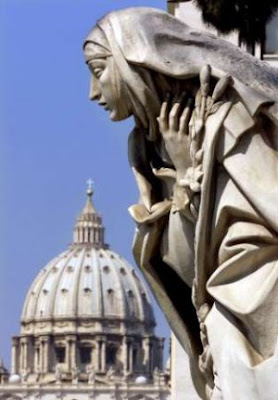
Fast forward to now-ish, and she's in a Dominican parish, still breathing in Catherine with every breath, and still not hungering for the piano now long gone. So for her I made a Catherine of Siena scent. It has a bunch more ingredients than this, but this is the part she will like:
Orris (=Iris rhizome) + Lily of the Valley (= yields no oils naturally, so a synthesized version of the compounds producing the natural scent; see headspace technology): Lily symbol of Catherine and of purity in general, as with other saints; Lilies and Iris considered same thing until 19th C.; now what still grows along the River Lys and was once called Fleur de Lis is actually 'Iris' in our lexicon (and I had to use orris as a fixative, since I'm desperative for fixatives in this, since florals scare me). So, lily + lily. More semantics, etymologies, and fights can be found here, if you're that picky.
Frankincense, Oud, Sandalwood, Benzoin, Patchouli: Very ecclesiastical, obviously; traditional ingredients for incense in many faith traditions for millennia. (Okay, also elements i know how to work with.) Anyway, in this tradition it means: ergo Jesus, and the Church. Very meaningful if one can argue that a scent can possess a narrative, as patently I believe it can, but also a great pragmatic blessing in that I can impart some resonance and richesse, so that the whole thing doesn't sound like Elvira de Hidalgo on a helium rebreather and last for all of a shrill twenty seconds.
Cedar: the Cedars of Lebanon; therefore the Song of Solomon; Divine Love; Deus Caritas Est; Catherine's Holy Bridegroom.
Rose Absolute and Rose Geranium (which has three of the same constituents as rose: linalool, geraniol, and citronellol, but with greater depth, complexity, and tenacity): Kind of obvious, but: Catherine's crown of roses; the Blessed Virgin; the Rosary (the Marion devotion as well as the sacramental - which Dominican friars and nuns wear as part of the habit, and which is likewise important to the Dominican Third Order and laity) and, being a partly kinaesthetic mode of prayer, evokes Dominic's Nine Ways of Prayer. At least to me.
And, lastly, Lotus: Death of the Old Self, Regeneration, New Life -- and Continuity. The lotus simultaneously represents the transitory and the eternal, two realms we as humans are challenged to mediate every day. What dies away will be replaced by something brighter, stronger, deeper. It is born out of mud, ,
, like the first man,
  , and strives ever upward. As we do.
It sounds super easy. Hit and run, like having 'bezique' staring at you in your Scrabble tray on opening. But I added a bunch of stuff besides this, to try and have it not read as 'rose and religion.' It would be sad if she loved the story and hated the scent!
Update 6/22: I added coriander. The opening had become as vigourous as a tulip stalk in late June. I thought about more citrus (there's hardly any), but the coriander seems a better bet, if it can link up with the frank and patch and cajeput in the prelude. We'll see. But middle and end are quite nice.
Update 6.23: Feeling tempted to add saffron for some reason. But I think logically I should give it a spike with more coriander and boost the cedar. Give me a couple weeks. I know I will...
--Look, it's riveting for the two of you for whom it's riveting. The other two of you can go practice your Uzbek.
In the meantime: I have a friend who's absolutely in love with Catherine of Siena.
 The first coup de foudre took place while she was, unsurprisingly, in Siena. Not being Catholic and not knowing a Dominican from a Double Englishman's at the time, she returned home and went back to work, enjoying the occasional nostalgic Brunello and trying to make sense out of the whole thing while feeling a distinct urge to learn how to make rosaries out of rose petals. (Or something: I totally made that last bit up.)
Go ahead a year. The friend sells her piano so she can go to Siena again, not needing to get to a why or even a how there, but at least a What, God help her, as to the nature of what she is experiencing. She prays, meditates, cries, meets some religious, buys some books, is yet more moved, and the whole time the piano is more than worth it.
Then it's almost time for her to leave, so she asks the bookstore guy, who remembers her from last time, whom she sort of knows halfway enough to feel one-quarter comfortable, if there are any 'Dominicans' near where she lives, which is near Seattle, in Washington, United States. And then Vincenzo, or Bartolomeo, or God help us all, Domenico, tells her that, well, he knows he sends some books to this parish in Seattle, and maybe that could help?

Fast forward to now-ish, and she's in a Dominican parish, still breathing in Catherine with every breath, and still not hungering for the piano now long gone. So for her I made a Catherine of Siena scent. It has a bunch more ingredients than this, but this is the part she will like:
Orris (=Iris rhizome) + Lily of the Valley (= yields no oils naturally, so a synthesized version of the compounds producing the natural scent; see headspace technology): Lily symbol of Catherine and of purity in general, as with other saints; Lilies and Iris considered same thing until 19th C.; now what still grows along the River Lys and was once called Fleur de Lis is actually 'Iris' in our lexicon (and I had to use orris as a fixative, since I'm desperative for fixatives in this, since florals scare me). So, lily + lily. More semantics, etymologies, and fights can be found here, if you're that picky.
Frankincense, Oud, Sandalwood, Benzoin, Patchouli: Very ecclesiastical, obviously; traditional ingredients for incense in many faith traditions for millennia. (Okay, also elements i know how to work with.) Anyway, in this tradition it means: ergo Jesus, and the Church. Very meaningful if one can argue that a scent can possess a narrative, as patently I believe it can, but also a great pragmatic blessing in that I can impart some resonance and richesse, so that the whole thing doesn't sound like Elvira de Hidalgo on a helium rebreather and last for all of a shrill twenty seconds.
Cedar: the Cedars of Lebanon; therefore the Song of Solomon; Divine Love; Deus Caritas Est; Catherine's Holy Bridegroom.
Rose Absolute and Rose Geranium (which has three of the same constituents as rose: linalool, geraniol, and citronellol, but with greater depth, complexity, and tenacity): Kind of obvious, but: Catherine's crown of roses; the Blessed Virgin; the Rosary (the Marion devotion as well as the sacramental - which Dominican friars and nuns wear as part of the habit, and which is likewise important to the Dominican Third Order and laity) and, being a partly kinaesthetic mode of prayer, evokes Dominic's Nine Ways of Prayer. At least to me.
And, lastly, Lotus: Death of the Old Self, Regeneration, New Life -- and Continuity. The lotus simultaneously represents the transitory and the eternal, two realms we as humans are challenged to mediate every day. What dies away will be replaced by something brighter, stronger, deeper. It is born out of mud,
, like the first man, , and strives ever upward. As we do.It sounds super easy. Hit and run, like having 'bezique' staring at you in your Scrabble tray on opening. But I added a bunch of stuff besides this, to try and have it not read as 'rose and religion.' It would be sad if she loved the story and hated the scent!
Update 6/22: I added coriander. The opening had become as vigourous as a tulip stalk in late June. I thought about more citrus (there's hardly any), but the coriander seems a better bet, if it can link up with the frank and patch and cajeput in the prelude. We'll see. But middle and end are quite nice.
Update 6.23: Feeling tempted to add saffron for some reason. But I think logically I should give it a spike with more coriander and boost the cedar. Give me a couple weeks. I know I will...
Subscribe to:
Comments (Atom)