Well, my love affair with Peggy Noonan continues. She is that all-too-rare combination: a lady, a Conservative, a human, demonstrably non-insane, and a thinker (although I disagree, and quite vigorously so, with several positions she has held), something nearly as hard to find as 'small town values' in small towns.
Tonight Ms. Noonan was on the Daily Show to promote her new book, Patriotic Grace: What It Is and Why We Need It Now. The title will be disturbing in some quarters for its inclusion of the term 'patriotic,' syllables which, when mispronounced, rhyme rather effortlessly with volk and kokutai (国体). I, however, would advise those naysayers to notice the second word, grace, and reflect on what our country, its politicians, and its political contests, might look like were grace, alongside its parents maturity and reflection, to be employed more widely.
Nor did Ms. Noonan's performance belie her espousal of grace as a virtue. She was calm, soft-spoken, persuasive, and did not once wink, wrinkle her nose, lick her finger and stick it in the air, or escalate her pitch to shrill or girlish levels. She spoke, reasoned, and comported herself like an adult, something which one should hope might pass unremarked, yet cannot for its rarity. And despite Ms. Noonan's recent still-on-microphone gaffe in which she used mild profanity and dismissed the wisdom of the Palin nomination, her ladylike demeanor and reasonable speech helped stifle almost all of John Stewart's customary swearing.
Part of Sarah Palin's gut demagogic appeal, I suspect, is that she acts like a girl. She is unintimidating, even when she resorts to the crudest, most puerile sarcasm. But girlishness, or childishness, does not engender respect, nor does it facilitate rational conversation or debate. I entertain grave doubts that the Corinthians wore red peep-toe pumps or bobbed their heads coquettishly while pursuing the Vice-Presidency, but Paul nonetheless saw fit to caution them thus: “When I was a child, I spoke as a child, I thought as a child, I reasoned like a child. But when I became a man, I put childish ways behind me”(1 Corinthians 13:11). Would that the majority of American politicians follow Peggy Noonan and do the same thing.
'Shall I teach you what knowledge is? When you know a thing, to hold that you know it; and when you do not know a thing, to allow that you do not know it;-this is knowledge.' -Confucius
Showing posts with label Catholics. Show all posts
Showing posts with label Catholics. Show all posts
Thursday, October 2, 2008


Wednesday, September 17, 2008
Swearing in French in Guerrero
We'll get back to Marie de l'Incarnation soon, I hope, because her story is nuts. She was a powerhouse, a dynamo, a great teacher, a prolific letter-writer, and a nun-scholar-philologist in the wilds of old Canada. In the meantime, here is a story about swearing like a (Québec) Frenchman while wintering south of two borders.
Québecois swearing is justly famous for its outrageousness. If the offense or inconvenience you are suffering is not too great, you can of course just mutter a clipped 'marde' under your breath and have done with it. If, however, the flurry from your neighbor's souffleuse just blew your tasty string of tire d'érable (I remember loving that as a kid; thank God those teeth were temporary) right into the bits of hair sticking out from under your tuque, your ire is unlikely to be fully vented after a mere monosyllable (we think our four-letter-words are handy stress relievers: imagine having ten or fifteen syllables to let off that steam). Instead of a tiny clenched fistful of choices and one short puff of air, Québec Francophones have at their disposal the vast vocabulary of four hundred years of North American Catholic history from which to fashion not merely obscene, but elaborately, flamboyantly, nonsensically obscene multi-part jurons/sacrés combining every religious term conceivable. In English, people sometimes murmur 'Oh, God,' or 'Jesus,' (whether knowingly/deliberately or completely unconsciously) whereas in Québec the would-be swearer has the entire Mass, the Old and New Testaments, two thousand years of saints, all entries main and sub- in the Catechism, and every last detail of ecclesiastical vestments, architecture and ornamentation from which to choose his sacrés.
Now, baptism records notwithstanding, no one is actually Catholic anymore in Québec. That stopped in the 60s, but it doesn't change the fact that it is still objectionable in polite society to yell a series of religious words interspersed with terms alluding to the body's copulatory and excretory functions. So there are euphemisms. Plenty of them. Calvaire (Calvary) and câlisse (chalice) can become calette, calvette, caltour, calvasse, calverasse, câlif/caliphe (caliph or qaliph), câlique and, with adig at reference to the Huguenot Protestant portion of the province's settlers, Calvin, Calvinasse, Calvinisse, Calvinouche, and so on.
In order not to offend old ladies by saying 'tabarnac' which is what you would say if you were a Québecois trying to mutter 'tabernacle' while frustratedly searching for the nearly invisible
 you might instead grumble tabarnache, tabarnouche, tabarniche, tabarnane, tabaslac, or even tabarouette (= ta barouette).

 NaCo T-shirts
which is the Mexican version of 'chav' and 'joual' and just as classist as these, but with the advantage of having a fair bit of racism mixed in, as well.

('There is no racism in Mexico. -Said this câline of a tabarname of a calvénousse of a baptême of a naco.')
But, just as other vicious words have been retranslated and refurbished in the past few decades as emblems of pride rather than vehicles of derision or hate, so, too, has naquismo as an identity been reclaimed and self-consciously turned on its head in all its garish glory. For the past decade there has been a NaCo clothing company (which was even quite trendy a couple years ago in distinctly non-naco circles with t-shirts such as the designs in this posting and 'Ser Naco Es Chido' and 'M is for Mojado' ['wetback']), with outlets in both Mexico and the U.S., not to mention online.
According to cultural critics such as Carlos Monsiváis and others, however, the word is simply too nasty from its very origin to merit rehabilitation. Most agree the word comes from 'Totonaco' or, possibly, 'Nacohuatl/Nahuatl,' and thus always contains a racial element when used by comparatively cultured, educated and light-skinned Mexicans to refer not only to those with less refinement and schooling, but more indigenous blood. 'Naco' for Monsiváis is 'proletario, lumpenproletario, pobre, sudoroso, el pelo grasiento y el copete alto, el perfil de cabeza de Palenque, vestido a la moda de hace seis meses, vestido fuera de moda. Naco es los anteojos oscuros a la media noche, el acento golpeado, la herencia del peladito y el lépero, el diente de oro. Naco es el insulto que una clase dirige a otra.'
Now, I for one am about as sick of feigned folksyism as I could be, but it is one thing deliberately and inconsistently to drop one's G's from the present progressive in an attempt to get the lumpenproletariat to vote for you ('Guysngals, our regulatory system is outdated...there's somethin that's goin on in our world, in our nation...that needs some shakin up and fixin') and another altogether to be at ease with and proud of all the sweat, callouses, and disapproving looks your naco or joual heritage has earned you. Had someone suggested to me a few years ago that there would be a Democratic presidential candidate of African ancestry, to which the Republican response was going to be Class War, I would have suggested to the speaker that he perhaps 'didn't inhale' a great many more times than Bill Clinton - and quite possibly didn't do that inhaling very, very recently.
Québecois swearing is justly famous for its outrageousness. If the offense or inconvenience you are suffering is not too great, you can of course just mutter a clipped 'marde' under your breath and have done with it. If, however, the flurry from your neighbor's souffleuse just blew your tasty string of tire d'érable (I remember loving that as a kid; thank God those teeth were temporary) right into the bits of hair sticking out from under your tuque, your ire is unlikely to be fully vented after a mere monosyllable (we think our four-letter-words are handy stress relievers: imagine having ten or fifteen syllables to let off that steam). Instead of a tiny clenched fistful of choices and one short puff of air, Québec Francophones have at their disposal the vast vocabulary of four hundred years of North American Catholic history from which to fashion not merely obscene, but elaborately, flamboyantly, nonsensically obscene multi-part jurons/sacrés combining every religious term conceivable. In English, people sometimes murmur 'Oh, God,' or 'Jesus,' (whether knowingly/deliberately or completely unconsciously) whereas in Québec the would-be swearer has the entire Mass, the Old and New Testaments, two thousand years of saints, all entries main and sub- in the Catechism, and every last detail of ecclesiastical vestments, architecture and ornamentation from which to choose his sacrés.
Now, baptism records notwithstanding, no one is actually Catholic anymore in Québec. That stopped in the 60s, but it doesn't change the fact that it is still objectionable in polite society to yell a series of religious words interspersed with terms alluding to the body's copulatory and excretory functions. So there are euphemisms. Plenty of them. Calvaire (Calvary) and câlisse (chalice) can become calette, calvette, caltour, calvasse, calverasse, câlif/caliphe (caliph or qaliph), câlique and, with a
In order not to offend old ladies by saying 'tabarnac' which is what you would say if you were a Québecois trying to mutter 'tabernacle' while frustratedly searching for the nearly invisible
Rue Calvin in Québec City,
 you might instead grumble tabarnache, tabarnouche, tabarniche, tabarnane, tabaslac, or even tabarouette (= ta barouette).
(Sa Barouette.)
(Jean à de longues moustaches. Je répète: Jean à de longues moustaches.)
If, however, you were less worried about people overhearing and being offended by your swearing because you were somewhere no one would understand the polite words, either, such as frustratedly searching for the nearly invisible Calle No. 2 in Acapulco, you might be less inclined toward restraint and let all three real syllables fly, giving yet another reason for Mexican resort workers, street vendors, and taxicab drivers to continue to refer to loud Francophone Quebeckers as 'tabernacos,' via analogy to 'nacos'(Jean à de longues moustaches. Je répète: Jean à de longues moustaches.)

 NaCo T-shirts
('There is no racism in Mexico. -Said this câline of a tabarname of a calvénousse of a baptême of a naco.')
But, just as other vicious words have been retranslated and refurbished in the past few decades as emblems of pride rather than vehicles of derision or hate, so, too, has naquismo as an identity been reclaimed and self-consciously turned on its head in all its garish glory. For the past decade there has been a NaCo clothing company (which was even quite trendy a couple years ago in distinctly non-naco circles with t-shirts such as the designs in this posting and 'Ser Naco Es Chido' and 'M is for Mojado' ['wetback']), with outlets in both Mexico and the U.S., not to mention online.
According to cultural critics such as Carlos Monsiváis and others, however, the word is simply too nasty from its very origin to merit rehabilitation. Most agree the word comes from 'Totonaco' or, possibly, 'Nacohuatl/Nahuatl,' and thus always contains a racial element when used by comparatively cultured, educated and light-skinned Mexicans to refer not only to those with less refinement and schooling, but more indigenous blood. 'Naco' for Monsiváis is 'proletario, lumpenproletario, pobre, sudoroso, el pelo grasiento y el copete alto, el perfil de cabeza de Palenque, vestido a la moda de hace seis meses, vestido fuera de moda. Naco es los anteojos oscuros a la media noche, el acento golpeado, la herencia del peladito y el lépero, el diente de oro. Naco es el insulto que una clase dirige a otra.'
Now, I for one am about as sick of feigned folksyism as I could be, but it is one thing deliberately and inconsistently to drop one's G's from the present progressive in an attempt to get the lumpenproletariat to vote for you ('Guysngals, our regulatory system is outdated...there's somethin that's goin on in our world, in our nation...that needs some shakin up and fixin') and another altogether to be at ease with and proud of all the sweat, callouses, and disapproving looks your naco or joual heritage has earned you. Had someone suggested to me a few years ago that there would be a Democratic presidential candidate of African ancestry, to which the Republican response was going to be Class War, I would have suggested to the speaker that he perhaps 'didn't inhale' a great many more times than Bill Clinton - and quite possibly didn't do that inhaling very, very recently.
Sunday, September 14, 2008
Monastic of the Day!

(Not him, obviously. But weren't the 80s ghastly, though?
Leggings and miniskirts, oh my.
And a headband, no less!)
Leggings and miniskirts, oh my.
And a headband, no less!)
In what seems to be becoming a regular feature here, today's featured religious* is the Venerable Mère Marie de l'Incarnation, 1599-1672, who started out this life in Tours and departed it in an Ursuline convent in New France, which is alot like Québec only with a great deal fewer Frites-Alors, much less poutine, and not even close to as much or as many habitant and habitants.
Both sides of my family, the French ones and the English ones, came over to North America early. This could mean they were desperate, adventurous, bored, reckless, in danger of incarceration, excessively fond of lengthy boat travel, or all these in varying measures. I know a lot about the English side: they fought in the Revolutionary and Civil Wars and sent letters telling about this. I know less about the earliest French arrivals, and I suspect it is because they are the ones who gave the women in our family the facial hair, and the less known about them, the less rancour towards the dead will arise. Still, though, I love the history of Québec/New France/Nouvelle France as much as I love that of the Ottoman Empire and Turkey, so while rummaging around online for stuff about the former, I was reminded of the story of the Filles du Roi, in which the above Mother Marie played a part.
 (The Roi Whose Filles We're Talking About.
Somehow this style never caught on in Trois-Rivières.
They were still probably wearing headbands.)
Firstly, it should be said that Filles du Roi are not at all the same as filles de joie, who figured in earlier posts and had far better wardrobes, not to mention restaurant choices, even after Escoffier, than the habitants of the Canadian wilderness.
 (As you can see from the rug and the furniture
in this painting by honorary Canadian Cornelius Krieghoff,
imported spouses were also forced to endure shopping at Ikea, which was
even more horrific when Karl XI
 was in charge of Sweden
than it is now.)
Unlike filles de joie, Filles du Roi were not career women; their job - once they moved to the New World and found a husband (which tended to happen within a month or so after disembarkation) - was to be a wife and mother, which, alongside religious and camp-follower, was one of the three main career trajectories available to women at the time. Despite the arduous passage across the Atlantic, New Franceian Hausfrau could well have seemed the middle-ground option for marriageable girls with a moderate, though not overweening, sense of adventure and a similarly underwhelming set of marriage prospects.
The Filles du Roi were recruited and imported from 1663 to 1673, beginning in northern cities like Paris, Rouen, and New Rochelle. The purpose of the programme was to populate the colony, which would eventually provide new soldiers to defend France's holdings against Iroquois and English alike. Moreover, having a wife, family, house, land - not to mention livestock, two barrels of salted meat, and dowry from the King - would in theory serve to keep more of the colony's male population where they were instead of following the trend of leaving New France to return home after their three years of service. Though there were only 700, or 852, or 1000 women shipped in during those years, the French population of New France was itself only about 2500 in 1663 (as contrasted with English North America, which already had 100,000 inhabitants), with only 1 percent of New France territory being used by the settlers, so the resulting marriages and considerable progeny (you only got a 300-livre annual pension if you stalled at 10 children, but 400 if you made it past a clean dozen) could indeed eventually constitute a relatively significant bulwark against English encroachment once the children reached soldiering age. In 1671 alone, about 700 babies were born to the new families, and by the end of the ten-year importation of Filles du Roi, the sex ratio in Nouvelle France was more or less even. By 1754, at the start of the Seven Years' War, or the Fourth Intercolonial War, or the Guerre de la Conquête, or the 'French and Indian War,' the 'Indians' at least had some Frenchmen to fight alongside them.
All that notwithstanding.

Some of the girls were not as ready for the privations of Canadian homesteading as were others. They got a quick remedial education in whatever practical domestic arts they lacked while awaiting introduction to suitable suitors, plus a ration of pins, needles, thread, taffeta, and scissors among other things. They did not, however, receive a pair of Sorels or experience in wood-chopping or fence-building. Just as the Filles preferred garçons who already had une habitation set up and ready for move-in (look, I love the Canadiens as much as you do and, honestly, probably more so, but that really is the boring reason they're called The Habs: steady settlers with land and a cabin. Homesteaders. Pea soup. Stability and stoicism, not high-sticking), the male colonists were in need more of a sturdy helpmeet than a piano-playing bourgeoise.
Enter Marie Guyart the Ursuline.
(And also another entry, since this one got away from me.)
*And for the irreligious among you, 'religious' in the nominative way is different than the adjectival version. Flat-earthers, for example, or snake-charming charismatics, no matter how ardent their faith in their faith, would only be adjectivally religious, i.e., religious people, a religious population, rather than 'a religious' like Mother Marie, who took vows/joined an order/consecrated her life. It's not biased language, I assure you, and it certainly doesn't prove the earth isn't flat.
Monday, September 8, 2008

Saturday, August 23, 2008
Hopeless Causes, Claretians, and Charisms
'La caridad me urge, me impele, me obliga a gritar.' -St. Antonio Maria Claret
'You will find something more in woods than in books. Trees and stones will teach you that which you can never learn from masters.' - St. Bernard of Clairvaux
'To reach something good it is very useful to have gone astray, and thus acquire experience.' - St. Teresa of Avila
'Arm yourself with prayer rather than a sword; wear humility rather than fine clothes.' - St. Dominic
With all that being said, in regards to my statement in the last post about there being no one-fits-all spirituality, I do not mean to say that some truths cannot be universal, nor either that admiring and utilizing elements of other traditions is inherently wrong or fatuous. But trading one inadequately-investigated tradition for superficial adherence to another, one set of misapprehended truths for another yet more confusing system, is every bit as goofy as Chesterton makes it sound. Familiarity is a no more sufficient basis for renouncing a spiritual tradition than it is for divorcing a spouse or vowing never again to read Dostoevsky or eat ice cream.
Augustine defended his use of Plotinus by likening it to the Jews taking the gold out of Egypt, and varied things from different sources may have especial resonance to individual seekers. What is necessary when confronted with all these sparkling jewels is a determined refusal either to make lead out of them or to appropriate what seems convenient or commonsensical while gravely mistaking its essence.
In that vein, there are as many different spiritualities available within Catholicism as there are Catholics. John Dunne, John Dear, John Main, and the fourteenth-century Dominican John Tauler have not only the same name but a shared focus on contemplation and meditation that would not be entirely unfamiliar to a real Buddhist. Martin de Porres, Vincent de Paul, Francis of Assisi, Oscar Romero, Dorothy Day, Antonio Claret, Cesar Chavez, Jean Vanier, and Simone Weil can give anyone a good start who wishes he could combine his love of the poor and the suffering with his love of God.
And this is where the saints come in. There are two primary ways to look at the saints. One is as Friends of God. They did so well in this lifetime that they have God's ear in the next, so while you are praying to God directly that the Red Sox please, please, please take the pennant this time, you can also suggest to St. Jude that this may be the sort of hopeless case worthy of his attention as an advocate. If you are struggling in school, you can ask a brilliant scholar like Aquinas to help you along, or you can petition someone who battled the same challenges to at least give you the courage to keep plugging away diligently.
The other way to see them is as Heroes for Grownups. Saints can indeed be intimidating: they were saints, after all, and we are probably not. But each is as memorable for what he or she overcame as for what s/he accomplished, and meditating on those struggles is often where we can gain the most. They were also individuals, with distinct tendencies and temperaments, walking very different paths toward union, and just as we feel greater sympathy toward particular people we meet in daily life, so, too, will different saints' stories seem more or less apropos of our own journeys, strivings, and weaknesses.
I don't know why people are scared of saints. I think particularly if we refuse to idolize them, to make them into something they were not (i.e., perfect), we can see in their examples how far a small, flawed, and eminently human being - possibly a human being who shared some of our own fears and failures - can get in this life by not letting those fears and weaknesses surmount him.
'You will find something more in woods than in books. Trees and stones will teach you that which you can never learn from masters.' - St. Bernard of Clairvaux
'To reach something good it is very useful to have gone astray, and thus acquire experience.' - St. Teresa of Avila
'Arm yourself with prayer rather than a sword; wear humility rather than fine clothes.' - St. Dominic
With all that being said, in regards to my statement in the last post about there being no one-fits-all spirituality, I do not mean to say that some truths cannot be universal, nor either that admiring and utilizing elements of other traditions is inherently wrong or fatuous. But trading one inadequately-investigated tradition for superficial adherence to another, one set of misapprehended truths for another yet more confusing system, is every bit as goofy as Chesterton makes it sound. Familiarity is a no more sufficient basis for renouncing a spiritual tradition than it is for divorcing a spouse or vowing never again to read Dostoevsky or eat ice cream.
Augustine defended his use of Plotinus by likening it to the Jews taking the gold out of Egypt, and varied things from different sources may have especial resonance to individual seekers. What is necessary when confronted with all these sparkling jewels is a determined refusal either to make lead out of them or to appropriate what seems convenient or commonsensical while gravely mistaking its essence.
In that vein, there are as many different spiritualities available within Catholicism as there are Catholics. John Dunne, John Dear, John Main, and the fourteenth-century Dominican John Tauler have not only the same name but a shared focus on contemplation and meditation that would not be entirely unfamiliar to a real Buddhist. Martin de Porres, Vincent de Paul, Francis of Assisi, Oscar Romero, Dorothy Day, Antonio Claret, Cesar Chavez, Jean Vanier, and Simone Weil can give anyone a good start who wishes he could combine his love of the poor and the suffering with his love of God.
And this is where the saints come in. There are two primary ways to look at the saints. One is as Friends of God. They did so well in this lifetime that they have God's ear in the next, so while you are praying to God directly that the Red Sox please, please, please take the pennant this time, you can also suggest to St. Jude that this may be the sort of hopeless case worthy of his attention as an advocate. If you are struggling in school, you can ask a brilliant scholar like Aquinas to help you along, or you can petition someone who battled the same challenges to at least give you the courage to keep plugging away diligently.
The other way to see them is as Heroes for Grownups. Saints can indeed be intimidating: they were saints, after all, and we are probably not. But each is as memorable for what he or she overcame as for what s/he accomplished, and meditating on those struggles is often where we can gain the most. They were also individuals, with distinct tendencies and temperaments, walking very different paths toward union, and just as we feel greater sympathy toward particular people we meet in daily life, so, too, will different saints' stories seem more or less apropos of our own journeys, strivings, and weaknesses.
I don't know why people are scared of saints. I think particularly if we refuse to idolize them, to make them into something they were not (i.e., perfect), we can see in their examples how far a small, flawed, and eminently human being - possibly a human being who shared some of our own fears and failures - can get in this life by not letting those fears and weaknesses surmount him.
Monday, August 18, 2008
More from our Correspondent in Geneva
Well, very excitingly (to me, anyway) today is St. Jane Frances de Chantal's day. It is exciting to me not just because I love her and her story, but because also this not only brings us back to Savoy (yikes! who would have thought!) and Geneva and all its Calvinists, and gets back to that issue of historicity that I snarkily mentioned a few posts back. Which I'll get to a few lines down, or a few posts down the road, but first: St. Jane Frances, or Ste. Jeanne Françoise, if you like your French names to stay in French.

She is sort of another St. Francis' St. Clare: his student, his peer, his friend, his spiritual companion, and his travel partner on a long and profound journey. This time, it is a François-Francis instead of a Francesco one, the sixteenth century instead of the thirteenth, the Renaissance rather than the Middle Ages, and a Francis born of Savoyard nobility rather than of wealthy Umbrian merchants. This Francis, Francis de Sales, was a carefree and competent student, then lawyer, and then a bishop, rather than an apathetic student turned playboy-dandy turned mendicant, and before joining and guiding Jane Frances on her spiritual journey, he set out like Francis of Assisi on a way of life quite unlike that his family had intended for him, turning his back on his wealth like Francis, but going over to Geneva to convert Calvinists à la St. Dominic instead of founding an order à la the Franciscan Francis.

Both St. Francis de Sales' and St. Jane Frances' stories are stories of waiting. Francis felt a strong vocation before he went to law school, but he waited and waited, wanting to make sure it was truly a vocation rather than his ego leading him. St. Jane was a young devout widow with children when she felt overcome with a desire to serve God more fully. When Jane asked the now Bishop Francis to undertake her spiritual direction, he counseled her to patience: 'I had to know fully what God himself wanted. I had to be sure that everything in this should be done as though his hand had done it.' Just as he had waited for his calling and for his Calvinists, and as he would later for his new sister's convent, Francis counseled Jane again to wait when she told him of her overwhelming desire to take vows: 'Be patient until you get the wings of a dove, and then you can fly. I am very much afraid that you are a little too ardent and headlong, that you pursue too many desires rather too eagerly. Courage, my dear sister; if our will belongs to God, we ourselves are surely His.'
And this moderation was an essential element of the institute, and then order, the two founded in 1610, the Order of the Visitation of the Blessed Virgin. So that religious aspirants of older age or less robust health, 'strong souls with weak bodies,' might be able to fulfill their calling, Francis and Jane dispensed with the sort of physical austerities Poor Clares and other orders endured. St. Francis advised the community's new members and superior, 'Let your humility be boundless; let it be the source of your virtues; let it be manifested in all your actions, till gentleness towards your neighbor become natural to you by force of your frequent use of it.' Later, St. Jane described the charism of the order as essentially 'a spirit of deep humility before God and of great gentleness toward our neighbor.'
This gentleness was modeled already by Jane the wife and widow as she fed the town's poor and sick, and in the very gentleness of the rule itself: St. Jane accepted into the order a woman in her eighties and those young and old women whose infirmities would have barred them from religious life were it not for the inclusiveness of Salesian spirituality and its insistence that all people, regardless of health, wealth, status, occupation, age, or education, are called to love and holiness, and that we can manifest our love in small but profound acts of mercy and compassion. As Thomas Dailey said in Praying with Francis de Sales, 'Enabled and ennobled by this love, human beings are capable of much more than might well be imagined. They are capable of living a true life of devotion in the midst of worldly pursuits. They are capable of giving birth, through faith, to a new culture of life and of love.'
Also, unlike Savonarola, Francis de Sales in The Devout Life reveals that he thought games and jokes and dancing were okay, if in moderation: 'I am inclined to say about balls what doctors say of certain articles of food, such as mushrooms and the like--the best are not good for much; but if eat them you must, at least mind that they are properly cooked,' and 'if you would dance or play rightly, it must be done as a recreation, not as a pursuit, for a brief space of time, not so as make you unfit for other things.' I like anyone who has bad things to say about mushrooms.

She is sort of another St. Francis' St. Clare: his student, his peer, his friend, his spiritual companion, and his travel partner on a long and profound journey. This time, it is a François-Francis instead of a Francesco one, the sixteenth century instead of the thirteenth, the Renaissance rather than the Middle Ages, and a Francis born of Savoyard nobility rather than of wealthy Umbrian merchants. This Francis, Francis de Sales, was a carefree and competent student, then lawyer, and then a bishop, rather than an apathetic student turned playboy-dandy turned mendicant, and before joining and guiding Jane Frances on her spiritual journey, he set out like Francis of Assisi on a way of life quite unlike that his family had intended for him, turning his back on his wealth like Francis, but going over to Geneva to convert Calvinists à la St. Dominic instead of founding an order à la the Franciscan Francis.

Both St. Francis de Sales' and St. Jane Frances' stories are stories of waiting. Francis felt a strong vocation before he went to law school, but he waited and waited, wanting to make sure it was truly a vocation rather than his ego leading him. St. Jane was a young devout widow with children when she felt overcome with a desire to serve God more fully. When Jane asked the now Bishop Francis to undertake her spiritual direction, he counseled her to patience: 'I had to know fully what God himself wanted. I had to be sure that everything in this should be done as though his hand had done it.' Just as he had waited for his calling and for his Calvinists, and as he would later for his new sister's convent, Francis counseled Jane again to wait when she told him of her overwhelming desire to take vows: 'Be patient until you get the wings of a dove, and then you can fly. I am very much afraid that you are a little too ardent and headlong, that you pursue too many desires rather too eagerly. Courage, my dear sister; if our will belongs to God, we ourselves are surely His.'
And this moderation was an essential element of the institute, and then order, the two founded in 1610, the Order of the Visitation of the Blessed Virgin. So that religious aspirants of older age or less robust health, 'strong souls with weak bodies,' might be able to fulfill their calling, Francis and Jane dispensed with the sort of physical austerities Poor Clares and other orders endured. St. Francis advised the community's new members and superior, 'Let your humility be boundless; let it be the source of your virtues; let it be manifested in all your actions, till gentleness towards your neighbor become natural to you by force of your frequent use of it.' Later, St. Jane described the charism of the order as essentially 'a spirit of deep humility before God and of great gentleness toward our neighbor.'
This gentleness was modeled already by Jane the wife and widow as she fed the town's poor and sick, and in the very gentleness of the rule itself: St. Jane accepted into the order a woman in her eighties and those young and old women whose infirmities would have barred them from religious life were it not for the inclusiveness of Salesian spirituality and its insistence that all people, regardless of health, wealth, status, occupation, age, or education, are called to love and holiness, and that we can manifest our love in small but profound acts of mercy and compassion. As Thomas Dailey said in Praying with Francis de Sales, 'Enabled and ennobled by this love, human beings are capable of much more than might well be imagined. They are capable of living a true life of devotion in the midst of worldly pursuits. They are capable of giving birth, through faith, to a new culture of life and of love.'
Also, unlike Savonarola, Francis de Sales in The Devout Life reveals that he thought games and jokes and dancing were okay, if in moderation: 'I am inclined to say about balls what doctors say of certain articles of food, such as mushrooms and the like--the best are not good for much; but if eat them you must, at least mind that they are properly cooked,' and 'if you would dance or play rightly, it must be done as a recreation, not as a pursuit, for a brief space of time, not so as make you unfit for other things.' I like anyone who has bad things to say about mushrooms.
Sunday, August 17, 2008
Mud Floors, Tibetan Sephardim, and Tuscany in SE Jung Guo
In other news, I had an absolutely lovely conversation tonight about (what else?) theology (with a friend soon to depart for another hemisphere.) He gave me a book which was absolutely perfect in many ways, not least of which is that it is entirely relevant to a rant I have not yet given into, since I'm terribly lazy and would have to buy another little easel in order to have three books propped up around the little laptop in order satisfyingly to vent my spleen.
But, now I will feel impelled to buy my little easel (is it truly an easel? I don't think so; I don't know what they are called, but people who collect things with cats on them use them to display plates with either state insignias or details of Botticelli's greatest hits printed in Fujian) and tell you what the Dalai Lama had to say about 'Tibetan Buddhists' raised in Farmington in a John Main Seminar in the '80s or '90s. The Lama, not the Farmingtonians. I don't know that many were raised in a John Main Seminar. But I am open to possibilities. Not to mention, in the distant future, good nutrition.
In the meantime (not to hold all 7.3 of you in too-great suspense), here is how John Dunne, who is neither John Dear nor that John Donne, weighed in briefly - and similarly - on the issue: 'I think of a Sufi sheik I met on the Mount of Olives in Jerusalem who told me and the two young Israeli women who were with me, 'Go deep in your own religion.' Okay, fine, I already know which book I'm trading him. But God bless those Sufis, eh? Here is the spiritual work one Naqshbandi master gave to an aspirant: Pray nothing, think nothing, say nothing, but 'Oh, God,' all day every day. When the disciple came back saying he had succeeded in that task, the teacher told him no longer to speak it, but to breathe the prayer in his thoughts, to think and feel nothing else but 'Oh, God; Oh, God,' all day. After internalizing this, after training his spirit to unceasing dhikr, one day a loose beam fell from the roof of his house onto the pupil's head. The blood that dropped to the ground spelled Allah on the mud floor.
But, now I will feel impelled to buy my little easel (is it truly an easel? I don't think so; I don't know what they are called, but people who collect things with cats on them use them to display plates with either state insignias or details of Botticelli's greatest hits printed in Fujian) and tell you what the Dalai Lama had to say about 'Tibetan Buddhists' raised in Farmington in a John Main Seminar in the '80s or '90s. The Lama, not the Farmingtonians. I don't know that many were raised in a John Main Seminar. But I am open to possibilities. Not to mention, in the distant future, good nutrition.
In the meantime (not to hold all 7.3 of you in too-great suspense), here is how John Dunne, who is neither John Dear nor that John Donne, weighed in briefly - and similarly - on the issue: 'I think of a Sufi sheik I met on the Mount of Olives in Jerusalem who told me and the two young Israeli women who were with me, 'Go deep in your own religion.' Okay, fine, I already know which book I'm trading him. But God bless those Sufis, eh? Here is the spiritual work one Naqshbandi master gave to an aspirant: Pray nothing, think nothing, say nothing, but 'Oh, God,' all day every day. When the disciple came back saying he had succeeded in that task, the teacher told him no longer to speak it, but to breathe the prayer in his thoughts, to think and feel nothing else but 'Oh, God; Oh, God,' all day. After internalizing this, after training his spirit to unceasing dhikr, one day a loose beam fell from the roof of his house onto the pupil's head. The blood that dropped to the ground spelled Allah on the mud floor.
Tuesday, August 12, 2008
St. Clare

It's St. Clare's feast day today; here is a picture of her from a manuscript of Bishop Ugolino, a reluctant but eventual full supporter of Francis' and Clare's cause for the Poor Ladies of San Damiano/Poor Clares to be a truly mendicant order. Once convinced, the then Pope Gregory IX issued a privilegium paupertatis two years after Francis' death for the fledgling order and wrote these beautiful words: 'Neither does the want of necessary things deter you from such a proposal, for the left arm of your Celestial Spouse is beneath your head to sustain the infirmity of your body, which, according to the order of charity, you have subjected to the law of the spirit. Finally, He who feeds the birds of the air and who gives the lilies of the field their raiment and their nourishment, will not leave you in want of clothing or of food until He shall come Himself to minister to you in eternity.'
Saturday, August 9, 2008
Infelix Ego -
if they only hadn't stolen all those left shoes, I could have pawned them and the visor-light and made a bid!
Wow, in just the same manner of everything I think or do or feel being reduplicated in some way about 12 hours later, this time it was over on the Intentional Disciples blog, which is the blog for the Catherine of Siena Institute, which was started at Blessed Sacrament parish here in Seattle, which had a Dominican mass today, which was the Feast Day of St. Dominic - they had a quiz on whose signature is this?
It was Savonarola's, and you could buy it at auction at the moment if you were thusly disposed (and thusly endowed), and I know it was Savonarola's not just because I'm not one to forget a pretty face,

but because I have been reading about him and trying to figure out his place in early Protestantism, if there is such a place. I would say Protestantism, but excepting Lutherans I do often get the sense that many Protestant denominations take a - what? - segmented? discontinuous? disarticulated? view of Christian history, inasmuch as those inclined that way tend to see two punctuating epochs - the First/Second Covenants, and then the Reformation/now - with a large fuzzy bit in between populated by hazy robed figures undeserving of much scrutiny.
Yet even among this group there are some revered figures in medieval theology (and, admittedly, among other groups there are loads), and many of the ideas of this singular figure (who himself ended up in a bonfire, but not before being treated to the rack first by his Medici hosts) prefigured many of the Reformers' concerns. He criticized the excesses of Rome and of Orders in much the same language and to much the same level of vituperation as Reformers did - yet he also echoed the return-to-the-heart-of-Jesus'-Christianity sentiment that had resounded over and over throughout the Middle Ages. The Church eventually had all his works formally banned - but by that time they were best-sellers all over the place and being printed in areas and languages too far from Rome to control.
Anyway, if you like the asceticism of a Calvin but prefer a Florentine accent in denunciations of dancing and drink, you would love Savonarola. If you like the gist of Dante but would prefer to do away with all the needless poesy, he's your man. And if you are inclined to think that Boccaccio and Erasmus would be just fine were it not for the wit, you will find all the spleen you need but none of the humor you don't in the fiery Dominican from Florence.
Here is some of Isaias' bonfire of the vanities in Savonarola's honor. I think this is most poetic in the King James. And the Dominican New Testament translation by Francis Spencer, OP, doesn't have Isaias, for what may or may not be obvious reasons.
Moreover the LORD saith, Because the daughters of Zion are haughty, and walk with stretched forth necks and wanton eyes, walking and mincing as they go, and making a tinkling with their feet:
Wow, in just the same manner of everything I think or do or feel being reduplicated in some way about 12 hours later, this time it was over on the Intentional Disciples blog, which is the blog for the Catherine of Siena Institute, which was started at Blessed Sacrament parish here in Seattle, which had a Dominican mass today, which was the Feast Day of St. Dominic - they had a quiz on whose signature is this?
It was Savonarola's, and you could buy it at auction at the moment if you were thusly disposed (and thusly endowed), and I know it was Savonarola's not just because I'm not one to forget a pretty face,

but because I have been reading about him and trying to figure out his place in early Protestantism, if there is such a place. I would say Protestantism, but excepting Lutherans I do often get the sense that many Protestant denominations take a - what? - segmented? discontinuous? disarticulated? view of Christian history, inasmuch as those inclined that way tend to see two punctuating epochs - the First/Second Covenants, and then the Reformation/now - with a large fuzzy bit in between populated by hazy robed figures undeserving of much scrutiny.
Yet even among this group there are some revered figures in medieval theology (and, admittedly, among other groups there are loads), and many of the ideas of this singular figure (who himself ended up in a bonfire, but not before being treated to the rack first by his Medici hosts) prefigured many of the Reformers' concerns. He criticized the excesses of Rome and of Orders in much the same language and to much the same level of vituperation as Reformers did - yet he also echoed the return-to-the-heart-of-Jesus'-Christianity sentiment that had resounded over and over throughout the Middle Ages. The Church eventually had all his works formally banned - but by that time they were best-sellers all over the place and being printed in areas and languages too far from Rome to control.
Anyway, if you like the asceticism of a Calvin but prefer a Florentine accent in denunciations of dancing and drink, you would love Savonarola. If you like the gist of Dante but would prefer to do away with all the needless poesy, he's your man. And if you are inclined to think that Boccaccio and Erasmus would be just fine were it not for the wit, you will find all the spleen you need but none of the humor you don't in the fiery Dominican from Florence.
Here is some of Isaias' bonfire of the vanities in Savonarola's honor. I think this is most poetic in the King James. And the Dominican New Testament translation by Francis Spencer, OP, doesn't have Isaias, for what may or may not be obvious reasons.
Moreover the LORD saith, Because the daughters of Zion are haughty, and walk with stretched forth necks and wanton eyes, walking and mincing as they go, and making a tinkling with their feet:
Therefore the LORD will smite with a scab the crown of the head of the daughters of Zion, and the LORD will discover their secret parts.
In that day the Lord will take away the bravery of their tinkling ornaments about their feet, and their cauls, and their round tires like the moon, The chains, and the bracelets, and the mufflers, The bonnets, and the ornaments of the legs, and the headbands, and the tablets, and the earrings, The rings, and nose jewels, The changeable suits of apparel, and the mantles, and the wimples, and the crisping pins, The glasses, and the fine linen, and the hoods, and the veils.
And it shall come to pass, that instead of sweet smell there shall be stink; and instead of a girdle a rent; and instead of well set hair baldness; and instead of a stomacher a girding of sackcloth; and burning instead of beauty.
Tuesday, July 15, 2008
Confusing but Comforting
I am a bit mystified. There has been an odd surge in numbers of people reading this goofy blog in the last week, and I cannot for the life of me figure out why.
Here is what I have covered in that time period:
-Catholics
-Compassion
-Commandments (yikes, eh?)
-Cats
-Cats
-Cats
-Courtesans
-Cooking
-Canada
-Cohen
-Campesinos in California (four of whom have died in the past month), and
-Comedy, even.
So you can see why I'm shocked. I didn't once cover Angelina Jolie, or how to make a million dollars in a week. I can only imagine what will happen when I get to the letter D.
Here is what I have covered in that time period:
-Catholics
-Compassion
-Commandments (yikes, eh?)
-Cats
-Cats
-Cats
-Courtesans
-Cooking
-Canada
-Cohen
-Campesinos in California (four of whom have died in the past month), and
-Comedy, even.
So you can see why I'm shocked. I didn't once cover Angelina Jolie, or how to make a million dollars in a week. I can only imagine what will happen when I get to the letter D.
Sunday, July 13, 2008
Avalokitesvara Meets Aristotle, or Metta in the Modern World

The other night we were talking about the Fifth Commandment. As with everything else, Catholics have a rich understanding of the larger meaning of this rule. One direction it got me thinking, since it has always been the focus of my own spiritual path, is about compassion, or gentleness, or love, as one's abiding principle. Though this is not a specifically Catholic position, there is room for it within orthodoxy. I can believe the Church's position on just war, for example, but in searching my own conscience find no examples in history or current events in which this doctrine has been put into action.
But sticking (at least for the moment) to absolute orthodoxy, within the Catechism itself the Commandment's proscription against murder is understood to extend to anger. Anger construed in its active sense as wishing another ill is, I think, fairly obviously the opposite of charity/caritas, which is itself the active version of love or, viewed differently, the inevitable fruit of compassion. In this view, there is some transactional quality behind even the impulse to charity, inasmuch as it would seem to me that, lacking the ability to feel the other's position, being therefore unable genuinely to embrace empathy or compassion, there is no soil for mercy or charity to grow in. It is not simply a matter of 'If A then B,' which is, if you believe it, rather a lot by itself, making charity not merely a result but an inextricable concomitant of compassion and love. It is as well the understanding that 'If not A then not B,' -- and 'If not B then clearly not A.'
In this framework, my good works evidence my love, and lack of love, by contrast, confers a quite different meaning on ostensible works of charity. I argued tonight that once someone internalizes this comprehensive compassion there are certain acts that the person will never be able to do, there are certain choices that will never again have to be made. It is a different way of being, a different way of interacting with the world. If one has reached the point of being able to see the Divine, the Buddha-nature - or in Quaker terms, the Inner Light - within others, the point of being able readily to relate to another's suffering, it is not a matter of choosing not to strike. Certain reactions do not arise, and therefore certain responses are precluded a priori. They are precluded unconsciously, actually, since the mind does not have to go yet again to the point of laboring intellectually over a matter which was in fact long ago decided.

And this is all very pressing to me, given my own particular road of spiritual development. On my path, compassion, tolerance, and gentleness have always seemed the most necessary bedrock, the attributes without which other virtues are either meaningless or impossible. Moreover, in order to attain those three, one must start with the very first stone, which is humility. One cannot understand the struggles of another, let alone wish to ease the other's suffering, if he cannot first comprehend - viscerally, completely, in the profoundest depths of his soul - the truth of 'there but for the grace of God go I.'
My view is simple: there is no species of human suffering that is the province only of one type of human. The paths that lead to suffering are as diverse as the people who choose them and who are thrust into them, but in the end, sadness, loneliness, and fear are experienced as the same thing by us all, at whatever age, in whatever country, with whatever level of education or wealth. Whatever someone else is feeling, the specifics of his or her situation notwithstanding, is something each of us has, will, or can feel ourselves.
It is easier to feel compassion and thus be giving when the stakes are low, when the issue is something like rude and aggressive driving, or getting overcharged by a mechanic, than when it involves actual hatred or violence -- but that is where the principle is proven. That is where a person either lives his truth or renounces the core of his beliefs. Responding calmly to mild stress is one thing; very, very, very few of us even consider running over pedestrians on a crosswalk because they are making us late for a business meeting. In situations of real violence or deliberate victimization, literally turning the other cheek is a significantly deeper commitment.
One of the things I take greatest comfort in within Catholic spirituality is the huge emphasis laid on individual discernment, on prudent use of one's own conscience to determine the correct path in novel circumstances. This is likewise one of the things I most respect about the Friends; both share a belief that with prayer and devout listening we have it within ourselves to hear God's will, an amazing God-given power of judgment. In Catholicism, obviously there is more dogma and doctrine than with the Friends, but if after the best use I can make of my conscience I find in that something I cannot fully accept, or one element, such as mercy, the necessity of which outshines all other imperatives, that is between God and me, so long as I don't portray my actions as being representative of all official Church teaching.
And that is a tremendous gift of spiritual liberty, borne of a deep respect for the many ways we in our wondrous diversity can inhabit God's Word. If this catholicity of gifts and spiritualities were not recognized, then in a manner of speaking either the Carthusians or the Franciscans would have to be 'wrong.' Either the noble soldier serving his country or the grandmother in the Peace and Justice Ministry would be a heretic, and somebody or other would have to chuck either the thinky Chesterton, the silent John Main, or the loving Jean Vanier off the proverbial Train to Glory. I'm glad we get to keep them all!
Thursday, July 10, 2008
'Laissez-vous faire, Milord,
Venez dans mon royaume!'
And I'm sorry to be redundant about my royaume, such as it is, but when I turned on the BBC World Service very late last night (this is what happens when there are too few dishwasher-volunteers and one's 'nap' ends at 11:30 PM), the first upcoming story they promoted was about an 800-year-old Dominican church in Maastricht, once serving a long-since-destroyed friary, eventually turned into bike storage, and now become a bookstore. (Both those links go to stories on the converted building.)
Seriously. I don't ask for this stuff. And it's getting odd. I'm scared that if someone should send me a gift of an old book found in their grandfather's attic they thought would amuse me, it's going to be Tintin and the Black Friars, or that if I haphazardly throw on an Edith Piaf CD in the car, 'Milord' and 'L'Accordéoniste' will have been replaced somehow by a recording of a Dominican Mass.
(By the way, try one on for size at the historic Blessed Sacrament church in Seattle's University District, on 8/8/08, as part of their centenary celebration. I make no guarantees about la Piaf or Tintin being there, however.)
And I'm sorry to be redundant about my royaume, such as it is, but when I turned on the BBC World Service very late last night (this is what happens when there are too few dishwasher-volunteers and one's 'nap' ends at 11:30 PM), the first upcoming story they promoted was about an 800-year-old Dominican church in Maastricht, once serving a long-since-destroyed friary, eventually turned into bike storage, and now become a bookstore. (Both those links go to stories on the converted building.)
Seriously. I don't ask for this stuff. And it's getting odd. I'm scared that if someone should send me a gift of an old book found in their grandfather's attic they thought would amuse me, it's going to be Tintin and the Black Friars, or that if I haphazardly throw on an Edith Piaf CD in the car, 'Milord' and 'L'Accordéoniste' will have been replaced somehow by a recording of a Dominican Mass.
(By the way, try one on for size at the historic Blessed Sacrament church in Seattle's University District, on 8/8/08, as part of their centenary celebration. I make no guarantees about la Piaf or Tintin being there, however.)
Wednesday, July 9, 2008
'Between soup and love,
the first is better.' -Spanish proverb
I couldn't disagree more, but then, other than a couple bisques and chilled consommé with fresh mint and lemon, I tend to find soup a rather terrifying proposition. However, whether we agree or disagree with old Spanish chestnut-writers, or old Spanish-chestnut writers (and I do make exception to my soup exception for a good chestnut bisque, I assure you), the degrees of separation between soup and love are not as numerous as may appear. They involve:
- Belle-Epoque Grandes Horizontales
- guilds
- lesbian thespians
- cured meats
- Jacobins
- gastronomic proto-Taylorism
----and Dominicans.
You think I can't pull these together; you suspect it could be done by no one. And it is a disparate list. But I can and I will, and it will further buttress my argument that just when you let down your guard and imagine it can't possibly happen here, you meet Dominicans in the strangest of places...
The august Auguste Escoffier is the name that unites this strange list. I was reading Kenneth James' absorbing biography of the chef (from which any names or numbers herein are taken), which briefly gives a summation of the state of restaurants and cuisine in France and England before Ritz and Escoffier launched the Savoy in London. There was very much in France (though by no means paralleled in England) by this time a tradition of haute cuisine; Escoffier's revolution on the Continent was the efficiency and systematization brought by his brigade system, and a substantial reduction thereby, in the name of modernization and productivity, of the number and severity of beatings of cooks delivered by chefs. Corporal punishment in a kitchen slows everything down, and Escoffier believed quality and speed could coexist.
Despite there being by Escoffier's time a short history of fine restaurants in France, this development could not have happened without the short history of the guillotine, a more severe form of corporal punishment than that used by successful chefs in their private reigns of terror in tiny, sweaty fiefdoms. The Jacobins had, amongst other things, succeeded in producing a class of ronin chefs, as prior to the Revolution the best cooks had always worked for the best families. Gourmandise took place on estates and in castles; eating out was, as it had been since the time of the ancient Romans, the province of travelers, who had no choice of entrée at the hostelry they stopped at, but rather partook of the same potluck pot au feu as the rest of the overnight guests.
An enterprising Parisian by the name of Boulanger twenty-some years before the Revolution conceived of offering a sit-down meal with a choice of options from a menu to city-dwellers wanting a meal but no room to go with it. The climax of his meal was always a soup, which he called a 'restorative,' or 'restaurant,' getting him in trouble with the guilds, who had continued to operate since the Middle Ages in various formulations and groupings as the sole source of takeaway items such as cured meats, cooked meats, bread, pastry, sausages and sauces. Specifically, the traiteurs (
Enter Escoffier, England, and César Ritz. The world of dining in Britain changed for the better with the opening of the Savoy: there was fine food, organization, modern menus, ambiance, and personalized service for the guests. All that remained was to coax well-to-do Victorians, with their armies of servants and cooks, out of the house on occasion for epicurean entertainment. While Victorian gentlemen were accustomed to dining out, they did so in the company of other men or with women other than their wives; it was considered unseemly for ladies to be seen eating in public. Thus one prong in Ritz' and Escoffier's campaign was to create an atmosphere that would welcome and enchant, rather than discomfit, wives and other ladies of virtue. To succeed in this would require banishing the other sorts of ladies, such as actresses, singers, and those more skilled in the companionship arts than the domestic. An evening dress-code stipulation eliminated some; barring single female diners left well-heeled-but-dateless demimondaines dining elsewhere.
One celebrity courtesan who lacked neither escorts nor evening dress and thus continued to patronize the Savoy was one-time Folies Bergère dancer Mlle. Liane de Pougy, born Anne Marie Chassaigne and later crowned Princess Anne-Marie Ghika of Romania, who despite two marriages and a Sapphic amour she described as the love of her life, renounced her past life of scandal and splendor and finished her days serving disabled orphans at the Asylum of St. Anne as a Dominican tertiary.
In (there's no way it wouldn't be, is there?) Savoy...
And you thought I couldn't do it.
I couldn't disagree more, but then, other than a couple bisques and chilled consommé with fresh mint and lemon, I tend to find soup a rather terrifying proposition. However, whether we agree or disagree with old Spanish chestnut-writers, or old Spanish-chestnut writers (and I do make exception to my soup exception for a good chestnut bisque, I assure you), the degrees of separation between soup and love are not as numerous as may appear. They involve:
- Belle-Epoque Grandes Horizontales
- guilds
- lesbian thespians
- cured meats
- Jacobins
- gastronomic proto-Taylorism
----and Dominicans.
You think I can't pull these together; you suspect it could be done by no one. And it is a disparate list. But I can and I will, and it will further buttress my argument that just when you let down your guard and imagine it can't possibly happen here, you meet Dominicans in the strangest of places...
The august Auguste Escoffier is the name that unites this strange list. I was reading Kenneth James' absorbing biography of the chef (from which any names or numbers herein are taken), which briefly gives a summation of the state of restaurants and cuisine in France and England before Ritz and Escoffier launched the Savoy in London. There was very much in France (though by no means paralleled in England) by this time a tradition of haute cuisine; Escoffier's revolution on the Continent was the efficiency and systematization brought by his brigade system, and a substantial reduction thereby, in the name of modernization and productivity, of the number and severity of beatings of cooks delivered by chefs. Corporal punishment in a kitchen slows everything down, and Escoffier believed quality and speed could coexist.
Despite there being by Escoffier's time a short history of fine restaurants in France, this development could not have happened without the short history of the guillotine, a more severe form of corporal punishment than that used by successful chefs in their private reigns of terror in tiny, sweaty fiefdoms. The Jacobins had, amongst other things, succeeded in producing a class of ronin chefs, as prior to the Revolution the best cooks had always worked for the best families. Gourmandise took place on estates and in castles; eating out was, as it had been since the time of the ancient Romans, the province of travelers, who had no choice of entrée at the hostelry they stopped at, but rather partook of the same
An enterprising Parisian by the name of Boulanger twenty-some years before the Revolution conceived of offering a sit-down meal with a choice of options from a menu to city-dwellers wanting a meal but no room to go with it. The climax of his meal was always a soup, which he called a 'restorative,' or 'restaurant,' getting him in trouble with the guilds, who had continued to operate since the Middle Ages in various formulations and groupings as the sole source of takeaway items such as cured meats, cooked meats, bread, pastry, sausages and sauces. Specifically, the traiteurs (
Enter Escoffier, England, and César Ritz. The world of dining in Britain changed for the better with the opening of the Savoy: there was fine food, organization, modern menus, ambiance, and personalized service for the guests. All that remained was to coax well-to-do Victorians, with their armies of servants and cooks, out of the house on occasion for epicurean entertainment. While Victorian gentlemen were accustomed to dining out, they did so in the company of other men or with women other than their wives; it was considered unseemly for ladies to be seen eating in public. Thus one prong in Ritz' and Escoffier's campaign was to create an atmosphere that would welcome and enchant, rather than discomfit, wives and other ladies of virtue. To succeed in this would require banishing the other sorts of ladies, such as actresses, singers, and those more skilled in the companionship arts than the domestic. An evening dress-code stipulation eliminated some; barring single female diners left well-heeled-but-dateless demimondaines dining elsewhere.
One celebrity courtesan who lacked neither escorts nor evening dress and thus continued to patronize the Savoy was one-time Folies Bergère dancer Mlle. Liane de Pougy, born Anne Marie Chassaigne and later crowned Princess Anne-Marie Ghika of Romania, who despite two marriages and a Sapphic amour she described as the love of her life, renounced her past life of scandal and splendor and finished her days serving disabled orphans at the Asylum of St. Anne as a Dominican tertiary.
In (there's no way it wouldn't be, is there?) Savoy...
And you thought I couldn't do it.
Sunday, June 29, 2008
Habitual Concerns
Alright, more on Merton, it seems, and nothing on Dominicans. Okay, not really so much on Merton, either, truth be told, but it starts with him.
In the same part of the same book, the Sign of Jonas, where Merton deals a bit with his struggle between intellect and something like what he construed as 'real work' or the 'right path' to communion with the Divine at the time, he mentions his correspondence with some Carthusians. For Merton the Trappist Cistercian, the spirituality and life of the Carthusians seems to have seemed higher, purer, better. At the time he wrote that particular entry, there was no Carthusian monastery in the US (by the early 1950s, however, there was a small Carthusian Foundation, followed by construction of the Charterhouse of the Transfiguration in Vermont, completed by 1960), and Dom Porion suggested to Merton from France that the idea of an American Carthusian charterhouse was an unlikely one at any point. The Carthusian rule is the most austere of all the orders, and Americans, well...
Echoing Merton's respect for the Carthusian charisms, Robert Speaight, visiting the monastery at the time for a performance, remarked to Merton that 'half the people he knew at at some time or other tried to become Carthusians.' Merton reflects upon Dom Porion's letter that 'I saw at once very clearly how literally the contemplative vocation is taken by the Carthusians...It reminded me of my own longing for solitude, interior purity, perfect silence, a life for God alone. I haven't prayed in months as I have been praying since I read that letter...but burning up with the desire of God and with shame at my unmitigated interior activity and the futility of so much that I do.'
Now, part of Merton's frustration would arise in anyone committed to any sort of a mission, whether religious or secular. He had to do all sorts of administrative things for his publishing and for the monastery, he had to proofread, revise, order books for his monastery, 'barter' books with other communities, and he had to read and answer fan mail, as the world's most famous Catholic, the world's favorite monk, and some kind of unintentional poster boy for religion and the contemplative way in the new age. And as he said, 'the theology of contemplation does not mix well with fan mail. Also it is difficult.' These are all rather worldly things, 'noisy' things - even the theology of contemplation - compared to the encompassing silence he wished to cultivate and live inside - a silence to which it seemed the Carthusians had more ready access.
And this is what I am getting to: this apparent human need to have a hierarchy, rather than an egalitarian taxonomy, of gifts. The Tibetan Buddhists are better than straight-up Mahayana, because theirs is a solidly monastic tradition. The priest is better than the devoted father of three, because he is celibate. A Poor Clare is better than a Franciscan sister, because she has renounced all possessions, not 'merely' embraced poverty. The choir nun is better than the lay sister, and Carthusians are better than Cistercians, who are better than Benedictines, who are better than Dominicans. And any religious who wears a habit is better than a religious who doesn't.
I see a lot of this, and a whole lot of the latter. Vocations are booming, too (okay, relatively speaking) in more 'traditional' orders part of whose tradition includes centuries-old garb. There are good and bad reasons to be drawn to orders part of whose rule includes habits, but as someone with a lot of experience with clothing, history of clothing, anthropology of clothing, psychology of clothing, and philosophy/semiotics (yes, there is such a thing) of clothing, I can understand and relate to feelings on both sides. In part this whole issue relates to the 'traditionalist' stream in Catholicism in general, and I'm not not going to get into that specifically. Everyone's spirituality is their own, and it's up to the individual and his conscience to figure out what his path is.
But there is a sound bit of logic on the part of apostolic or active (i.e., out in the world doing stuff; not solely contemplative) orders for not wearing 13th-century clothing. When the Franciscan and Dominican orders were started, the clothing reflected the clothing of the common people of the time. It was meant in part as a bridge between the brother or sister and the population they were called to serve among. Yes, a vow of poverty is indeed one of the vows of every religious, so even the many who came at that time from aristocratic backgrounds would have renounced their rich robes in favor of simple garments, but the aim is greater, and more communal, than that.
Clothing is on the surface (forgive the pun) completely trivial. It's just fabric and some fasteners, shoes, maybe some jewelry. But what we wear conditions how people perceive us. And it does so in an instant, rather than gradually, as through diction, accent, mannerisms, vocabulary. Clothing can also condition our own behavior: imagine just your own gait in an evening gown and heels versus in shorts, a baggy tee-shirt and 'flip-flops.' And the average person, consciously or no, does treat people differently based on their clothing. Whatever we might wish the ideal be, in reality clothing is always an easily readable declaration of something.
So, an ungreat reason for wanting the habit (and, certainly, for focusing overmuch on that aspect in assaying an order's 'worth' or level of spirituality) involves this declarative aspect. It can signify, and be read as, an unbridgeable distance between the person in it and everyone else, between the sister and the world. A habit neither confers nor proves holiness or inaccessibility, but it can easily be perceived that way, most particularly in environments hostile to or ignorant of, religion, religious life, or spirituality. For those populations, whether they are university students, counseling patients, or clients of a soup line, a habit can be a barrier to natural and vital human interaction, to a feeling of community - which is for anyone suffering any kind of trial what is most precisely and urgently needed.
Merton indirectly brings up another motive for desiring the habit. He talks in his later work about his juvenile and facile contempt for all things worldly, which he believed in his immaturity had led him to a larger contempt for the world, for everything outside obvious spiritual pursuit. I get the notion in some things I read that the habit provides for some this clear delineation between, or defense against, the things of the world: the truly hideous, the rightly renounced, rather than the merely mundane, as with Merton's jejune stance. It's not outward-directed, and it's not ego. Rather, it is maybe some psychological bulwark against worldliness, a prayer and hope in itself that the wearer remain true, a 'full-body sacramental' to aid the wearer in maintaining full-time devotion. From this perspective, it's more like a soldier's letters from home pressed against his heart than the suit of armor he wears on the outside.
Then, too, there is an interpretation that shares something in common with Queen Victoria's perpetual mourning gear after the death of her beloved husband. She would hardly have been inclined to go out dancing and carousing had she simply changed her clothes, but the widow's weeds she cleaved to for forty years linked her outer and inner life. Again, it's not so much meant as a barrier as an invitation: read this, know this - and you will know a great deal about who I am, what I am, today and tomorrow. The problem that arose with Victoria's extended mourning, however, was that many of her subjects had experienced a great many more deaths in their families than she had (Catholics can easily recall the family of Thérèse of Lisieux, who lived in the same period and were middle class, not underprivileged, and yet lost four children within just three years and for the first year of her life feared the sickly Thérèse was next). Victoria's focus on mourning rather than the 'pastoral,' public duties of a monarch, served to alienate her from her subjects. It's not a great parallel, since her reclusiveness was as great an obstacle as her arch attire, but my point is that for apostolic, active work that is not confined to religious or exigent circumstances, or serving the already-faithful alone, a habit can be confusing, distancing, and make the wearer seem more like a symbol than a rich, complex, fault-filled and human individual to whom the suffering and struggling can turn in a lonely moment of crisis and pain.
And I think any smart person will tell you that reaching out in love to the wounded and needy is the highest pursuit of anyone who even suspects there may be something greater than solecism and material gain to strive for.
In the same part of the same book, the Sign of Jonas, where Merton deals a bit with his struggle between intellect and something like what he construed as 'real work' or the 'right path' to communion with the Divine at the time, he mentions his correspondence with some Carthusians. For Merton the Trappist Cistercian, the spirituality and life of the Carthusians seems to have seemed higher, purer, better. At the time he wrote that particular entry, there was no Carthusian monastery in the US (by the early 1950s, however, there was a small Carthusian Foundation, followed by construction of the Charterhouse of the Transfiguration in Vermont, completed by 1960), and Dom Porion suggested to Merton from France that the idea of an American Carthusian charterhouse was an unlikely one at any point. The Carthusian rule is the most austere of all the orders, and Americans, well...
Echoing Merton's respect for the Carthusian charisms, Robert Speaight, visiting the monastery at the time for a performance, remarked to Merton that 'half the people he knew at at some time or other tried to become Carthusians.' Merton reflects upon Dom Porion's letter that 'I saw at once very clearly how literally the contemplative vocation is taken by the Carthusians...It reminded me of my own longing for solitude, interior purity, perfect silence, a life for God alone. I haven't prayed in months as I have been praying since I read that letter...but burning up with the desire of God and with shame at my unmitigated interior activity and the futility of so much that I do.'
Now, part of Merton's frustration would arise in anyone committed to any sort of a mission, whether religious or secular. He had to do all sorts of administrative things for his publishing and for the monastery, he had to proofread, revise, order books for his monastery, 'barter' books with other communities, and he had to read and answer fan mail, as the world's most famous Catholic, the world's favorite monk, and some kind of unintentional poster boy for religion and the contemplative way in the new age. And as he said, 'the theology of contemplation does not mix well with fan mail. Also it is difficult.' These are all rather worldly things, 'noisy' things - even the theology of contemplation - compared to the encompassing silence he wished to cultivate and live inside - a silence to which it seemed the Carthusians had more ready access.
And this is what I am getting to: this apparent human need to have a hierarchy, rather than an egalitarian taxonomy, of gifts. The Tibetan Buddhists are better than straight-up Mahayana, because theirs is a solidly monastic tradition. The priest is better than the devoted father of three, because he is celibate. A Poor Clare is better than a Franciscan sister, because she has renounced all possessions, not 'merely' embraced poverty. The choir nun is better than the lay sister, and Carthusians are better than Cistercians, who are better than Benedictines, who are better than Dominicans. And any religious who wears a habit is better than a religious who doesn't.
I see a lot of this, and a whole lot of the latter. Vocations are booming, too (okay, relatively speaking) in more 'traditional' orders part of whose tradition includes centuries-old garb. There are good and bad reasons to be drawn to orders part of whose rule includes habits, but as someone with a lot of experience with clothing, history of clothing, anthropology of clothing, psychology of clothing, and philosophy/semiotics (yes, there is such a thing) of clothing, I can understand and relate to feelings on both sides. In part this whole issue relates to the 'traditionalist' stream in Catholicism in general, and I'm not not going to get into that specifically. Everyone's spirituality is their own, and it's up to the individual and his conscience to figure out what his path is.
But there is a sound bit of logic on the part of apostolic or active (i.e., out in the world doing stuff; not solely contemplative) orders for not wearing 13th-century clothing. When the Franciscan and Dominican orders were started, the clothing reflected the clothing of the common people of the time. It was meant in part as a bridge between the brother or sister and the population they were called to serve among. Yes, a vow of poverty is indeed one of the vows of every religious, so even the many who came at that time from aristocratic backgrounds would have renounced their rich robes in favor of simple garments, but the aim is greater, and more communal, than that.
Clothing is on the surface (forgive the pun) completely trivial. It's just fabric and some fasteners, shoes, maybe some jewelry. But what we wear conditions how people perceive us. And it does so in an instant, rather than gradually, as through diction, accent, mannerisms, vocabulary. Clothing can also condition our own behavior: imagine just your own gait in an evening gown and heels versus in shorts, a baggy tee-shirt and 'flip-flops.' And the average person, consciously or no, does treat people differently based on their clothing. Whatever we might wish the ideal be, in reality clothing is always an easily readable declaration of something.
So, an ungreat reason for wanting the habit (and, certainly, for focusing overmuch on that aspect in assaying an order's 'worth' or level of spirituality) involves this declarative aspect. It can signify, and be read as, an unbridgeable distance between the person in it and everyone else, between the sister and the world. A habit neither confers nor proves holiness or inaccessibility, but it can easily be perceived that way, most particularly in environments hostile to or ignorant of, religion, religious life, or spirituality. For those populations, whether they are university students, counseling patients, or clients of a soup line, a habit can be a barrier to natural and vital human interaction, to a feeling of community - which is for anyone suffering any kind of trial what is most precisely and urgently needed.
Merton indirectly brings up another motive for desiring the habit. He talks in his later work about his juvenile and facile contempt for all things worldly, which he believed in his immaturity had led him to a larger contempt for the world, for everything outside obvious spiritual pursuit. I get the notion in some things I read that the habit provides for some this clear delineation between, or defense against, the things of the world: the truly hideous, the rightly renounced, rather than the merely mundane, as with Merton's jejune stance. It's not outward-directed, and it's not ego. Rather, it is maybe some psychological bulwark against worldliness, a prayer and hope in itself that the wearer remain true, a 'full-body sacramental' to aid the wearer in maintaining full-time devotion. From this perspective, it's more like a soldier's letters from home pressed against his heart than the suit of armor he wears on the outside.
Then, too, there is an interpretation that shares something in common with Queen Victoria's perpetual mourning gear after the death of her beloved husband. She would hardly have been inclined to go out dancing and carousing had she simply changed her clothes, but the widow's weeds she cleaved to for forty years linked her outer and inner life. Again, it's not so much meant as a barrier as an invitation: read this, know this - and you will know a great deal about who I am, what I am, today and tomorrow. The problem that arose with Victoria's extended mourning, however, was that many of her subjects had experienced a great many more deaths in their families than she had (Catholics can easily recall the family of Thérèse of Lisieux, who lived in the same period and were middle class, not underprivileged, and yet lost four children within just three years and for the first year of her life feared the sickly Thérèse was next). Victoria's focus on mourning rather than the 'pastoral,' public duties of a monarch, served to alienate her from her subjects. It's not a great parallel, since her reclusiveness was as great an obstacle as her arch attire, but my point is that for apostolic, active work that is not confined to religious or exigent circumstances, or serving the already-faithful alone, a habit can be confusing, distancing, and make the wearer seem more like a symbol than a rich, complex, fault-filled and human individual to whom the suffering and struggling can turn in a lonely moment of crisis and pain.
And I think any smart person will tell you that reaching out in love to the wounded and needy is the highest pursuit of anyone who even suspects there may be something greater than solecism and material gain to strive for.
Saturday, June 28, 2008
There's no Escaping Them, Part II
So, as the last posting recounted, Thomas Merton the young Trappist had just become a sub-deacon, was undergoing troubles in his writing, and had come across an issue of La Vie Intellectuelle, which happens to have been written by a Dominican, a thinky Frenchman by the name of Sertillanges.
At this time Merton was struggling with something I, too, have always intermittently struggled with: essentially a distrust of la vie intellectuelle. It's not like Merton didn't read, and it's not as though I don't. But in certain people inclined that way there is a very real awareness of the aridity that can arise by being given overmuch to cerebration. Intellect can give rise to intellectualism. Philosophy can lead to sophism. One can know all there is to know about the first three years of the first plastics-manufacturing plant in Guangdong -- and know nothing about love, or living, or laughter. One can be esteemed by one's peers as the most brilliant and erudite exponent of ____, and yet remain a cripple in all other areas. In life, that is.
Merton seems always to have been terribly uneasy with his vocation as writer. He realized how many he touched, he realized it was a gift, and that he was thus obliged to exercise it - and yet his particular spirituality made the intellectual aspects of his writing hard for him to reconcile with his faith, his desires, his ideal of the man of God:
'Every book I write is a mirror of my own character and conscience. I always open the final, printed job, with a faint hope of finding myself agreeable, and I never do.
There is nothing to be proud of in this one (speaking of his Seeds of Contemplation), either. It is clever and difficult to follow, not so much because I am deep as because I don't know how to punctuate, and my line of thought is clumsy and tortuous. It lacks warmth and human affection. I find in myself an underlying pride that I had thought was all gone, but it is still there, as bad as ever. I don't see how the book will ever do any good. It will antagonize people, or else make them go around acting superior and stepping on everybody.
Laughlin tells me a book club is taking it and advertising it as a "streamlined Imitation of Christ." God forgive me. It is more like Swift than Thomas a Kempis.
...the book is cold and cerebral.'
Now, some of that can read to modern ears unfamiliar with the larger picture of Merton, as reminiscent of the self-flagellation in print of medieval saints, whose 'autobiographies' were constrained by social and ecclesiastical realities as much as by the lack of modern psychological perspective. Merton's auto-critique here is, taken in the broader context, about his fear of excessive intellectualism and its effects on others. He is trying to lead others into contemplation, a union with God in the heart, and he is scared his vital message will be obscured by 'cleverness' and rhetoric, which will have the opposite effect from that intended. He is humble, yes: no one in his right mind would wish to be called the 'new Aquinas' or 'this century's Aristotle,' but it's far, far from pathological insecurity. It is only recently that humility has come to be perceived as a vice.
Anyway, Merton finds much of sound value in the little book. It is in many ways a handbook; it's not, despite the similarity of titles, something like Hannah Arendt's A Life of the Mind. And, being by a Dominican/Catholic/Christian/believer, it views thinkiness and writing, for those thus endowed, as vocations, as a means of and responsibility toward using one's (God-given) gifts in service to God and man.
Which is something Dominicans and Jesuits are not just good at, but comfortable with and schooled in. Other orders, other faiths, people with different histories -- well, it can be a tricky road. Most ethical traditions teach the importance of giving, whether as corporal acts of mercy, or standing up in the face of injustice, or giving materially, as with traditions of philanthropy, alms, tzedekah, and zakat. Compared with, say, the extraordinary giving of Miep and Jan Gies or Mother Teresa or Dorothy Day, it can be difficult for some people to believe a philosopher, a thinker - or, for that matter, a Carmelite or Tibetan Buddhist monastic pray-er, might be as worthy as these individuals. In rigidly secular circles, the latter groups are dismissed altogether, as either charmingly benighted or possibly obscenely self-indulgent.
Which brings us back to Thomas Merton, who didn't want to be self-indulgent but feared that the nature of his work might always be thus. In his handbook, Sertillanges advises that the body is not inseparable from the mind, and insists (sounding rather Benedictine, I might add) that work, sleep, silence, and proper eating all play a part in cultivating the whole person necessary to such a pursuit. If one is properly to exercise this gift, one must exercise also other disciplines: detachment, simplicity, ample reflection, note-taking, etc. In Sertillanges' schema, right ordering of the whole of one's life and one's mind results in an intellectual life which is neither all-consuming, nor shallow, nor sterile, nor incompatible with spirituality or the contemplative life.
Merton, however, while seeing the great practical wisdom of the book, recoiled and wondered what John of the Cross would have to say about all this. He felt he could never reconcile the two -- but perhaps someone like Maritain (une vie intellectuelle, bien sûr!) might be able to. When Sertillanges decrees that the man who has just come from physical labor is like a wounded man, should be respected and cared for, Merton demands to know What about John of the Cross, and his 'labor' in prison in Toledo? Surely he emerged from his cell 'comme un blessé' - and with the Canticle and the Dark Night stuffed in his clothes!
His concern is largely, as I interpret it, the same as mine: a fear of losing humility in some sort of elegant proportion to using the intellect. Merton relents and admits the two paths may not be irreconcilable - but it seems that he still feels he would in some way be choosing to 'be' Jacques Maritain in a sense when what his heart really seeks is the direct mystical union between 'God in His Oneness and not broken up into all His shadows' of St. John of the Cross. He doesn't really feel he can have it both ways, but he confesses, 'the truth is, there is room for both. In what proportions is there room for them in my life? That'll work itself out in practice.'
The truth is, I love Merton. And ask ten different Catholics, ten different Buddhists, and ten different 'Buddhist' Whole Foods customers, what they believe about Thomas Merton, and you'll get thirty different answers, possibly. He can no doubt express it best:
"I will be a better Catholic, not if I can refute every shade of Protestantism, but if I can affirm the truth in it and still go further. So, too, with the Muslims, the Hindus, the Buddhists, etc. This does not mean syncretism, indifferentism, the vapid and careless friendliness that accepts everything by thinking of nothing. There is much that one cannot 'affirm' and 'accept,' but first one must say 'yes' where one really can. If I affirm myself as a Catholic merely by denying all that is Muslim, Jewish, Protestant, Hindu, Buddhist, etc., in the end I will find that there is not much left for me to affirm as a Catholic: and certainly no breath of the Spirit with which to affirm it."
And I think it is this effervescent, radiant, expansive 'Yes' that is at the core of any true religious, and any true vocation. Merton was afraid of losing that Yes if he wandered too far into the cerebral, while at the same time he felt no risk to it by embracing the genuine beauty he could see elsewhere.
I still didn't get to the Dominicans and their intimidating 'balance' (which is my perspective, not their expression), but I'm sure they'll follow me again, if not to the next posting, then the one after the bit about vicious Australian reds that destroy the esophagus in one swallow...
At this time Merton was struggling with something I, too, have always intermittently struggled with: essentially a distrust of la vie intellectuelle. It's not like Merton didn't read, and it's not as though I don't. But in certain people inclined that way there is a very real awareness of the aridity that can arise by being given overmuch to cerebration. Intellect can give rise to intellectualism. Philosophy can lead to sophism. One can know all there is to know about the first three years of the first plastics-manufacturing plant in Guangdong -- and know nothing about love, or living, or laughter. One can be esteemed by one's peers as the most brilliant and erudite exponent of ____, and yet remain a cripple in all other areas. In life, that is.
Merton seems always to have been terribly uneasy with his vocation as writer. He realized how many he touched, he realized it was a gift, and that he was thus obliged to exercise it - and yet his particular spirituality made the intellectual aspects of his writing hard for him to reconcile with his faith, his desires, his ideal of the man of God:
'Every book I write is a mirror of my own character and conscience. I always open the final, printed job, with a faint hope of finding myself agreeable, and I never do.
There is nothing to be proud of in this one (speaking of his Seeds of Contemplation), either. It is clever and difficult to follow, not so much because I am deep as because I don't know how to punctuate, and my line of thought is clumsy and tortuous. It lacks warmth and human affection. I find in myself an underlying pride that I had thought was all gone, but it is still there, as bad as ever. I don't see how the book will ever do any good. It will antagonize people, or else make them go around acting superior and stepping on everybody.
Laughlin tells me a book club is taking it and advertising it as a "streamlined Imitation of Christ." God forgive me. It is more like Swift than Thomas a Kempis.
...the book is cold and cerebral.'
Now, some of that can read to modern ears unfamiliar with the larger picture of Merton, as reminiscent of the self-flagellation in print of medieval saints, whose 'autobiographies' were constrained by social and ecclesiastical realities as much as by the lack of modern psychological perspective. Merton's auto-critique here is, taken in the broader context, about his fear of excessive intellectualism and its effects on others. He is trying to lead others into contemplation, a union with God in the heart, and he is scared his vital message will be obscured by 'cleverness' and rhetoric, which will have the opposite effect from that intended. He is humble, yes: no one in his right mind would wish to be called the 'new Aquinas' or 'this century's Aristotle,' but it's far, far from pathological insecurity. It is only recently that humility has come to be perceived as a vice.
Anyway, Merton finds much of sound value in the little book. It is in many ways a handbook; it's not, despite the similarity of titles, something like Hannah Arendt's A Life of the Mind. And, being by a Dominican/Catholic/Christian/believer, it views thinkiness and writing, for those thus endowed, as vocations, as a means of and responsibility toward using one's (God-given) gifts in service to God and man.
Which is something Dominicans and Jesuits are not just good at, but comfortable with and schooled in. Other orders, other faiths, people with different histories -- well, it can be a tricky road. Most ethical traditions teach the importance of giving, whether as corporal acts of mercy, or standing up in the face of injustice, or giving materially, as with traditions of philanthropy, alms, tzedekah, and zakat. Compared with, say, the extraordinary giving of Miep and Jan Gies or Mother Teresa or Dorothy Day, it can be difficult for some people to believe a philosopher, a thinker - or, for that matter, a Carmelite or Tibetan Buddhist monastic pray-er, might be as worthy as these individuals. In rigidly secular circles, the latter groups are dismissed altogether, as either charmingly benighted or possibly obscenely self-indulgent.
Which brings us back to Thomas Merton, who didn't want to be self-indulgent but feared that the nature of his work might always be thus. In his handbook, Sertillanges advises that the body is not inseparable from the mind, and insists (sounding rather Benedictine, I might add) that work, sleep, silence, and proper eating all play a part in cultivating the whole person necessary to such a pursuit. If one is properly to exercise this gift, one must exercise also other disciplines: detachment, simplicity, ample reflection, note-taking, etc. In Sertillanges' schema, right ordering of the whole of one's life and one's mind results in an intellectual life which is neither all-consuming, nor shallow, nor sterile, nor incompatible with spirituality or the contemplative life.
Merton, however, while seeing the great practical wisdom of the book, recoiled and wondered what John of the Cross would have to say about all this. He felt he could never reconcile the two -- but perhaps someone like Maritain (une vie intellectuelle, bien sûr!) might be able to. When Sertillanges decrees that the man who has just come from physical labor is like a wounded man, should be respected and cared for, Merton demands to know What about John of the Cross, and his 'labor' in prison in Toledo? Surely he emerged from his cell 'comme un blessé' - and with the Canticle and the Dark Night stuffed in his clothes!
His concern is largely, as I interpret it, the same as mine: a fear of losing humility in some sort of elegant proportion to using the intellect. Merton relents and admits the two paths may not be irreconcilable - but it seems that he still feels he would in some way be choosing to 'be' Jacques Maritain in a sense when what his heart really seeks is the direct mystical union between 'God in His Oneness and not broken up into all His shadows' of St. John of the Cross. He doesn't really feel he can have it both ways, but he confesses, 'the truth is, there is room for both. In what proportions is there room for them in my life? That'll work itself out in practice.'
The truth is, I love Merton. And ask ten different Catholics, ten different Buddhists, and ten different 'Buddhist' Whole Foods customers, what they believe about Thomas Merton, and you'll get thirty different answers, possibly. He can no doubt express it best:
"I will be a better Catholic, not if I can refute every shade of Protestantism, but if I can affirm the truth in it and still go further. So, too, with the Muslims, the Hindus, the Buddhists, etc. This does not mean syncretism, indifferentism, the vapid and careless friendliness that accepts everything by thinking of nothing. There is much that one cannot 'affirm' and 'accept,' but first one must say 'yes' where one really can. If I affirm myself as a Catholic merely by denying all that is Muslim, Jewish, Protestant, Hindu, Buddhist, etc., in the end I will find that there is not much left for me to affirm as a Catholic: and certainly no breath of the Spirit with which to affirm it."
And I think it is this effervescent, radiant, expansive 'Yes' that is at the core of any true religious, and any true vocation. Merton was afraid of losing that Yes if he wandered too far into the cerebral, while at the same time he felt no risk to it by embracing the genuine beauty he could see elsewhere.
I still didn't get to the Dominicans and their intimidating 'balance' (which is my perspective, not their expression), but I'm sure they'll follow me again, if not to the next posting, then the one after the bit about vicious Australian reds that destroy the esophagus in one swallow...
Those Pesky Dominicans Return -
and just where you'd least expect them...
To begin, here are some of the books I'm reading right now: Chesterton's Aquinas bio in a double volume with his Francis, Josipovici's On Trust: Art and the Temptation of Suspicion, Rancière's Hatred of Democracy, the Dalai Lama's The Good Heart, Jean-Luc Nancy's Dis-Enclosure: the Deconstruction of Christianity, and Ratzinger's Truth and Tolerance: Christian Belief and World Religions. Apart from the Chesterton, which is very chatty, 'personable,' and inviting, the rest are more, well, I take time off. With different things: with the Chesterton, with poetry (a lot of Jorge Guillén at the moment),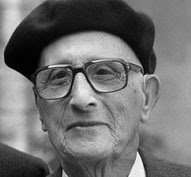 a slim, early volume by Eco on aesthetics in the Middle Ages and, I just decided today when I lay down for a nap, Merton's The Sign of Jonas, which I probably haven't read since I was 17 or 18.
Now, why there is no fiction in there, either as a primary reading or as 'relief,' is that I can't do with a novel what I can do with poetry or non-fiction, which is to say stop and start wherever and whenever I please. In fact, even with language textbooks, as long as you have a good base already you can go forward and backward, practicing just the dative case one day and the past dubitative-abilitative mood the next. A good novel consumes the reader to the exclusion of all other books until it is sated; a bad one merely bores and is tossed away - and then the reader is back where he started in either case.
And at the moment I am enjoying this profligacy, so no novel right now.
But back to Merton.
 As I said, this particular book I haven't read in many years. It is five years of Merton's daily journal early in his vocation just before and after his ordination, an it was interesting (in a manner now completely unshocking to me) that I picked it today, as just last night I had written to a friend just starting a blog how sometimes I become frustrated with what I would call the 'definitional' issues of the medium. It is not at all a diary, though a personal blog does, or can, share attributes with that form. It's not the same as even a completely open op-ed column, since if the blog is truly non-commercial/personal, the sense of writing for/to one's audience is naturally different - if the writer even considers the issue of audience at all.
For me, certain topics seem clearly too boring to subject others to (not that I don't sometimes ignore this concern altogether), some too emotional to discuss in a (potentially, at least) public space, some too heavy or controversial to feel right mixing them in with postings about shoe organization and exboyfriends' irksome proclivities. Then, too, there is the idea of coherence of the whole, coherence of voice, something which has bedeviled me to the point of not posting anything at different times, because the stuff I was writing about wasn't 'bloggy' enough in my view. I have no idea how to address this, because worrying about it overmuch defeats one of the points of personal weblogs, which is that sense of freedom the medium shares with diaries, but which distinguishes it from even the most unrestricted columns in the paid world. Minimally, a columnist would have to find a way to unify that week's concern with the voice and the stance that come through the column as a whole. More typically, the subject itself would have to appear clearly congruent with the other topics in the series.
But back to me.
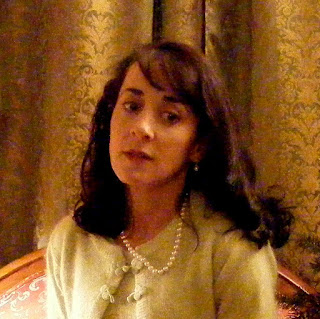
I'm not a columnist (despite any sartorial similarity to Peggy Noonan in the above; I'm just running out of photos and my mother insists upon 'seeing your pretty face' every so often). Any sense of wishing a consistent voice or outlook or stance is my own preoccupation, comes from my own meditations on why anyone would be writing one of these things in the first place, and a desire to make it 'earn its keep.' The reason I started to write a blog was as a discipline, to make myself write regularly. The reason I was told to write a blog is the same as with anyone who has demonstrated evidence of writing ability: people tell you that since you can write, you should write; in fact, you should 'be a writer.'
Which, as those less reactionary among us are all too aware, is something altogether different than merely being able to write. And it is not solely a matter of discipline: being able to expatiate endlessly on the differential merits of various wardrobe-organizational systems is not the same as being able to write 500 pages on the social history of wardrobe-organizing systems, nor certainly 500 more on the history of railroad building in Japanese-occupied Manchuria.
And yet there is overlap: those who taught themselves to read, those who spent their childhoods in books, read books about books and books about words, those to whom language comes easily and those for whom a well-turned description is as alluring as a well-turned ankle, clearly have much in common with those who spend lifetimes capturing their own or others' lifetimes in print. Even if not Writers, they can certainly be called writers, without any need of scare quotes to emphasize their non-professional status. I look at it this way: my exhusband was and is a musician. He can do other jobs, he has done other jobs; like all of us, he has various different abilities. But his gifts as a musician are so clear, so profound, that they are, I would argue, constitutive of who he is, his self, his way of being in the world, such that one reveals much of substance to say about him 'he is a musician,' the copula there doing what it is has the power to do but seldom does.
But back to Merton.
As I said above, I enjoy being able to open books and start reading at whatever page I happen to land on. It doesn't always work so well while in school, I admit, but I'm not in school, and I like the way it works much of the rest of the time. In cases of postmodern history and historiography, it works very, very well, I must say, as I get to miss the introduction wherein the same list of the same secondary sources is tiresomely trotted out to ensure the reader understands just how thoroughgoingly postmodern the coming exegesis of trends in kitchen appliances in postwar Bavaria is going to be. I like skipping that bit and getting right to the riveting parts about the evolution in backsplashes and cupboard-pulls.
Anyway, not that Merton has exhausting prefaces, or cites much Gramsci, Derrida, Butler, or Homi Bhabha, but part of my enjoyment in reading this way, at least with certain types of material, is to imagine why I'm being given what I'm being given right then. It's often shocking, and always productive. I tuned in when Merton has just become a subdeacon, and I had to go back a few pages to find out what he was referencing when he referenced his current experience with Sertillanges' La Vie Intellectuelle. It turns out (a few pages earlier, which is one of the downsides of this reading method) that he received a copy during this time, when he was really struggling with writing what became The Ascent to Truth. He got stuck a lot, he wrote a good deal he was completely unhappy with, but spending time with Sertillange had on him 'the effect that Dale Carnegie's advice might have had on a despondent salesman.'
Now, I've loved Merton forever. He taught me invaluable things, led me in all sorts of meaningful directions, and I have to say a good deal of that was due to the personal tone of much of what he wrote. I do love struggling with prickly authors and thorny texts at times, and in my weaker moments I can take great delight in the recondite and the recherché, but we're all human, and it is only the deeply, universally human expressed in the works of great novelists, poets, memoirists, and diarists that speaks directly to the heart, and results in a staggering convincement of the soul, rather than a gradual assent via logic.
***Because this is already too long for a blog posting, I'm going to leave this with 'logic' as the last word in the body, since that is surely a one-off, and I should savor it!
To begin, here are some of the books I'm reading right now: Chesterton's Aquinas bio in a double volume with his Francis, Josipovici's On Trust: Art and the Temptation of Suspicion, Rancière's Hatred of Democracy, the Dalai Lama's The Good Heart, Jean-Luc Nancy's Dis-Enclosure: the Deconstruction of Christianity, and Ratzinger's Truth and Tolerance: Christian Belief and World Religions. Apart from the Chesterton, which is very chatty, 'personable,' and inviting, the rest are more, well, I take time off. With different things: with the Chesterton, with poetry (a lot of Jorge Guillén at the moment),
 a slim, early volume by Eco on aesthetics in the Middle Ages and, I just decided today when I lay down for a nap, Merton's The Sign of Jonas, which I probably haven't read since I was 17 or 18.
Now, why there is no fiction in there, either as a primary reading or as 'relief,' is that I can't do with a novel what I can do with poetry or non-fiction, which is to say stop and start wherever and whenever I please. In fact, even with language textbooks, as long as you have a good base already you can go forward and backward, practicing just the dative case one day and the past dubitative-abilitative mood the next. A good novel consumes the reader to the exclusion of all other books until it is sated; a bad one merely bores and is tossed away - and then the reader is back where he started in either case.
And at the moment I am enjoying this profligacy, so no novel right now.
But back to Merton.
 As I said, this particular book I haven't read in many years. It is five years of Merton's daily journal early in his vocation just before and after his ordination, an it was interesting (in a manner now completely unshocking to me) that I picked it today, as just last night I had written to a friend just starting a blog how sometimes I become frustrated with what I would call the 'definitional' issues of the medium. It is not at all a diary, though a personal blog does, or can, share attributes with that form. It's not the same as even a completely open op-ed column, since if the blog is truly non-commercial/personal, the sense of writing for/to one's audience is naturally different - if the writer even considers the issue of audience at all.
For me, certain topics seem clearly too boring to subject others to (not that I don't sometimes ignore this concern altogether), some too emotional to discuss in a (potentially, at least) public space, some too heavy or controversial to feel right mixing them in with postings about shoe organization and exboyfriends' irksome proclivities. Then, too, there is the idea of coherence of the whole, coherence of voice, something which has bedeviled me to the point of not posting anything at different times, because the stuff I was writing about wasn't 'bloggy' enough in my view. I have no idea how to address this, because worrying about it overmuch defeats one of the points of personal weblogs, which is that sense of freedom the medium shares with diaries, but which distinguishes it from even the most unrestricted columns in the paid world. Minimally, a columnist would have to find a way to unify that week's concern with the voice and the stance that come through the column as a whole. More typically, the subject itself would have to appear clearly congruent with the other topics in the series.
But back to me.

I'm not a columnist (despite any sartorial similarity to Peggy Noonan in the above; I'm just running out of photos and my mother insists upon 'seeing your pretty face' every so often). Any sense of wishing a consistent voice or outlook or stance is my own preoccupation, comes from my own meditations on why anyone would be writing one of these things in the first place, and a desire to make it 'earn its keep.' The reason I started to write a blog was as a discipline, to make myself write regularly. The reason I was told to write a blog is the same as with anyone who has demonstrated evidence of writing ability: people tell you that since you can write, you should write; in fact, you should 'be a writer.'
Which, as those less reactionary among us are all too aware, is something altogether different than merely being able to write. And it is not solely a matter of discipline: being able to expatiate endlessly on the differential merits of various wardrobe-organizational systems is not the same as being able to write 500 pages on the social history of wardrobe-organizing systems, nor certainly 500 more on the history of railroad building in Japanese-occupied Manchuria.
And yet there is overlap: those who taught themselves to read, those who spent their childhoods in books, read books about books and books about words, those to whom language comes easily and those for whom a well-turned description is as alluring as a well-turned ankle, clearly have much in common with those who spend lifetimes capturing their own or others' lifetimes in print. Even if not Writers, they can certainly be called writers, without any need of scare quotes to emphasize their non-professional status. I look at it this way: my exhusband was and is a musician. He can do other jobs, he has done other jobs; like all of us, he has various different abilities. But his gifts as a musician are so clear, so profound, that they are, I would argue, constitutive of who he is, his self, his way of being in the world, such that one reveals much of substance to say about him 'he is a musician,' the copula there doing what it is has the power to do but seldom does.
But back to Merton.
As I said above, I enjoy being able to open books and start reading at whatever page I happen to land on. It doesn't always work so well while in school, I admit, but I'm not in school, and I like the way it works much of the rest of the time. In cases of postmodern history and historiography, it works very, very well, I must say, as I get to miss the introduction wherein the same list of the same secondary sources is tiresomely trotted out to ensure the reader understands just how thoroughgoingly postmodern the coming exegesis of trends in kitchen appliances in postwar Bavaria is going to be. I like skipping that bit and getting right to the riveting parts about the evolution in backsplashes and cupboard-pulls.
Anyway, not that Merton has exhausting prefaces, or cites much Gramsci, Derrida, Butler, or Homi Bhabha, but part of my enjoyment in reading this way, at least with certain types of material, is to imagine why I'm being given what I'm being given right then. It's often shocking, and always productive. I tuned in when Merton has just become a subdeacon, and I had to go back a few pages to find out what he was referencing when he referenced his current experience with Sertillanges' La Vie Intellectuelle. It turns out (a few pages earlier, which is one of the downsides of this reading method) that he received a copy during this time, when he was really struggling with writing what became The Ascent to Truth. He got stuck a lot, he wrote a good deal he was completely unhappy with, but spending time with Sertillange had on him 'the effect that Dale Carnegie's advice might have had on a despondent salesman.'
Now, I've loved Merton forever. He taught me invaluable things, led me in all sorts of meaningful directions, and I have to say a good deal of that was due to the personal tone of much of what he wrote. I do love struggling with prickly authors and thorny texts at times, and in my weaker moments I can take great delight in the recondite and the recherché, but we're all human, and it is only the deeply, universally human expressed in the works of great novelists, poets, memoirists, and diarists that speaks directly to the heart, and results in a staggering convincement of the soul, rather than a gradual assent via logic.
***Because this is already too long for a blog posting, I'm going to leave this with 'logic' as the last word in the body, since that is surely a one-off, and I should savor it!
Friday, June 27, 2008
'la grandeur et la vérité' - et l'absurde
Hmmm. I don't quite know what to make of this. And it's not the Philipponnat I'm sipping, either. I'd show you a picture, but the bottle is lodged between the hideous plastic vat of palm oil, a candle holder that belongs by the other ones nestled between the jungle and the television, a box of wire nails and a resin tincture I'm trying to remember to agitate. Not to mention the emergency extra cellphone that, despite its life of idleness, nonetheless manages to run out of steam every so often and emit a desperate chirping sound audible from the car. Which I'm charging.
So.
I gave a teensy decant of the in-process 'Catherine of Siena' scent to the dear and impressive lady I made it for, with a printout of its description and intent. (With ample caveats as to its need of more time and tinkering.)
But that's not my point.
My point is that I had not remembered that the French Resistance fighter, and Nazi prisoner, Fr. Joseph Marie Perrin, who was basically Simone Weil's guide into Catholicism, was a - yes, okay, it's obvious by now - Dominican. They met in Marseilles, had a long and close interaction in person and in letters -- and to me, I guess, the Little Manual of Perfect Prayer and Adoration - written, it should be added, during the occupation of France and his activities in the Resistance - seems to have been too envelopingly universal/catholic, as were what few of his thousand other works I've read, for one to be able readily to recall the author's particular/'partisan' Catholic spirituality. Simone Weil - who bridges the gap between fellow École Normale Supérieure brooding Gallic leftist alums like the preceding post's Sartre et tchums and the equally august roll-call of modern-day thinky Catholic converts like Chesterton, Merton, Jacques & Raissa Maritain, Dorothy Day, Claire Booth Luce, Avery Dulles, Graham Green, Brubeck (yes, Brubeck!), Gerard Manley Hopkins, Malcolm Muggeridge (yay! Punch! I never get Michael Bywater in here anymore) and even newly-minted Maronite, WSJ bigwig Peggy Noonan - was roped by a Dominican.
Anyway, since everything is strange and confluent and doubly-signified, and I have no hope of cohesion in this post, in 1946 Vogue magazine ran a spread called 'Portraits of Paris' of photographs by Messrs. Sartre and Camus. On the one hand, I admit this seems a bit like Wittgenstein offering up prose-poems about the rights or wrongs of the New Look; on the other, I do understand that these days Derrida or at least Baudrillard is invoked every time there is a change in heel shape or skirt length, and that every fashion magazine no less than every home-decorating periodical considers itself 'cutting edge. ' Still, it is a bit shocking considering the state of magazine journalism today, and I like to imagine Elle commissioning Ismael Kadare to do a photographic series on 'Sidewalks of Tirana,' which he fulfills with portraits of improvisational Rom 'habitation-artists,' impromptu scenes of trafficked 'sex artists,' and a 'location shoot' of 'hunger artists' in a car trunk lumbering across the immeasurable divide between Nogales and Green Valley.
Undoubtedly at this point that IS the Philipponnat talking, as it's taken me about an hour to write this that in any way makes sense even to me.
So.
I gave a teensy decant of the in-process 'Catherine of Siena' scent to the dear and impressive lady I made it for, with a printout of its description and intent. (With ample caveats as to its need of more time and tinkering.)
But that's not my point.
My point is that I had not remembered that the French Resistance fighter, and Nazi prisoner, Fr. Joseph Marie Perrin, who was basically Simone Weil's guide into Catholicism, was a - yes, okay, it's obvious by now - Dominican. They met in Marseilles, had a long and close interaction in person and in letters -- and to me, I guess, the Little Manual of Perfect Prayer and Adoration - written, it should be added, during the occupation of France and his activities in the Resistance - seems to have been too envelopingly universal/catholic, as were what few of his thousand other works I've read, for one to be able readily to recall the author's particular/'partisan' Catholic spirituality. Simone Weil - who bridges the gap between fellow École Normale Supérieure brooding Gallic leftist alums like the preceding post's Sartre et tchums and the equally august roll-call of modern-day thinky Catholic converts like Chesterton, Merton, Jacques & Raissa Maritain, Dorothy Day, Claire Booth Luce, Avery Dulles, Graham Green, Brubeck (yes, Brubeck!), Gerard Manley Hopkins, Malcolm Muggeridge (yay! Punch! I never get Michael Bywater in here anymore) and even newly-minted Maronite, WSJ bigwig Peggy Noonan - was roped by a Dominican.
Anyway, since everything is strange and confluent and doubly-signified, and I have no hope of cohesion in this post, in 1946 Vogue magazine ran a spread called 'Portraits of Paris' of photographs by Messrs. Sartre and Camus. On the one hand, I admit this seems a bit like Wittgenstein offering up prose-poems about the rights or wrongs of the New Look; on the other, I do understand that these days Derrida or at least Baudrillard is invoked every time there is a change in heel shape or skirt length, and that every fashion magazine no less than every home-decorating periodical considers itself 'cutting edge. ' Still, it is a bit shocking considering the state of magazine journalism today, and I like to imagine Elle commissioning Ismael Kadare to do a photographic series on 'Sidewalks of Tirana,' which he fulfills with portraits of improvisational Rom 'habitation-artists,' impromptu scenes of trafficked 'sex artists,' and a 'location shoot' of 'hunger artists' in a car trunk lumbering across the immeasurable divide between Nogales and Green Valley.
Undoubtedly at this point that IS the Philipponnat talking, as it's taken me about an hour to write this that in any way makes sense even to me.
Subscribe to:
Posts (Atom)