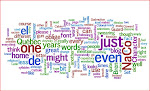
On Got Medieval, there was a 'contest' back in July to see what seven words readers would come up with to describe the Middle Ages. The origin of the idea, which is described here, was a disheartening day in class when the new crop of students was asked to free-associate their way to a picture of the era. They came up with 'knights, knights, knights,' 'other knights,' and 'things about knights,' basically, and the writer of the blog uses the story on social occasions to set others at ease when they start to apologize, upon hearing his profession, for their lack of knowledge about Ye Olde Medieval Tymes.
I don't think it's particularly odd that nobody here knows anything about the Middle Ages, because I would imagine most people at cocktail parties would be equally hard pressed to come up with much about the Renaissance, or the Enlightenment. (...Uh, Luther, yeah, Martin Luther!, em, art! there was lots and lots of art! The Crusades! no, em, no, those big skirts with the hoops in them? no, wait.) I may sound more generally pessimistic than is warranted, perhaps, but I will give him this: I do think the Middle Ages probably are a more complete void in most people's understanding of history than are other periods. Before reading his account, though, I hadn't really thought about how thoroughly jousting, heraldry, and ladies-in-waiting with long pointy hats encapsulated the era for most.
The lazy explanation is that it's down to The Media, since any film set in that time tends to have Chain Mail in the leading role, with horses, maidens, and scrofulous serfs filling in the gaps. But if after watching Le Weekend I don't feel I have a complete understanding of 20th-century French history, is that really Godard's fault?
Still, the reality is that most Americans think that, like, nothing happened in Western civ for ten centuries or so. Other than the Black Plague and jousting, that is. Plato or somebody died, and then everyone went to sleep - in really dirty clothes - until da Vinci, or maybe Martin Luther woke them up. (At which time, of course, they then wore hoop skirts and codpieces and really ugly hats with buckles on them and everyone had syphilis.)
But, although the whole thing makes me sad, as does the idea that his (very hilarious) blog gets lots of hits from people looking for sexy chainmail pictures, I like to think of what my list would be, and it was fun to read other lists, because it shows how unique our own perspectives or prejudices are. I would probably put:
-neo-Platonism
-monasticism/orders
-Norman Conquest
-Sacking of Constantinople
-East/West
-books
-The Church
There's repetition, and there's no form of 'music,' or 'law' or even 'Law,' but I think if you take what themes I do have, you end up with those anyway, and much more besides. I suppose you could just say 'The Church' and come up with my whole list incidentally, not to mention unicorns and guys in chainmail, but with a book-banning vice-presidential candidate, I can only muster so much self-loathing.
Showing posts with label reading. Show all posts
Showing posts with label reading. Show all posts
Monday, September 8, 2008


Sunday, August 17, 2008
Mud Floors, Tibetan Sephardim, and Tuscany in SE Jung Guo
In other news, I had an absolutely lovely conversation tonight about (what else?) theology (with a friend soon to depart for another hemisphere.) He gave me a book which was absolutely perfect in many ways, not least of which is that it is entirely relevant to a rant I have not yet given into, since I'm terribly lazy and would have to buy another little easel in order to have three books propped up around the little laptop in order satisfyingly to vent my spleen.
But, now I will feel impelled to buy my little easel (is it truly an easel? I don't think so; I don't know what they are called, but people who collect things with cats on them use them to display plates with either state insignias or details of Botticelli's greatest hits printed in Fujian) and tell you what the Dalai Lama had to say about 'Tibetan Buddhists' raised in Farmington in a John Main Seminar in the '80s or '90s. The Lama, not the Farmingtonians. I don't know that many were raised in a John Main Seminar. But I am open to possibilities. Not to mention, in the distant future, good nutrition.
In the meantime (not to hold all 7.3 of you in too-great suspense), here is how John Dunne, who is neither John Dear nor that John Donne, weighed in briefly - and similarly - on the issue: 'I think of a Sufi sheik I met on the Mount of Olives in Jerusalem who told me and the two young Israeli women who were with me, 'Go deep in your own religion.' Okay, fine, I already know which book I'm trading him. But God bless those Sufis, eh? Here is the spiritual work one Naqshbandi master gave to an aspirant: Pray nothing, think nothing, say nothing, but 'Oh, God,' all day every day. When the disciple came back saying he had succeeded in that task, the teacher told him no longer to speak it, but to breathe the prayer in his thoughts, to think and feel nothing else but 'Oh, God; Oh, God,' all day. After internalizing this, after training his spirit to unceasing dhikr, one day a loose beam fell from the roof of his house onto the pupil's head. The blood that dropped to the ground spelled Allah on the mud floor.
Sunday, July 27, 2008
The Sickness Unto Death (Not.)
And, lest you all think I am so holy and attuned to the wishes of my brethren that I am going to follow this gentleman's urging and end my life because I don't like Billy Joel, here is my reader's guide to the personal weblog, or at least to this one, and here is where I (uncharitably) address prospective and actual readers' concerns over the quality and content of this thing. I know I'm not Proust, but unless you have the very worst teacher in the world and this blog is assigned reading, it's kind of unskillful to waste time pouring out hatred when you can just click a button and go elsewhere. It does seem a bit silly to read stuff you hate, doesn't it?
'Who is she that looketh forth as the morning,
fair as the moon, clear as the sun, terrible as an army with banners?' Well, let me assure you: it's not me. My head is muddy as the Okefenokee, vague as a valley wrapped in fog, and imposing as a one-man marching band.
To wit: I found that Schimmel book today, anyway. It was cunningly disguised as a book, on the bookshelf, between a teenytiny Zizek volume and a very crappy Romanian textbook. I looked three times yesterday at that bookshelf and didn't see it. This is made all the odder by the fact that the Zizek book is so little that I could see both the spine and a good part of the front cover of the one I was looking for/at. And I'm not at all surprised anymore that that should occur on the same day that I happen to write stuff about seeing-but-not-seeing.

Anyway, here are the two lines with which Mevlana encapsulated his whole life:
'And the result is not more than these three words:
I burnt, and burnt, and burnt.'
Tuesday, July 22, 2008
'There is something in humility
which strangely exalts the heart.' -St. Augustine
Just to bring humility, tolerance, and the common limits of our human understanding more fully into this rant about arrogance, bigotry, and factionalism, here is a quote about science and religion from turn-of-the(other)-century Muslim scholar Mustafa al-Maraghi. I want to use a Muslim because about as many Christians as atheists consider them unschooled and indelicate of thought, and also because the Muslim's relationship to the Qur'an as revealed rather than written, unchanging, untranslatable, and truly as the Word Inlibrate, is of a quite different order from other traditions' belief in and veneration for their own holy books. (In other words, I guess I conceive of this as the strong form of the argument to which other traditions could likewise accede in moderated form ?)
'True religion cannot conflict with truth, and when we are positively convinced of the truth of any scientific remark which seems to be incompatible with Islam, this is only because we do not understand correctly the Qur'an and the traditions. In our religion, we possess a universal teaching which declares that, when an apodeictic truth contradicts a revealed text, we have to interpret the text allegorically.'
Such a stance wisely refuses to conflate a holy book with a science text, to demand from one what it can never give and what, moreover, the other was explicitly designed to provide. It also places what might be an unsettling responsibility on the reader to read his book as well as the natural world carefully -- but this should be unsettling only if you find using rationality in your pursuit of wisdom and truth ignoble. For me, it points again to the need to recognize our limitations: there is much that each of us will never understand in this lifetime. Even if you don't believe there is one who is omniscient, it is pretty clear that humans are not. And a stinky-type atheist might do well to recognize that he is as limited in his understand as both the stinky and the thinky believers.
Subscribe to:
Posts (Atom)