Showing posts with label poetry. Show all posts

Friday, October 3, 2008

Politics for Grownups


This autumn night
Dawns, yet unaware
An insect sings on-
Just as am I,
Is he sunk in sadness?

Another thing that struck me in the brief Jon Stewart-Peggy Noonan interview was Mr. Stewart's visceral frustration at politicians' meretricious use of slogans, catch-words, and symbols as stand-ins for defined terms, argument, truth, or clarity. I believe two examples he gave were Conservative pack-mules 'legislating from the bench' and 'strict constructionist.' These could mean all sorts of things, but in practice are code for rather specific anathemas and goals. As Stewart pointed out, rather than risk alienating some groups of voters by railing against gay marriage, a candidate can remain in good stead with both his more Conservative core and moderate voters by espousing his distaste for the first and his fondness for the latter. A major point in Noonan's book is that the bulk of the American populace, regardless of political views, is as angry at being talked down to in this fashion as is Stewart.

And I think this is part of Sarah Palin's appeal. Unlike 'managed' and 'handled' long-time 'insiders,' she says what she thinks. She may get flustered, she may not always make sense, but until recently, when her logorrhea and lack of self-censorship became blunted by those same managers and handlers, she could be relied upon at least part of the time to say what she meant. I don't mean to say that she any more than the rest of us always acted in accord with her values, but she was largely upfront about them and the extent to which they informed her decisions. Nor do I mean that she was entirely unsophisticated politically or did not sometimes choose her public words judiciously, but her back-country candor, her physical expressiveness, and her fitted pink jackets undoubtedly do seem fresh, and more 'real' than the blandly and painstakingly contrived 'brands' of other national figures.

Perhaps tonight in the VP debate, with Palin's recent intensive training and the 90-second limit on responses, she will say as little of what she means as anyone else. She may even have a new more 'professional' haircut and style. Perhaps those ghastly faltering interviews with their exaggerated expressions and gestures and the incoherent strings of 'talking points' were a necessary intermediary step between her original shoot-from-the-hip/ take-no-prisoners/'Joe-Six-Pack' upfrontness, and she will now be ready to respond to any and all questions in a perfectly-clear and meaning-bereft coherent iteration of the same populist 'talking points' minus the nose-wiggle and the finger-licking, but with added 'y'alls' and more consistently dropped terminal G's. Should she remain on the national stage, whether the point is reached tonight or later, she will eventually be able to say as little in as many words as anyone else -- but succeed in doing so with appropriate punctuation and breath stops.

I enjoy subtlety in the right places as much as the next person. But this isn't Edo Japan, and foreign policy can hardly be confused with a lone heron on a foggy marsh. Evocation is not called for: clarity and direct speech are. I don't want synechdoche or stand-ins; I want facts, actual positions, and exposition! It doesn't matter to me in the slightest who pulled whom up by whose bootstraps -- or whether there were bootstraps involved in anyone's 'narrative' at all. I am not a medieval Japanese, and neither are you, so a symbol-ridden terse tanka is of no use to me whatever in parsing your actual stance on a specific issue. God help me, I, as much as anyone else, support 'freedom,' 'democracy,' 'democratic values,' 'rights,' and wish the best for the 'American taxpayer' and the 'American Dream' - but from my espousal of these abstract concepts here you still have no idea in what way I believe they are to be defined, pursued, implemented, or served. Like a bugling stag weary in the browned bush-clover, or a departing goose calling a distant farewell, the autumn mountains echo with my mournful cry: Say something, one of you, any of you, that isn't fully, patently, abhorrently inane!

Thursday, September 18, 2008

I Can't Stop!


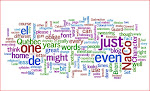
Again from http://wordle.net, this is a word cloud for Seamus Heaney's 'Death of a Naturalist.'*

*Eh, and another one, too.**

**(Em. Look? FROGS!!??)

Thursday, July 24, 2008

Coherent Narratives (in Life, friends, not here.)

Caution: This entry says nothing of consequence about anything of consequence. Things of substance, written somewhat coherently, are elsewhere; skip ahead or back if you want one of those. If you like your logic loose, loopy, and slapdash, read on.

...At any rate, Dominicans being everywhere does not mitigate the fact that the last place I would expect to find one in my blog is IN-in my blog, but it seems you can't escape them with anything near the sort of regularity and indeed predictability with which we routinely fail to bump into Cistercians at the Circle K (do Circle K's still exist? I used to buy my Now 'n' Laters there, and once got a Bit o' Honey with a mosquito half-embedded in the top), but Fr. Fones, of prudential-judgment-and-politics, whom/which you'll remember from a few posts back, left a lovely comment about one of my posts about poverty.

But that's not what I'm getting to. Although, if only more people would comment, that would be great. Although, 'more people commenting' does presuppose someone is reading, and I think that is where the whole idea sort of loses a bit of steam.

At any rate.

Unlike a journal entry or emails, I try to afford those nonexistent readers of my blog the courtesy not only of a concluding sentence, but often a good title, too, when something strikes me. This allows me to believe, by framing the post so nicely, that there is indeed a middle thus framed, leaving me free of guilt and able to carry on with outfit-coordination for another day.

However.

Dominicans were called sometimes, by some, in certain parts, the Black Friars, or the Blackfriars, due, unsurprisingly, to their wearing of a black outergarment. And Shakespeare's (well, partly Shakespeare's) Blackfriars Theatre in London is on the site of a 13th-century Dominican monastery which, after Henry VIII's dissolution of the monasteries in England, France, and Wales in the 16th century, had very few friars of any color left in it.

That fact notwithstanding.

I was trying to trying to come up with something vaguely amusing for the title here. Now, stepping up another century, the Black Robes were the Jesuits, the Sulpicians, and the Récollets in New France. But mostly the Jesuits. I could use 'black robe' if I gave it a twist. But I lacked a twist.

So at this point (in the naming of one stupid blog entry!) we have: Dominicans, Shakespeare, England, egomaniacal homicidal kings, Québec, Jesuits, and the color black. Which is a lot of things, but not much to work with. So I looked up stuff on the author of Black Robe, the Belfast native Brian Moore, who also wrote Judith Hearne, which became The Lonely Passion of Judith Hearne with Maggie Smith and Bob Hoskins, which I did not see and have nothing funny to say about.

But Black Robe also became a movie about two centuries after bad King Henry, when in 1991 it was directed by Bruce Beresford, who had previously directed Driving Miss Daisy, which is about slow driving and a slow-building relationship. Black Robe happily retained in film form many of the difficult moral issues of the book. And it had Lothaire Bluteau, of Jesus of Montréal fame, in the lead as Fr. Laforgue, whose deep faith leads him to great courage. It's one of my favorite films, and is at times unbearably beautiful and at others unbearably disturbing.

Which of course has nothing to do with Dominicans. Inconveniently.

However, it turns out that that when he died in 1999 (in Malibu, which is far, far away from Shakespeare and the Algonquins of either 1600s-Québec or 1920s-New-York-City type), Moore was working on a novel based on the life of Arthur Rimbaud, while in 1984 his screenplay for Simone de Beauvoir's (a thinky, ethical risking-her-life-for-the-good-of-others atheist if ever there were one) Le Sang des Autres, her novel about the French Resistance, was made into an American film by French director Claude Chabrol. And is said to be ungreat.

But to go back a century now, Arthur Rimbaud, while probably more anti-religion than either Mr. Moore or Mme. de Beauvoir, and not one to trouble himself overmuch with ethical problems - from gun-running (and some biographers say slave-running, as well) to stealing people's husbands - was, despite all that and his early death and even earlier renunciation of poetry-writing (at 20), one of the most influential poets in modern times.

Which brings us to me, as the stupid URL of this blog, oisive-vitesse (which only exists because I couldn't get vifargent) (who only has one post, by the way, from 2004), which is a very stupid pun on a very famous Rimbaud poem and also has to do with my driving style, which could very well be characterized (by a gentle person, charitable of heart and tolerant by nature) as 'relaxed,' or 'easy-going.'

The line I bastardized is from the poem 'La chanson de la plus haute tour,' and goes something like this:

'Oisive jeunesse
A tout asservie,

Par délicatesse
J'ai perdue ma vie.

Ah! Que le temps viennent

Où les coeurs s'éprennent.'

And likewise something like this:

'Idle youth
Enslaved to everything,
Through sensitivity

I have wasted my life.
Oh! Let the time come
When hearts open up.'


Which is ungraceful, but there you go. You get what you pay for. Anyway, 'oisive' means lazy, even though birds are anything but. Sort of like Canadian Smarties, which are no longer made by Rowntree and are basically sweeter M & M's, with nothing acidic or 'smarty' about them. And I'm not a lazy driver, but I'm sure it looks like either the car or I must be at times. Still, I have remembered this stanza always (I have no idea what the rest of the poem says) not just because I like the redemptive hope of the last line, not if such a time comes, but when (literally 'where,' but we'll not trouble ourselves excessively with that for now; the certainty holds either way), but also because it can seem sometimes that all our youthful passion for fifty thousand different things simultaneously could have been wasted.

I don't think it is. I think we take it with us. I think perhaps one has to reach a certain age to be able to look back and see just how shockingly coherent the narrative of our lives is. Maybe the aggregate of facts simply has to be large enough to let the pattern emerge. All my childhood obsessions I still have, if sometimes in mitigated form. All my tastes and predilections (except those for footed pjyamas and tea with sugar) remain about the same, with some accommodation for education and fine-tuning (I no longer want literally to live in a genie bottle; I'm content to hang a Moroccan lantern inside, and string some curtains around, my bateau ivre of a bed and call it done), and I'm most satisfied or content when I have some version of the things that made me happiest as a child and adolescent - down to the bottle full of buttons I spent countless hours sorting and resorting on my grandmother's floor. I don't think it's wasted; I think we just sometimes take too long to realize what it taught us about ourselves.

Saturday, June 14, 2008

'And did the Countenance Divine

Shine forth upon our clouded hills?'

Thursday, May 29, 2008

And From Your Lips She Drew a Hallelujah?

Today so far there was no random reading. I woke up, drank some Diet Coke, checked my email and could think of nothing but Lorca's 'Thamar y Amnon' before work. I just had repeating in my head the ending lines:

'Y cuando los cuatro cascos
eran cuatro resonancias,
David con unas tijeras
cortó las cuerdas del arpa.'


Well, it is a haunting finale, with the alliterative, diminishing hoofbeat of cuando cuatro cascos, and I think it's a masterful, powerful po
em, but the last two lines always really get to me. In the poem, Lorca weaves the story of Amnon's rape of his half-sister Thamar together with references to David's sins and other earthly repercussions for the house of David. Everything happens together, and Thamar is Bathsheba bathing on the rooftop, while Absalom murders Amnon, the arrows killing Urias shoot from David's own palace walls and Amnon's lust murders his sister's innocence. Wanting to read it and being lazy, and realizing that moving my mouse is easier than moving my body, I just looked the poem up online. By putting in 'David unas tijeras' (in hopes of getting a page with the entire poem, instead of a site only about the poem) in the search form, I got this site, and got, along with the poem, a commentary that included this: '

'This
is a highly problematic poem, for what Garcia Lorca does here, I argue, is to present us with a sympathetic view of Amnón, that it was his overpowering sexual desire that caused him to rape Thamar. Federico is not the first or last person to argue that sexuality has a dark side, that it can and will take on a barbarous, even suicidal persona; however, by entering into the debate by claiming Amnón just couldn't "help himself," that Thamar's own beauty "forced" her half-brother to violate her, Lorca is simply presenting a tired old chestnut that has been used since time-immortal; in short, that there is no such thing as free will, that men are simply slaves to their own libidos.'

So I felt compelled to write about it, because I don't think Lorca was doing that at all. Amnon is portrayed as lusting heavily - and as (perhaps overdramatically, or perhaps genuinely, in fear of God and more divine retribution on his clan) asking for some kind of relief from it.

"Cut out my eyes, Thamar,

with your fixed dawn.

The threads of my blood

weave ruffles on your dress."

There are two separate issues: temptation and sin. Lorca was well aware of the distance between the two, and the lack of causal relationship. In 'Lucia Martinez' from three years earlier, the poet's predatory narrator baldly describes his intent:

'Here I am, Lucia Martinez.
I've come to devour your mouth
And drag you off by the hair
into the seashells of daybreak'

and his chilling, egoistic rationale of the act he intends to commit:

'because I want to and I can.'

And, the story of the later poem - whether David's, the House of David's, or solely Amnon's, has a vastly different meaning if David or Amnon or Absalom does not
choose to sin. Canonically, the story goes that the Christian God will not allow us to be tempted more than we can resist. Literarily, not only is David the most complex and most fully-developed character in the Bible (and the 'first human being in world literature' according to Baruch Halpern's David's Secret Demons: Messiah, Murderer, Traitor, King), but this poem would be about something else altogether had it simply been foreordained, destiny, or some law of nature (or human nature) that Amnon would rape Thamar. David would not be the same rich character if he were simply forced to do all the great good and bad things he did, and if Shakespeare likewise had written about automatons instead of tormented heroes in his tragedies, would anyone bother reading (let alone memorizing, filming, studying, restaging, and continuing to tease out new meanings from) him all these centuries?

Yes, Amnon was overcome by temptation. That is the point. Temptation as a plot development, spiritual crisis, or moment of growth or decline has no content if it is not hugely desirable. If I have no lust for money, offering me a million dollars to do something unsavory will not sway me: the payoff is insufficient to the task. In other words, I am not tempted. The plot, of the book or of my life, does not move forward. If I do not have lust for my sister, I will not rape her. And the gravest transgressions are not only the ones with the strongest pull but the ones both rationality and our conscience most vehemently cry out against. Our conscience, together with social mores, perhaps, and common sense, human decency, fear of secular or heavenly punishment, empathy, logic, and the like, urge us not to rob the bank, not to drive drunk, not to hit our spouse, and not to embezzle those funds it would be so hard to trace...

It is therefore a struggle, a meaningful struggle, as Amnon admitted when he suggested his eyes be cut out - before they wandered again in the poem down to the ruffles his lust was weaving on her dress. If he could only stop seeing, he reasons, could no longer behold Thamar's beauty, he would have no cause to sin. Amnon's 'threads of blood' directly recall Jesus' sweat of blood as He suffered - suffered temptation, more precisely
- in Gesthemani. He could have skipped his execution, and Amnon could have let go of Thamar's arm. I think Lorca evokes that familiar image and contrasts the brief moment Amnon meditates on what it is he is about to choose to do in order to make clear how deliberate the act is. Rather than struggle with the temptation for hours, turn to God, and ultimately accept His will as did Jesus in His torment, Amnon thinks about it for a few lines' worth of text, realizes the grave wrong of what he is considering - and decides that, all things considered, what he really wants right now is to rape his sister, not wait around for an angel to tell him he is strong. The 'hilos de sangre' linking Amnon and Christ serve to emphasize, not powerlessness, but how important it is to realize we do have a choice, and how serious and far-reaching the consequences can be, whether we resist or give in to temptation: in Christianity, it is through Christ's full acceptance in Gethsemani of his role as Savior on the Cross the next day that sinners like Amnon can find forgiveness and redemption.

In the Biblical story as in the poem, Thamar does not just resist physically, she remonstrates aloud with Amnon.

'Déjame tranquila, hermano.
Son tus besos en mi esp
alda
avispas y vientecillos
en doble enjambre de flautas.'


In the Lorca, she gives appeals to Amnon's empathy, while in the Biblical passages, she as well speaks of the moral, legal, and social aspects of the crime, and even tells Amnon if he were to get David's assent first then she could be his. But despite the fewer words of protest in the poem, surely the entreaty of his soon-to-be victim registered, along with the cries of his own conscience and common sense, in Amnon's mind. She even calls him brother, which should not merely evoke tenderness and kinship loyalty, but remind him that the crime he wants to commit is not merely rape and assault, but incest, as well.

David was chosen of God to found and lead the state of Israel, he wrote love songs to God, he sinned mightily (against Urias, Bathsheba, his people, his son, the people of Israel and, of course, against God, who is the only one we ever really sin against), repented mightily, and was forgiven due to his sincere repentance - but with Yahweh decreeing through the prophet Nathan that 'the sword will not depart' from his house, that evil will rise 'against you out of your own house,' that his own wives would be taken by others, and that the product of his adultery and the impetus for the murder to cover it up, his and Bathsheba's baby, would die. King David heartily, deeply, and sincerely regretted his actions, because he knew he could have made other choices and yet succumbed to temptation. So, too, did Amnon know his options; the charitable impulses and rationality he pushed to the back of his mind were brought to the forefront as Thamar pleaded with him while he pulled her to him. It wasn't fate, it wasn't biology; it was willful sin - with meaning and consequences as powerful as the temptation that urged it forward.

And David the psalmist, the rhapsodic lover of God, David with his unending faith and sincere contrition on a par with that of the Sufi's paradigmatic lover Iblis, Davidwho writes of the evil he has bred in the world,

'For I know my transgression,
and my sin is ever before me.
Against thee, thee only, have I sinned,
and done that which is evil in thy sight'


seeing the evil his son has done, which recapitulates his own, stops pleading,

'O Lord, open thou my lips,
and my mouth shall show forth thy
praise'

and instead in the poem abandons hope, abandons praise, and cuts the strings of his harp. David the shepherd with a flock in disarray, David the King of Israel and head of a murdering and incestuous royal family, David the giant-killer who finally tamed his own demons now watching in horror at his sons repeating his crimes and, in the end, David the rapturous Psalmist laying down his harp and songs of praise on hearing the hoofbeats of Amnon's departing horse. That's the part that sticks with me!


Here's the poem itself

Federico García Lorca

Thamar y Amnón

(pub. 1928)


La luna gira en el cielo
sobre las sierras sin agua
mientras el verano siembra
rumores de tigre y llama.
Por encima de los techos
nervios de metal sonaban.
Aire rizado venía
con los balidos de lana.
La sierra se ofrece llena
de heridas cicatrizadas,
o estremecida de agudos
cauterios de luces blancas.


Thamár estaba soñando
pájaros en su garganta
al son de panderos fríos
y cítaras enlunadas.
Su desnudo en el alero,
agudo norte de palma,
pide copos a su vientre
y granizo a sus espaldas.
Thamár estaba cantando
desnuda por la terraza.
Alrededor de sus pies,
cinco palomas heladas.
Amnón, delgado y concreto,
en la torre la miraba,
llenas las ingles de espuma
y oscilaciones la barba.
Su desnudo iluminado
se tendía en la terraza,
con un rumor entre dientes
de flecha recién clavada.
Amnón estaba mirando
la luna redonda y baja,
y vio en la luna los pechos
durísimos de su hermana.


Amnón a las tres y media
se tendió sobre la cama.
Toda la alcoba sufría
con sus ojos llenos de alas.
La luz, maciza, sepulta
pueblos en la arena parda,
o descubre transitorio
coral de rosas y dalias.
Linfa de pozo oprimida
brota silencio en las jarras.
En el musgo de los troncos
la cobra tendida canta.
Amnón gime por la tela
fresquísima de la cama.
Yedra del escalofrío
cubre su carne quemada.
Thamár entró silenciosa
en la alcoba silenciada,
color de vena y Danubio,
turbia de huellas lejanas.
Thamár, bórrame los ojos
con tu fija madrugada.
Mis hilos de sangre tejen
volantes sobre tu falda.
Déjame tranquila, hermano.
Son tus besos en mi espalda
avispas y vientecillos
en doble enjambre de flautas.
Thamár, en tus pechos altos
hay dos peces que me llaman,
y en las yemas de tus dedos
rumor de rosa encerrada.


Los cien caballos del rey
en el patio relinchaban.
Sol en cubos resistía
la delgadez de la parra.
Ya la coge del cabello,
ya la camisa le rasga.
Corales tibios dibujan
arroyos en rubio mapa.


¡Oh, qué gritos se sentían
por encima de las casas!
Qué espesura de puñales
y túnicas desgarradas.
Por las escaleras tristes
esclavos suben y bajan.
Émbolos y muslos juegan
bajo las nubes paradas.
Alrededor de Thamár
gritan vírgenes gitanas
y otras recogen las gotas
de su flor martirizada.
Paños blancos enrojecen
en las alcobas cerradas.
Rumores de tibia aurora
pámpanos y peces cambian.


Violador enfurecido,
Amnón huye con su jaca.
Negros le dirigen flechas
en los muros y atalayas.
Y cuando los cuatro cascos
eran cuatro resonancias,
David con unas tijeras cortó
las cuerdas del arpa.

Monday, December 17, 2007

Have You Seen This Inner Child?


I blame it on the Beats. That is unsurprising if you know me, as I blame most of everything on the Beats, from unpremeditated 'poems' of testosterone-ridden admiration hastily scribbled on cardboard bar coasters, to white men in dreadlocks, to women in public in sweatpants, to shorts on adults, sneakers as shoes, Dockers as dining attire, sexagenarian playboys, and restaurant place settings without knives. I blame blogs on the Beats, for heavens' sake: they are evidence of the now pandemic delusion that everyone, anyone, can write -- and therefore, what's more, should. But at least we are not getting paid for our self-indulgent drivel. And it is not being forced upon anyone, as is sadly the case with barroom panegyrics and their unwitting subject/victim, as well as the sight and sound of long-haired middle-aged men in sportscars blaring Korn or Dave Matthews or some indefensible 1980s girl band from their convertibles.


Yet I digress. While all those symptoms and disorders share a common etiology, and while I could digress far more in innumerable concentric circles about all of it until I bored even myself, what they also have in common is what I wish to lament here: a renunciation of the Civility clause in our social contract, the subsection that stresses that your rights end where mine begin. Now, only an adult can understand that concept; an infant doesn't even know that he stops at any point, and a child has great difficulty seeing beyond his immediate desires and their quick satisfaction --much like the Beats, and their latter-day progeny unswerving in their resolve to 'let it all hang out,' 'chill,' 'listen to their inner children,' and 'find themselves.'

I for one have yet to wonder where, or who, I am. (At least in the sense they intend, and for other, more practical, senses I have GPS, and the invaluable Google Maps on the Blackberry, not to mention the nice officers who pull me over and ask if I know where I am going, which is something, even with the above, that I sometimes cannot answer affirmatively.) It used to be common wisdom that if one had questions about this, the answers were predictably to be found in a youth hostel in India or Western Europe at the age of 18 or 21. Those failing to encounter an integrated self by that time, and to choose an appropriate superego congruent with this self, were quite rightly deemed insane and offered antipsychotics at government clinics.

Now, of course, it's quite different. One can realize at 70 that there is a gaping hole where instead a Whole should be, of personality, tastes, goals, desires, values, and dreams. A void where for years all those components of a self, of a Gestalt, were ignorantly presumed to have been resident. And nobody gets medicated, or lobotomized, or ridiculed. Divorced, perhaps, but then marriage or 'heavy' relationships are just one more instance of the hand of the Man keeping a free spirit down. A free spirit who could instead be occupying himself with penning boozy free-form verses with a Sharpie over several months' worth of Chimay stains on paperboard about my felid eyes and porcelain cheeks and sangria lips of oranges and sunshine and the endless day and hair black as rainwashed Dougfir in the misty gloom of the blackblack forest gloom. Or something.

No, I encounter myself every day, whether I want to or not. I'm the only reason I have ten red suit jackets. I'm the only excuse for buying aspirin by the case and for putting ice cream into the refrigerator. I can look to no one else for a rationale for the absurd bed, or the driftwood arrangement by the bathtub, or the highly idiosyncratic wine selection, or the dying houseplants. It's down to me and me only that there are bottles of unfinished perfume around, miles of sari cloth, hairstyling products in the wine cabinet, and socks in the tinned-goods-organizer in the kitchen. It's me with the tailor on speed dial and the phobia of hairdressers, and me with the books under the covers on the passenger side of the bed. Everywhere I turn, ever since I had a sense that there was in fact a me to speak of, I haven't been able to get rid of her. Even when I look in the mirror, it is chilling how deep a resemblance my reflection has always borne to me, and me alone.

So I don't get it. How does one wake up, in the midst of being an adult and decades after crashing triumphantly past Piaget's goal line, to find that that the hole one so recently discovered is a hole with a shape that can only be filled with Burning Man, or rabbit hunting, or arena rock shows, or casual sex, or over-the-road trucking? Genuinely, it strains my mind. Additionally, what makes it all the more grievous is that the vast majority of such cases do not 'realize' they have 'always wanted' to join the seminary, or start an NGO; instead, their epiphanies as regards this previously missing 'self' tend to focus on the need to tend to the needs of that neglected self, not to others. This in its turn leads to a convenient discursive loop, as the neglected self, being neglected, is always presumed to be in some child state, if not the dread Inner Child itself, thus excusing all manner of base and self-indulgent, if not overtly puerile, pursuits.

Which is where the Beats and the Social Contract come in, if only out of convenience rather than painstaking logic, since I am becoming quite cranky with thinking of all this, and have a long week ahead in which I will have to muster my usual charming self repeatedly. The painstaking logic can come later, if I feel like the taking of pain might for some reason be pleasant at that point. For now, the Beats and their popular lionization, quite simply, are handy scapegoats for the existence of the near-ubiquitous reverence for the supposed virtues and, indeed, necessity (for the 'self,' of course) of a perverted, solipsistic, jejune freedom over the adult responsibility necessarily implied in acknowledging the worth of others around one, one's fellows in society. Acknowledging that we are a part of a group, and that the group consists of other individuals with their own desires and needs, perforce constrains behavior. If one can manage to accept that it's improper to murder members of this brotherhood, I fail to see it as a great cognitive leap to acknowledge as well that respecting them in other ways is in order.

And etiquette is nothing but respect and consideration for others. It is not about proving to (or lording over) others that one knows the proper utensils to use for jellied consommé or oysters or bacon; it is instead at base an attempt to create and foster an environment of mutual respect. In other words, I respect you by not sonically resembling in any way a giddy aye-aye with an egret's egg as I eat my consommé, and by not air-guitaring 'Stairway to Heaven' as you pray with your congregation and by not ruining the coming week for you by blasting inane 'dance music' out the opened windows of my Porsche or forcing you to witness the horror of my deformed toenails and crusty heels in 'flipflops' or a topographical map of my cellulite through mangy sweats because I was, yes, rude, that is the word, and so is immature and so is tiresome and so is inexcusable after the age of three and in my rudeness wore Inside Clothes outside because my Inner Child wanted to.

Perhaps at this point we are too far gone in our stoned and Xanaxed and liposucted solipsism for one to expect that we might credit our peers with having existences, wills, and souls of their own. But if we are intent on becoming children ourselves, it is not unreasonable to suggest that we put into our service that much-vaunted 'childlike imagination' we thus have again at our disposal and, for the purposes of sustaining an at least marginally livable world, pretend that they do and accordingly put behind us the stringy grey ponytails, the shorts when not on the water or holiday, the adolescent pop music, the sweat pants and track suits outside the gym, and, in the name of all that is holy, unsolicited spontaneous 'poetry' of any stripe.