Alright, more on Merton, it seems, and nothing on Dominicans. Okay, not really so much on Merton, either, truth be told, but it starts with him.
In the same part of the same book, the Sign of Jonas, where Merton deals a bit with his struggle between intellect and something like what he construed as 'real work' or the 'right path' to communion with the Divine at the time, he mentions his correspondence with some Carthusians. For Merton the Trappist Cistercian, the spirituality and life of the Carthusians seems to have seemed higher, purer, better. At the time he wrote that particular entry, there was no Carthusian monastery in the US (by the early 1950s, however, there was a small Carthusian Foundation, followed by construction of the Charterhouse of the Transfiguration in Vermont, completed by 1960), and Dom Porion suggested to Merton from France that the idea of an American Carthusian charterhouse was an unlikely one at any point. The Carthusian rule is the most austere of all the orders, and Americans, well...
Echoing Merton's respect for the Carthusian charisms, Robert Speaight, visiting the monastery at the time for a performance, remarked to Merton that 'half the people he knew at at some time or other tried to become Carthusians.' Merton reflects upon Dom Porion's letter that 'I saw at once very clearly how literally the contemplative vocation is taken by the Carthusians...It reminded me of my own longing for solitude, interior purity, perfect silence, a life for God alone. I haven't prayed in months as I have been praying since I read that letter...but burning up with the desire of God and with shame at my unmitigated interior activity and the futility of so much that I do.'
Now, part of Merton's frustration would arise in anyone committed to any sort of a mission, whether religious or secular. He had to do all sorts of administrative things for his publishing and for the monastery, he had to proofread, revise, order books for his monastery, 'barter' books with other communities, and he had to read and answer fan mail, as the world's most famous Catholic, the world's favorite monk, and some kind of unintentional poster boy for religion and the contemplative way in the new age. And as he said, 'the theology of contemplation does not mix well with fan mail. Also it is difficult.' These are all rather worldly things, 'noisy' things - even the theology of contemplation - compared to the encompassing silence he wished to cultivate and live inside - a silence to which it seemed the Carthusians had more ready access.
And this is what I am getting to: this apparent human need to have a hierarchy, rather than an egalitarian taxonomy, of gifts. The Tibetan Buddhists are better than straight-up Mahayana, because theirs is a solidly monastic tradition. The priest is better than the devoted father of three, because he is celibate. A Poor Clare is better than a Franciscan sister, because she has renounced all possessions, not 'merely' embraced poverty. The choir nun is better than the lay sister, and Carthusians are better than Cistercians, who are better than Benedictines, who are better than Dominicans. And any religious who wears a habit is better than a religious who doesn't.
I see a lot of this, and a whole lot of the latter. Vocations are booming, too (okay, relatively speaking) in more 'traditional' orders part of whose tradition includes centuries-old garb. There are good and bad reasons to be drawn to orders part of whose rule includes habits, but as someone with a lot of experience with clothing, history of clothing, anthropology of clothing, psychology of clothing, and philosophy/semiotics (yes, there is such a thing) of clothing, I can understand and relate to feelings on both sides. In part this whole issue relates to the 'traditionalist' stream in Catholicism in general, and I'm not not going to get into that specifically. Everyone's spirituality is their own, and it's up to the individual and his conscience to figure out what his path is.
But there is a sound bit of logic on the part of apostolic or active (i.e., out in the world doing stuff; not solely contemplative) orders for not wearing 13th-century clothing. When the Franciscan and Dominican orders were started, the clothing reflected the clothing of the common people of the time. It was meant in part as a bridge between the brother or sister and the population they were called to serve among. Yes, a vow of poverty is indeed one of the vows of every religious, so even the many who came at that time from aristocratic backgrounds would have renounced their rich robes in favor of simple garments, but the aim is greater, and more communal, than that.
Clothing is on the surface (forgive the pun) completely trivial. It's just fabric and some fasteners, shoes, maybe some jewelry. But what we wear conditions how people perceive us. And it does so in an instant, rather than gradually, as through diction, accent, mannerisms, vocabulary. Clothing can also condition our own behavior: imagine just your own gait in an evening gown and heels versus in shorts, a baggy tee-shirt and 'flip-flops.' And the average person, consciously or no, does treat people differently based on their clothing. Whatever we might wish the ideal be, in reality clothing is always an easily readable declaration of something.
So, an ungreat reason for wanting the habit (and, certainly, for focusing overmuch on that aspect in assaying an order's 'worth' or level of spirituality) involves this declarative aspect. It can signify, and be read as, an unbridgeable distance between the person in it and everyone else, between the sister and the world. A habit neither confers nor proves holiness or inaccessibility, but it can easily be perceived that way, most particularly in environments hostile to or ignorant of, religion, religious life, or spirituality. For those populations, whether they are university students, counseling patients, or clients of a soup line, a habit can be a barrier to natural and vital human interaction, to a feeling of community - which is for anyone suffering any kind of trial what is most precisely and urgently needed.
Merton indirectly brings up another motive for desiring the habit. He talks in his later work about his juvenile and facile contempt for all things worldly, which he believed in his immaturity had led him to a larger contempt for the world, for everything outside obvious spiritual pursuit. I get the notion in some things I read that the habit provides for some this clear delineation between, or defense against, the things of the world: the truly hideous, the rightly renounced, rather than the merely mundane, as with Merton's jejune stance. It's not outward-directed, and it's not ego. Rather, it is maybe some psychological bulwark against worldliness, a prayer and hope in itself that the wearer remain true, a 'full-body sacramental' to aid the wearer in maintaining full-time devotion. From this perspective, it's more like a soldier's letters from home pressed against his heart than the suit of armor he wears on the outside.
Then, too, there is an interpretation that shares something in common with Queen Victoria's perpetual mourning gear after the death of her beloved husband. She would hardly have been inclined to go out dancing and carousing had she simply changed her clothes, but the widow's weeds she cleaved to for forty years linked her outer and inner life. Again, it's not so much meant as a barrier as an invitation: read this, know this - and you will know a great deal about who I am, what I am, today and tomorrow. The problem that arose with Victoria's extended mourning, however, was that many of her subjects had experienced a great many more deaths in their families than she had (Catholics can easily recall the family of Thérèse of Lisieux, who lived in the same period and were middle class, not underprivileged, and yet lost four children within just three years and for the first year of her life feared the sickly Thérèse was next). Victoria's focus on mourning rather than the 'pastoral,' public duties of a monarch, served to alienate her from her subjects. It's not a great parallel, since her reclusiveness was as great an obstacle as her arch attire, but my point is that for apostolic, active work that is not confined to religious or exigent circumstances, or serving the already-faithful alone, a habit can be confusing, distancing, and make the wearer seem more like a symbol than a rich, complex, fault-filled and human individual to whom the suffering and struggling can turn in a lonely moment of crisis and pain.
And I think any smart person will tell you that reaching out in love to the wounded and needy is the highest pursuit of anyone who even suspects there may be something greater than solecism and material gain to strive for.
Showing posts with label Merton. Show all posts
Showing posts with label Merton. Show all posts
Sunday, June 29, 2008


Saturday, June 28, 2008
There's no Escaping Them, Part II
So, as the last posting recounted, Thomas Merton the young Trappist had just become a sub-deacon, was undergoing troubles in his writing, and had come across an issue of La Vie Intellectuelle, which happens to have been written by a Dominican, a thinky Frenchman by the name of Sertillanges.
At this time Merton was struggling with something I, too, have always intermittently struggled with: essentially a distrust of la vie intellectuelle. It's not like Merton didn't read, and it's not as though I don't. But in certain people inclined that way there is a very real awareness of the aridity that can arise by being given overmuch to cerebration. Intellect can give rise to intellectualism. Philosophy can lead to sophism. One can know all there is to know about the first three years of the first plastics-manufacturing plant in Guangdong -- and know nothing about love, or living, or laughter. One can be esteemed by one's peers as the most brilliant and erudite exponent of ____, and yet remain a cripple in all other areas. In life, that is.
Merton seems always to have been terribly uneasy with his vocation as writer. He realized how many he touched, he realized it was a gift, and that he was thus obliged to exercise it - and yet his particular spirituality made the intellectual aspects of his writing hard for him to reconcile with his faith, his desires, his ideal of the man of God:
'Every book I write is a mirror of my own character and conscience. I always open the final, printed job, with a faint hope of finding myself agreeable, and I never do.
There is nothing to be proud of in this one (speaking of his Seeds of Contemplation), either. It is clever and difficult to follow, not so much because I am deep as because I don't know how to punctuate, and my line of thought is clumsy and tortuous. It lacks warmth and human affection. I find in myself an underlying pride that I had thought was all gone, but it is still there, as bad as ever. I don't see how the book will ever do any good. It will antagonize people, or else make them go around acting superior and stepping on everybody.
Laughlin tells me a book club is taking it and advertising it as a "streamlined Imitation of Christ." God forgive me. It is more like Swift than Thomas a Kempis.
...the book is cold and cerebral.'
Now, some of that can read to modern ears unfamiliar with the larger picture of Merton, as reminiscent of the self-flagellation in print of medieval saints, whose 'autobiographies' were constrained by social and ecclesiastical realities as much as by the lack of modern psychological perspective. Merton's auto-critique here is, taken in the broader context, about his fear of excessive intellectualism and its effects on others. He is trying to lead others into contemplation, a union with God in the heart, and he is scared his vital message will be obscured by 'cleverness' and rhetoric, which will have the opposite effect from that intended. He is humble, yes: no one in his right mind would wish to be called the 'new Aquinas' or 'this century's Aristotle,' but it's far, far from pathological insecurity. It is only recently that humility has come to be perceived as a vice.
Anyway, Merton finds much of sound value in the little book. It is in many ways a handbook; it's not, despite the similarity of titles, something like Hannah Arendt's A Life of the Mind. And, being by a Dominican/Catholic/Christian/believer, it views thinkiness and writing, for those thus endowed, as vocations, as a means of and responsibility toward using one's (God-given) gifts in service to God and man.
Which is something Dominicans and Jesuits are not just good at, but comfortable with and schooled in. Other orders, other faiths, people with different histories -- well, it can be a tricky road. Most ethical traditions teach the importance of giving, whether as corporal acts of mercy, or standing up in the face of injustice, or giving materially, as with traditions of philanthropy, alms, tzedekah, and zakat. Compared with, say, the extraordinary giving of Miep and Jan Gies or Mother Teresa or Dorothy Day, it can be difficult for some people to believe a philosopher, a thinker - or, for that matter, a Carmelite or Tibetan Buddhist monastic pray-er, might be as worthy as these individuals. In rigidly secular circles, the latter groups are dismissed altogether, as either charmingly benighted or possibly obscenely self-indulgent.
Which brings us back to Thomas Merton, who didn't want to be self-indulgent but feared that the nature of his work might always be thus. In his handbook, Sertillanges advises that the body is not inseparable from the mind, and insists (sounding rather Benedictine, I might add) that work, sleep, silence, and proper eating all play a part in cultivating the whole person necessary to such a pursuit. If one is properly to exercise this gift, one must exercise also other disciplines: detachment, simplicity, ample reflection, note-taking, etc. In Sertillanges' schema, right ordering of the whole of one's life and one's mind results in an intellectual life which is neither all-consuming, nor shallow, nor sterile, nor incompatible with spirituality or the contemplative life.
Merton, however, while seeing the great practical wisdom of the book, recoiled and wondered what John of the Cross would have to say about all this. He felt he could never reconcile the two -- but perhaps someone like Maritain (une vie intellectuelle, bien sûr!) might be able to. When Sertillanges decrees that the man who has just come from physical labor is like a wounded man, should be respected and cared for, Merton demands to know What about John of the Cross, and his 'labor' in prison in Toledo? Surely he emerged from his cell 'comme un blessé' - and with the Canticle and the Dark Night stuffed in his clothes!
His concern is largely, as I interpret it, the same as mine: a fear of losing humility in some sort of elegant proportion to using the intellect. Merton relents and admits the two paths may not be irreconcilable - but it seems that he still feels he would in some way be choosing to 'be' Jacques Maritain in a sense when what his heart really seeks is the direct mystical union between 'God in His Oneness and not broken up into all His shadows' of St. John of the Cross. He doesn't really feel he can have it both ways, but he confesses, 'the truth is, there is room for both. In what proportions is there room for them in my life? That'll work itself out in practice.'
The truth is, I love Merton. And ask ten different Catholics, ten different Buddhists, and ten different 'Buddhist' Whole Foods customers, what they believe about Thomas Merton, and you'll get thirty different answers, possibly. He can no doubt express it best:
"I will be a better Catholic, not if I can refute every shade of Protestantism, but if I can affirm the truth in it and still go further. So, too, with the Muslims, the Hindus, the Buddhists, etc. This does not mean syncretism, indifferentism, the vapid and careless friendliness that accepts everything by thinking of nothing. There is much that one cannot 'affirm' and 'accept,' but first one must say 'yes' where one really can. If I affirm myself as a Catholic merely by denying all that is Muslim, Jewish, Protestant, Hindu, Buddhist, etc., in the end I will find that there is not much left for me to affirm as a Catholic: and certainly no breath of the Spirit with which to affirm it."
And I think it is this effervescent, radiant, expansive 'Yes' that is at the core of any true religious, and any true vocation. Merton was afraid of losing that Yes if he wandered too far into the cerebral, while at the same time he felt no risk to it by embracing the genuine beauty he could see elsewhere.
I still didn't get to the Dominicans and their intimidating 'balance' (which is my perspective, not their expression), but I'm sure they'll follow me again, if not to the next posting, then the one after the bit about vicious Australian reds that destroy the esophagus in one swallow...
At this time Merton was struggling with something I, too, have always intermittently struggled with: essentially a distrust of la vie intellectuelle. It's not like Merton didn't read, and it's not as though I don't. But in certain people inclined that way there is a very real awareness of the aridity that can arise by being given overmuch to cerebration. Intellect can give rise to intellectualism. Philosophy can lead to sophism. One can know all there is to know about the first three years of the first plastics-manufacturing plant in Guangdong -- and know nothing about love, or living, or laughter. One can be esteemed by one's peers as the most brilliant and erudite exponent of ____, and yet remain a cripple in all other areas. In life, that is.
Merton seems always to have been terribly uneasy with his vocation as writer. He realized how many he touched, he realized it was a gift, and that he was thus obliged to exercise it - and yet his particular spirituality made the intellectual aspects of his writing hard for him to reconcile with his faith, his desires, his ideal of the man of God:
'Every book I write is a mirror of my own character and conscience. I always open the final, printed job, with a faint hope of finding myself agreeable, and I never do.
There is nothing to be proud of in this one (speaking of his Seeds of Contemplation), either. It is clever and difficult to follow, not so much because I am deep as because I don't know how to punctuate, and my line of thought is clumsy and tortuous. It lacks warmth and human affection. I find in myself an underlying pride that I had thought was all gone, but it is still there, as bad as ever. I don't see how the book will ever do any good. It will antagonize people, or else make them go around acting superior and stepping on everybody.
Laughlin tells me a book club is taking it and advertising it as a "streamlined Imitation of Christ." God forgive me. It is more like Swift than Thomas a Kempis.
...the book is cold and cerebral.'
Now, some of that can read to modern ears unfamiliar with the larger picture of Merton, as reminiscent of the self-flagellation in print of medieval saints, whose 'autobiographies' were constrained by social and ecclesiastical realities as much as by the lack of modern psychological perspective. Merton's auto-critique here is, taken in the broader context, about his fear of excessive intellectualism and its effects on others. He is trying to lead others into contemplation, a union with God in the heart, and he is scared his vital message will be obscured by 'cleverness' and rhetoric, which will have the opposite effect from that intended. He is humble, yes: no one in his right mind would wish to be called the 'new Aquinas' or 'this century's Aristotle,' but it's far, far from pathological insecurity. It is only recently that humility has come to be perceived as a vice.
Anyway, Merton finds much of sound value in the little book. It is in many ways a handbook; it's not, despite the similarity of titles, something like Hannah Arendt's A Life of the Mind. And, being by a Dominican/Catholic/Christian/believer, it views thinkiness and writing, for those thus endowed, as vocations, as a means of and responsibility toward using one's (God-given) gifts in service to God and man.
Which is something Dominicans and Jesuits are not just good at, but comfortable with and schooled in. Other orders, other faiths, people with different histories -- well, it can be a tricky road. Most ethical traditions teach the importance of giving, whether as corporal acts of mercy, or standing up in the face of injustice, or giving materially, as with traditions of philanthropy, alms, tzedekah, and zakat. Compared with, say, the extraordinary giving of Miep and Jan Gies or Mother Teresa or Dorothy Day, it can be difficult for some people to believe a philosopher, a thinker - or, for that matter, a Carmelite or Tibetan Buddhist monastic pray-er, might be as worthy as these individuals. In rigidly secular circles, the latter groups are dismissed altogether, as either charmingly benighted or possibly obscenely self-indulgent.
Which brings us back to Thomas Merton, who didn't want to be self-indulgent but feared that the nature of his work might always be thus. In his handbook, Sertillanges advises that the body is not inseparable from the mind, and insists (sounding rather Benedictine, I might add) that work, sleep, silence, and proper eating all play a part in cultivating the whole person necessary to such a pursuit. If one is properly to exercise this gift, one must exercise also other disciplines: detachment, simplicity, ample reflection, note-taking, etc. In Sertillanges' schema, right ordering of the whole of one's life and one's mind results in an intellectual life which is neither all-consuming, nor shallow, nor sterile, nor incompatible with spirituality or the contemplative life.
Merton, however, while seeing the great practical wisdom of the book, recoiled and wondered what John of the Cross would have to say about all this. He felt he could never reconcile the two -- but perhaps someone like Maritain (une vie intellectuelle, bien sûr!) might be able to. When Sertillanges decrees that the man who has just come from physical labor is like a wounded man, should be respected and cared for, Merton demands to know What about John of the Cross, and his 'labor' in prison in Toledo? Surely he emerged from his cell 'comme un blessé' - and with the Canticle and the Dark Night stuffed in his clothes!
His concern is largely, as I interpret it, the same as mine: a fear of losing humility in some sort of elegant proportion to using the intellect. Merton relents and admits the two paths may not be irreconcilable - but it seems that he still feels he would in some way be choosing to 'be' Jacques Maritain in a sense when what his heart really seeks is the direct mystical union between 'God in His Oneness and not broken up into all His shadows' of St. John of the Cross. He doesn't really feel he can have it both ways, but he confesses, 'the truth is, there is room for both. In what proportions is there room for them in my life? That'll work itself out in practice.'
The truth is, I love Merton. And ask ten different Catholics, ten different Buddhists, and ten different 'Buddhist' Whole Foods customers, what they believe about Thomas Merton, and you'll get thirty different answers, possibly. He can no doubt express it best:
"I will be a better Catholic, not if I can refute every shade of Protestantism, but if I can affirm the truth in it and still go further. So, too, with the Muslims, the Hindus, the Buddhists, etc. This does not mean syncretism, indifferentism, the vapid and careless friendliness that accepts everything by thinking of nothing. There is much that one cannot 'affirm' and 'accept,' but first one must say 'yes' where one really can. If I affirm myself as a Catholic merely by denying all that is Muslim, Jewish, Protestant, Hindu, Buddhist, etc., in the end I will find that there is not much left for me to affirm as a Catholic: and certainly no breath of the Spirit with which to affirm it."
And I think it is this effervescent, radiant, expansive 'Yes' that is at the core of any true religious, and any true vocation. Merton was afraid of losing that Yes if he wandered too far into the cerebral, while at the same time he felt no risk to it by embracing the genuine beauty he could see elsewhere.
I still didn't get to the Dominicans and their intimidating 'balance' (which is my perspective, not their expression), but I'm sure they'll follow me again, if not to the next posting, then the one after the bit about vicious Australian reds that destroy the esophagus in one swallow...
Those Pesky Dominicans Return -
and just where you'd least expect them...
To begin, here are some of the books I'm reading right now: Chesterton's Aquinas bio in a double volume with his Francis, Josipovici's On Trust: Art and the Temptation of Suspicion, Rancière's Hatred of Democracy, the Dalai Lama's The Good Heart, Jean-Luc Nancy's Dis-Enclosure: the Deconstruction of Christianity, and Ratzinger's Truth and Tolerance: Christian Belief and World Religions. Apart from the Chesterton, which is very chatty, 'personable,' and inviting, the rest are more, well, I take time off. With different things: with the Chesterton, with poetry (a lot of Jorge Guillén at the moment), a slim, early volume by Eco on aesthetics in the Middle Ages and, I just decided today when I lay down for a nap, Merton's The Sign of Jonas, which I probably haven't read since I was 17 or 18.
Now, why there is no fiction in there, either as a primary reading or as 'relief,' is that I can't do with a novel what I can do with poetry or non-fiction, which is to say stop and start wherever and whenever I please. In fact, even with language textbooks, as long as you have a good base already you can go forward and backward, practicing just the dative case one day and the past dubitative-abilitative mood the next. A good novel consumes the reader to the exclusion of all other books until it is sated; a bad one merely bores and is tossed away - and then the reader is back where he started in either case.
And at the moment I am enjoying this profligacy, so no novel right now.
But back to Merton.
 As I said, this particular book I haven't read in many years. It is five years of Merton's daily journal early in his vocation just before and after his ordination, an it was interesting (in a manner now completely unshocking to me) that I picked it today, as just last night I had written to a friend just starting a blog how sometimes I become frustrated with what I would call the 'definitional' issues of the medium. It is not at all a diary, though a personal blog does, or can, share attributes with that form. It's not the same as even a completely open op-ed column, since if the blog is truly non-commercial/personal, the sense of writing for/to one's audience is naturally different - if the writer even considers the issue of audience at all.
For me, certain topics seem clearly too boring to subject others to (not that I don't sometimes ignore this concern altogether), some too emotional to discuss in a (potentially, at least) public space, some too heavy or controversial to feel right mixing them in with postings about shoe organization and exboyfriends' irksome proclivities. Then, too, there is the idea of coherence of the whole, coherence of voice, something which has bedeviled me to the point of not posting anything at different times, because the stuff I was writing about wasn't 'bloggy' enough in my view. I have no idea how to address this, because worrying about it overmuch defeats one of the points of personal weblogs, which is that sense of freedom the medium shares with diaries, but which distinguishes it from even the most unrestricted columns in the paid world. Minimally, a columnist would have to find a way to unify that week's concern with the voice and the stance that come through the column as a whole. More typically, the subject itself would have to appear clearly congruent with the other topics in the series.
But back to me.
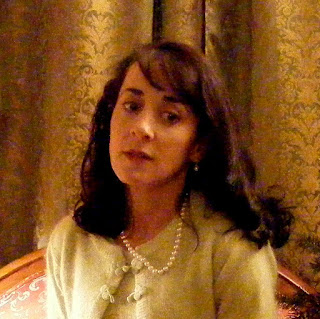
I'm not a columnist (despite any sartorial similarity to Peggy Noonan in the above; I'm just running out of photos and my mother insists upon 'seeing your pretty face' every so often). Any sense of wishing a consistent voice or outlook or stance is my own preoccupation, comes from my own meditations on why anyone would be writing one of these things in the first place, and a desire to make it 'earn its keep.' The reason I started to write a blog was as a discipline, to make myself write regularly. The reason I was told to write a blog is the same as with anyone who has demonstrated evidence of writing ability: people tell you that since you can write, you should write; in fact, you should 'be a writer.'
Which, as those less reactionary among us are all too aware, is something altogether different than merely being able to write. And it is not solely a matter of discipline: being able to expatiate endlessly on the differential merits of various wardrobe-organizational systems is not the same as being able to write 500 pages on the social history of wardrobe-organizing systems, nor certainly 500 more on the history of railroad building in Japanese-occupied Manchuria.
And yet there is overlap: those who taught themselves to read, those who spent their childhoods in books, read books about books and books about words, those to whom language comes easily and those for whom a well-turned description is as alluring as a well-turned ankle, clearly have much in common with those who spend lifetimes capturing their own or others' lifetimes in print. Even if not Writers, they can certainly be called writers, without any need of scare quotes to emphasize their non-professional status. I look at it this way: my exhusband was and is a musician. He can do other jobs, he has done other jobs; like all of us, he has various different abilities. But his gifts as a musician are so clear, so profound, that they are, I would argue, constitutive of who he is, his self, his way of being in the world, such that one reveals much of substance to say about him 'he is a musician,' the copula there doing what it is has the power to do but seldom does.
But back to Merton.
As I said above, I enjoy being able to open books and start reading at whatever page I happen to land on. It doesn't always work so well while in school, I admit, but I'm not in school, and I like the way it works much of the rest of the time. In cases of postmodern history and historiography, it works very, very well, I must say, as I get to miss the introduction wherein the same list of the same secondary sources is tiresomely trotted out to ensure the reader understands just how thoroughgoingly postmodern the coming exegesis of trends in kitchen appliances in postwar Bavaria is going to be. I like skipping that bit and getting right to the riveting parts about the evolution in backsplashes and cupboard-pulls.
Anyway, not that Merton has exhausting prefaces, or cites much Gramsci, Derrida, Butler, or Homi Bhabha, but part of my enjoyment in reading this way, at least with certain types of material, is to imagine why I'm being given what I'm being given right then. It's often shocking, and always productive. I tuned in when Merton has just become a subdeacon, and I had to go back a few pages to find out what he was referencing when he referenced his current experience with Sertillanges' La Vie Intellectuelle. It turns out (a few pages earlier, which is one of the downsides of this reading method) that he received a copy during this time, when he was really struggling with writing what became The Ascent to Truth. He got stuck a lot, he wrote a good deal he was completely unhappy with, but spending time with Sertillange had on him 'the effect that Dale Carnegie's advice might have had on a despondent salesman.'
Now, I've loved Merton forever. He taught me invaluable things, led me in all sorts of meaningful directions, and I have to say a good deal of that was due to the personal tone of much of what he wrote. I do love struggling with prickly authors and thorny texts at times, and in my weaker moments I can take great delight in the recondite and the recherché, but we're all human, and it is only the deeply, universally human expressed in the works of great novelists, poets, memoirists, and diarists that speaks directly to the heart, and results in a staggering convincement of the soul, rather than a gradual assent via logic.
***Because this is already too long for a blog posting, I'm going to leave this with 'logic' as the last word in the body, since that is surely a one-off, and I should savor it!
To begin, here are some of the books I'm reading right now: Chesterton's Aquinas bio in a double volume with his Francis, Josipovici's On Trust: Art and the Temptation of Suspicion, Rancière's Hatred of Democracy, the Dalai Lama's The Good Heart, Jean-Luc Nancy's Dis-Enclosure: the Deconstruction of Christianity, and Ratzinger's Truth and Tolerance: Christian Belief and World Religions. Apart from the Chesterton, which is very chatty, 'personable,' and inviting, the rest are more, well, I take time off. With different things: with the Chesterton, with poetry (a lot of Jorge Guillén at the moment),
 a slim, early volume by Eco on aesthetics in the Middle Ages and, I just decided today when I lay down for a nap, Merton's The Sign of Jonas, which I probably haven't read since I was 17 or 18.
Now, why there is no fiction in there, either as a primary reading or as 'relief,' is that I can't do with a novel what I can do with poetry or non-fiction, which is to say stop and start wherever and whenever I please. In fact, even with language textbooks, as long as you have a good base already you can go forward and backward, practicing just the dative case one day and the past dubitative-abilitative mood the next. A good novel consumes the reader to the exclusion of all other books until it is sated; a bad one merely bores and is tossed away - and then the reader is back where he started in either case.
And at the moment I am enjoying this profligacy, so no novel right now.
But back to Merton.
 As I said, this particular book I haven't read in many years. It is five years of Merton's daily journal early in his vocation just before and after his ordination, an it was interesting (in a manner now completely unshocking to me) that I picked it today, as just last night I had written to a friend just starting a blog how sometimes I become frustrated with what I would call the 'definitional' issues of the medium. It is not at all a diary, though a personal blog does, or can, share attributes with that form. It's not the same as even a completely open op-ed column, since if the blog is truly non-commercial/personal, the sense of writing for/to one's audience is naturally different - if the writer even considers the issue of audience at all.
For me, certain topics seem clearly too boring to subject others to (not that I don't sometimes ignore this concern altogether), some too emotional to discuss in a (potentially, at least) public space, some too heavy or controversial to feel right mixing them in with postings about shoe organization and exboyfriends' irksome proclivities. Then, too, there is the idea of coherence of the whole, coherence of voice, something which has bedeviled me to the point of not posting anything at different times, because the stuff I was writing about wasn't 'bloggy' enough in my view. I have no idea how to address this, because worrying about it overmuch defeats one of the points of personal weblogs, which is that sense of freedom the medium shares with diaries, but which distinguishes it from even the most unrestricted columns in the paid world. Minimally, a columnist would have to find a way to unify that week's concern with the voice and the stance that come through the column as a whole. More typically, the subject itself would have to appear clearly congruent with the other topics in the series.
But back to me.

I'm not a columnist (despite any sartorial similarity to Peggy Noonan in the above; I'm just running out of photos and my mother insists upon 'seeing your pretty face' every so often). Any sense of wishing a consistent voice or outlook or stance is my own preoccupation, comes from my own meditations on why anyone would be writing one of these things in the first place, and a desire to make it 'earn its keep.' The reason I started to write a blog was as a discipline, to make myself write regularly. The reason I was told to write a blog is the same as with anyone who has demonstrated evidence of writing ability: people tell you that since you can write, you should write; in fact, you should 'be a writer.'
Which, as those less reactionary among us are all too aware, is something altogether different than merely being able to write. And it is not solely a matter of discipline: being able to expatiate endlessly on the differential merits of various wardrobe-organizational systems is not the same as being able to write 500 pages on the social history of wardrobe-organizing systems, nor certainly 500 more on the history of railroad building in Japanese-occupied Manchuria.
And yet there is overlap: those who taught themselves to read, those who spent their childhoods in books, read books about books and books about words, those to whom language comes easily and those for whom a well-turned description is as alluring as a well-turned ankle, clearly have much in common with those who spend lifetimes capturing their own or others' lifetimes in print. Even if not Writers, they can certainly be called writers, without any need of scare quotes to emphasize their non-professional status. I look at it this way: my exhusband was and is a musician. He can do other jobs, he has done other jobs; like all of us, he has various different abilities. But his gifts as a musician are so clear, so profound, that they are, I would argue, constitutive of who he is, his self, his way of being in the world, such that one reveals much of substance to say about him 'he is a musician,' the copula there doing what it is has the power to do but seldom does.
But back to Merton.
As I said above, I enjoy being able to open books and start reading at whatever page I happen to land on. It doesn't always work so well while in school, I admit, but I'm not in school, and I like the way it works much of the rest of the time. In cases of postmodern history and historiography, it works very, very well, I must say, as I get to miss the introduction wherein the same list of the same secondary sources is tiresomely trotted out to ensure the reader understands just how thoroughgoingly postmodern the coming exegesis of trends in kitchen appliances in postwar Bavaria is going to be. I like skipping that bit and getting right to the riveting parts about the evolution in backsplashes and cupboard-pulls.
Anyway, not that Merton has exhausting prefaces, or cites much Gramsci, Derrida, Butler, or Homi Bhabha, but part of my enjoyment in reading this way, at least with certain types of material, is to imagine why I'm being given what I'm being given right then. It's often shocking, and always productive. I tuned in when Merton has just become a subdeacon, and I had to go back a few pages to find out what he was referencing when he referenced his current experience with Sertillanges' La Vie Intellectuelle. It turns out (a few pages earlier, which is one of the downsides of this reading method) that he received a copy during this time, when he was really struggling with writing what became The Ascent to Truth. He got stuck a lot, he wrote a good deal he was completely unhappy with, but spending time with Sertillange had on him 'the effect that Dale Carnegie's advice might have had on a despondent salesman.'
Now, I've loved Merton forever. He taught me invaluable things, led me in all sorts of meaningful directions, and I have to say a good deal of that was due to the personal tone of much of what he wrote. I do love struggling with prickly authors and thorny texts at times, and in my weaker moments I can take great delight in the recondite and the recherché, but we're all human, and it is only the deeply, universally human expressed in the works of great novelists, poets, memoirists, and diarists that speaks directly to the heart, and results in a staggering convincement of the soul, rather than a gradual assent via logic.
***Because this is already too long for a blog posting, I'm going to leave this with 'logic' as the last word in the body, since that is surely a one-off, and I should savor it!
Sunday, November 19, 2006
Because Underneath ,You Feel Pure Permanence
I don't think most people know how to be in relationships. I don't believe most people are, in their hearts, really looking for something huge and overpowering, something not merely substantive, which is unusual enough itself, but transformative. Love can do that, can change us immeasurably for the better, but one has to be opened to it, one has to accept the vulnerability that is both a prerequisite and a consequent of real love.
And of course that is terrifying. It is totally unlike our normal interactions, which are based on suites of deliberately congruent, affected manners, dictions, postures, appearances, that correspond to and flesh out whatever role we are enacting in that context. This isn't base or even dishonest: on the one hand, we really do need the second cellist behaving like a cellist during the symphony and not a botanist or ironworker; and on the other, he really is a cellist, as evidenced by the presence of his chair in the pit and his bowing of the strings. That isn't disingenuous; it's getting the job done!
But maybe it is the difference between a Bach fugue and bebop. Precision, order, the beauty of the work found in its elegant mathematics, in its stolid girders, right angles and re-bar, in perfection of Form above all else, as against the piercing, unutterable glory that can come only from leap of faith compounded geometrically by subsequent leap after leap after leap -- all these being, not 'explored' in a self-indulgent descent into solipsism, and certainly not 'reconciled' or 'rescued' once the head reemerges --no, not at all, but bared, freed, radically embraced, and then transcended and born anew, via that selfsame melody that could always so easily enslave a pedant or fundamentalist.
So I think it's a big deal, Love. I have difficulty understanding shopping for it, I admit, and I get prickly thinking of the people who don't bother to reflect on it and its significance, especially when they do already, or could if they expended effort, live inside it. I think it takes work, yes, but so do wine and music and childbirth, and yet people keep doing those without saying Wait, I need some Time to Listen to 'Self' in the middle of a bloody solo or parturition.
When you are in love, when you cherish someone, you honor them. Love seeks one thing only: the good of the one loved. It leaves all the other secondary effects to take care of themselves. Love, therefore, is its own reward. According to Thomas Merton, at any rate, and I agree that Love is indeed that elegantly simple, and that boundlessly rewarding. Still, it requires effort, requires temperance; and that miraculous, supple, and overpowering solicitude born jointly of eros and agape can only exist where there is sufficient maturity, wisdom, and openheartedness to allow its first seeds to grow.
I think where that sort of genuine and mature love is present, there are lines not merely inconceivable, but impossible, to cross. It's quite easy to see why kvetching about 'never getting any' to your hot boss or flirty assistant is risky, but while it may not be a Gateway to Sin! in everyone's view to lament someone's weight gain, odd facial hair choice, lack of understanding, bad habits, or emotional issues to friends, it nevertheless creates a rift. It lets someone in where they shouldn't be, between the man and the woman. It also keeps those complaints or critiques closer to the front of your mind, even when it's just you two. Joe from the pool hall is right there, in bed with you, with his I-Hear-You-Man comments from yesterday about his wife's growing middle as you run your hands up your wife's now-size-40 hips.
And of course that is terrifying. It is totally unlike our normal interactions, which are based on suites of deliberately congruent, affected manners, dictions, postures, appearances, that correspond to and flesh out whatever role we are enacting in that context. This isn't base or even dishonest: on the one hand, we really do need the second cellist behaving like a cellist during the symphony and not a botanist or ironworker; and on the other, he really is a cellist, as evidenced by the presence of his chair in the pit and his bowing of the strings. That isn't disingenuous; it's getting the job done!
But maybe it is the difference between a Bach fugue and bebop. Precision, order, the beauty of the work found in its elegant mathematics, in its stolid girders, right angles and re-bar, in perfection of Form above all else, as against the piercing, unutterable glory that can come only from leap of faith compounded geometrically by subsequent leap after leap after leap -- all these being, not 'explored' in a self-indulgent descent into solipsism, and certainly not 'reconciled' or 'rescued' once the head reemerges --no, not at all, but bared, freed, radically embraced, and then transcended and born anew, via that selfsame melody that could always so easily enslave a pedant or fundamentalist.
So I think it's a big deal, Love. I have difficulty understanding shopping for it, I admit, and I get prickly thinking of the people who don't bother to reflect on it and its significance, especially when they do already, or could if they expended effort, live inside it. I think it takes work, yes, but so do wine and music and childbirth, and yet people keep doing those without saying Wait, I need some Time to Listen to 'Self' in the middle of a bloody solo or parturition.
When you are in love, when you cherish someone, you honor them. Love seeks one thing only: the good of the one loved. It leaves all the other secondary effects to take care of themselves. Love, therefore, is its own reward. According to Thomas Merton, at any rate, and I agree that Love is indeed that elegantly simple, and that boundlessly rewarding. Still, it requires effort, requires temperance; and that miraculous, supple, and overpowering solicitude born jointly of eros and agape can only exist where there is sufficient maturity, wisdom, and openheartedness to allow its first seeds to grow.
I think where that sort of genuine and mature love is present, there are lines not merely inconceivable, but impossible, to cross. It's quite easy to see why kvetching about 'never getting any' to your hot boss or flirty assistant is risky, but while it may not be a Gateway to Sin! in everyone's view to lament someone's weight gain, odd facial hair choice, lack of understanding, bad habits, or emotional issues to friends, it nevertheless creates a rift. It lets someone in where they shouldn't be, between the man and the woman. It also keeps those complaints or critiques closer to the front of your mind, even when it's just you two. Joe from the pool hall is right there, in bed with you, with his I-Hear-You-Man comments from yesterday about his wife's growing middle as you run your hands up your wife's now-size-40 hips.
We are conditioned that, to a certain extent, articulation makes it so. Nearly all of our experience is filtered, necessarily, through language. This is why people do affirmations. 'I am good. I am strong. I do not eat Snickers.' Imagine if instead of desperate, last-ditch efforts at 'I love my husband. I love my husband. I love my husband' we had the wife daily complaining to her girlfriends about his stutter, his pot belly, his skin condition, and his lack of sexual skill. And, as we all know, our friends can be relied upon to take our side in such things. It is rare indeed for one of these sort of confidants to interrogate the speaker, ask him why it is he would want to say such disrespectful things, what it is he is really feeling, whether he understands that speaking out of class like that is going to leak a poison in and keep all those things in his mind.
I cringe when I hear such things spoken by people in a relationship -- and we hear them all the time. If it is one on one, I at least have the liberty and the opportunity to ask the other sorts of questions, the sort that can go somewhere, the sort that can open the person's heart rather than seal it shut for good -- but so often people just spout this crap, and don't care who hears. And then someone else commiserates, and tells private details about his partner. And then I perhaps know more about the state of his relationship than his spouse does!
Meanwhile, I am course am thinking You bloody idiots: you have someone who loves you! I am not speaking here of abusive things, or of gambling addictions, or infidelity. Instead, it's stupid, quotidian annoyances, or habitual ways of doing things regarding which the individuals' tendencies and preferences are at odds. Or, of course, pot bellies, skin conditions, Comfortable Shoes, fatigue at sex-time, and, simply, two people who were once together, engaged now in building up separate lives, deliberately or indeliberately. After a certain point, the fissure is irreparable, and if not 'Man,' then surely man's ego, has rent the two solidly asunder.
I have a stance, as well, partly ethical, partly aesthetic, part pragmatic, and part just Healthy Living, that distills down to wait and see, I suppose. A few bucks lost here and there at the race track is not the same as the mortgage payment going to the bookie. An otherwise shockingly thoughtful anniversary gift ordered too late for timely arrival is not the same as spending that anniversary with another girl in a hotel room. And, again (this is the pragmatic angle, I suppose, mixed in with the ethical), if you spend all the time collecting notes on what is not perfect, that, my dear, is what is in your head. Not the moments of beauty, not the act of deep tenderness, but the why-didn't-he-X-when-I-felt-sure-he-would? And if you take all those to your friends, because they're all clustering around your brain making you sick because you chose to focus on them and now can't think of the other things, after your iteration of all his/her failings, what do you think they will say? What average friend ever counsels, Yes, but she's so.... Or, But those are trivial, and look what he does when.... Or, Work on it, work on it, work on it, and keep your love for that person always in your mind?
But perhaps that is what distinguishes Love and friendship. Friendship so often concerns itself with reinforcing the status quo, with affirming assumptions rather than challenging them, by 'supporting' the friend in the least difficult, most prosaic ways. Love, by contrast, keeps always one hand outstretched to the Divine and the other gently opened to the beauty to be found here. It is the turning of the Mevlevi, the name of God ceaselessly on the lips, each step and every breath a rupture and mediation between the ineffable and the temporal.
 Love seeks alternately to veil and to transcend the less savoury aspects of what we see in this pathetic, finite moment, pointing always to the grander vision that lies beyond. It reaches, challenges, wounds, elates, soars. Love never disappoints, although it sometimes kills.
I know you touch so fervently because the caress preserves,/because the place you cover up, O tender ones,/doesn't disappear; because underneath, you feel/ pure permanence. Thus your embraces almost promise you eternity. -Rilke, Duino Elegies, 'Second Elegy'
Subscribe to:
Posts (Atom)